

Audio software affiliate programs turn the recommendations audio engineers already make—on forums, in client emails, inside YouTube walkthroughs—into measurable revenue without inventing a new business model. Mixing engineers, mastering specialists, podcast producers, and studio owners routinely steer peers toward plugins, DAWs, sample packs, and interfaces. Affiliate rails simply attach commission logic to that trust.
This guide maps five program types common in the audio stack, compares illustrative commission and cookie windows, covers FTC disclosure obligations, and names conversion tactics tuned for engineer audiences who smell marketing from a mile away.

Engineers monetize recommendations best when affiliate picks mirror tools they would buy anyway.
Why Engineers Monetize Recommendations
Audio engineers operate inside tight-knit referral networks. A freelance mixer who swears by a particular bus compressor becomes the default advisor for an entire client roster. Podcast producers share template chains in Slack. YouTube educators demo sale-season carts every Black Friday. Those moments carry commercial intent even when no money changes hands.
Affiliate programs formalize what already happens informally. Instead of sending traffic to a plugin marketplace with zero attribution, a tracked link records the referral and pays a percentage when the visitor purchases. For engineers with existing audiences—newsletters, Discord servers, course students—the marginal effort is low relative to studio billable hours.
The economics differ from session fees. Affiliate income is scalable but volatile: commission checks spike during sale windows and flatten when audiences stop clicking. Treat it as portfolio revenue, not a substitute for engineering work, until traffic and conversion data prove otherwise.
Affiliate Ecosystem Overview
Most audio software affiliate programs run through one of three rails: in-house partner portals hosted by the vendor, aggregator networks such as Impact or ShareASale, or marketplace-specific dashboards operated by large plugin retailers. Cookie duration, payout thresholds, and promotional rules vary by rail—not by how famous the brand is.
Engineers should evaluate programs on four axes before promoting anything: commission rate on net versus gross cart, cookie window length, whether recurring subscriptions pay recurring commissions, and creative restrictions on coupon stacking or bid-brand keywords in paid search.
According to affiliate marketing industry structure, last-click attribution still dominates audio retail—meaning the final referring link usually wins credit even if your tutorial convinced the buyer weeks earlier. Plan content accordingly.
Type 1: Plugin Marketplace Affiliates
The first category—plugin marketplace affiliates—covers large third-party retailers in the style of Plugin Boutique, JRRshop, or similar high-SKU storefronts that aggregate thousands of titles from dozens of publishers. These marketplaces win on breadth: one cart can hold a channel strip, a modular effect, and a utility meter from three different developers.
Marketplace programs typically pay commission on the entire cart, not only the product you linked. That basket effect matters during seasonal sales when engineers load five plugins at once. Illustrative commission ranges for this category often land between 5% and 15% of net sales, with occasional promotional bumps to 20% during partner campaigns. Verify live terms in each portal—figures here are composite industry illustrations, not guarantees from any single retailer.
Cookie windows for marketplace affiliates commonly span 14 to 30 days. Some extend to 45 days on VIP partner tiers. Shorter cookies punish educators who publish comparison videos weeks before a sale; longer cookies reward evergreen review content.
Conversion strengths: engineers already comparison-shop marketplaces. Weaknesses: brand dilution—you are promoting a store, not a hero product, unless you deep-link to a specific plugin page. Best practice: pair deep links with a written rationale about why that processor fits a named use case (vocals, drums, mastering glue).
Marketplace Promotion Tactics
Publish "what I would buy at 50% off" lists tied to your genre specialty. Screenshot your actual cart with disclosure language visible. Track which deep links convert; marketplace dashboards usually expose SKU-level earnings if the program is mature.
Type 2: DAW Vendor Programs
DAW vendor programs sit on the opposite end of the catalog spectrum: fewer SKUs, higher average order values, and longer consideration cycles. Think programs operated by major workstation brands and crossgrade-friendly platforms—Ableton, Steinberg, PreSonus, Bitwig, Apple Logic storefront partners, Avid, REAPER reseller chains, and similar.
Commissions on DAW licenses are often lower in percentage terms but higher in absolute dollars because list prices run hundreds. Illustrative ranges cluster around 3% to 10% on full licenses, with occasional flat bounties—$15 to $75 per paid seat—on entry-tier or subscription conversions. Subscription DAWs sometimes pay recurring commissions for the first 3 to 12 billing cycles; read the fine print because "lifetime recurring" is rare.
Cookie windows for DAW affiliates tend to be shorter—7 to 30 days—because purchase intent is tracked aggressively and vendors fight coupon fraud. Trial downloads may or may not set attribution cookies depending on whether the visitor arrived through your link before installing.
Engineer audiences treat DAW recommendations as identity statements. Promote only platforms you mix or master on weekly; credibility collapses if your template videos use a different host than your affiliate banner. Crossgrade eligibility is a high-intent hook—publish explicit paths for moving from Platform A to Platform B when sale terms allow it.
DAW Content Formats That Convert
Session walkthroughs, template breakdowns, and "speed mixing in [DAW]" shorts outperform generic feature lists. Link from the description field and inside pinned comments, not mid-video verbal pitches that feel like infomercials.
Type 3: Sample Library Affiliates
Sample library affiliates cover orchestral collections, drum kits, vocal stacks, sound-design expansions, and loop packs sold direct or through boutique distributors. Native Instruments, Spitfire-style partners, Splice referral programs, and smaller genre-specific libraries each run distinct terms—but the category behaves similarly in affiliate math.
Commission percentages on libraries are often generous relative to DAWs because marginal digital delivery costs are low and customer acquisition is competitive. Illustrative rates fall between 10% and 25%, with some boutique libraries offering 30% on first-party titles during launch windows. Bundles can push effective payouts higher if the program pays on total cart value.
Cookie windows frequently run 30 to 60 days because composers research libraries across multiple listening sessions before committing. Some libraries attribute only the first purchase; upsells inside the same account later may not credit you—check renewal and expansion language.
Engineers and composers convert on demonstrations, not spec sheets. Screen-record a short cue built only from the library you promote. A/B the dry MIDI versus the rendered mix. Affiliate links belong beside timestamped chapters so viewers jump to the moment they hear the brass swell that sold them.
Library Seasonality
Black Friday, Composer Sunday, and publisher anniversary sales concentrate revenue. Queue email and video content two weeks before doors open so cookies are active when discounts go live.
Type 4: Hardware and Software Hybrid Programs
Hardware and software hybrid programs attach commission logic to interfaces, control surfaces, microphones, and DSP boxes that ship with bundled plugins or DAW lite editions. Focusrite, Universal Audio, Solid State Logic, Antelope, and retailer programs through Sweetwater or Thomann-style partners exemplify the category without any single template governing all terms.
Hybrid commissions mix percentage and bounty models. Illustrative structures include 3% to 8% on hardware cart value plus fixed payouts when bundled software activates; or flat $20 to $100 bounties per qualifying interface sold during promotional quarters. High-ticket consoles and summing boxes may cap commission per unit—read maximum payout clauses before forecasting income.
Cookie windows vary widely: 24-hour same-session cookies appear on some high-volume electronics portals; 30-day windows are common on specialty audio retailers. Software-only activations bundled with hardware might attribute on a separate, shorter window if the buyer registers the product days after unboxing.
Engineer audiences ask reliability questions first: driver stability, latency, headroom, repair policies. Affiliate content should mirror support threads you would post without a commission—setup guides, gain-staging walkthroughs, and honest limitations on bundled "lite" DAWs that nudge upgrades later.
Hybrid Disclosure Nuance
When a manufacturer sends review units, disclose both the gifted hardware and any affiliate link used in the buying guide. The FTC Disclosures 101 guide treats free product and paid commissions as separate material connections—stack them clearly.
Type 5: Education and Course Platforms
Education and course platform affiliates monetize the teaching side of engineering: mixing bootcamps, mastering intensives, sound-design memberships, and platform subscriptions on Teachable, Skillshare, Udemy, or audio-specific schools. Engineers who already coach—formally or through Patreon tiers—fit this category naturally.
Commission models skew toward high percentages on digital goods with low refund rates after the first module. Illustrative rates: 20% to 50% on first-party courses, 10% to 30% on marketplace listings, and recurring 10% to 20% on membership sites for as long as the subscriber stays—if the program offers lifetime recurring, which is increasingly rare on mass-market platforms.
Cookie windows on education affiliates are often 30 to 90 days because students procrastinate enrollment. Webinar funnels may use 7-day urgent windows on last-chance pricing; align promotional copy with the actual cookie duration to avoid silent attribution drops.
Conversion hinges on curriculum proof: publish a syllabus slice, show student mix before/after with permission, and explain who the course is not for. Engineers respect negative qualifiers—"skip this if you already master mid-side drum bussing"—more than hype adjectives.
Education Ethical Line
Promoting a course you have not completed is permissible legally with disclosure, but engineer communities punish shallow endorsements. Minimum bar: audit at least 30% of the curriculum or interview a trusted graduate on-record.
Commission Comparison Table
| Program Type | Illustrative Commission | Typical Cookie Window | Avg. Order Value | Best Engineer Channel |
|---|---|---|---|---|
| Plugin marketplace | 5% – 15% (sale bumps to ~20%) | 14 – 30 days | $30 – $200 | Sale lists, deep-link reviews |
| DAW vendor | 3% – 10% or $15 – $75 bounty | 7 – 30 days | $99 – $599 | Template videos, crossgrade guides |
| Sample library | 10% – 25% (launch ~30%) | 30 – 60 days | $49 – $499 | Scoring demos, A/B stems |
| Hardware + software | 3% – 8% + bounties $20 – $100 | 1 – 30 days | $150 – $2,500 | Setup tutorials, latency tests |
| Education / courses | 20% – 50% first-party; 10% – 30% marketplace | 30 – 90 days | $49 – $997 | Curriculum previews, office hours |
All figures are illustrative composites drawn from publicly posted partner terms and industry chatter in 2024–2026 cycles—not binding quotes from any vendor. Confirm live rates before building revenue models.
Cookie Windows and Attribution
Cookie duration determines how long after a click you can still earn credit. Audio purchases are rarely impulse: engineers research, add to wishlists, wait for sales, then checkout from a different device. Shorter cookies favor retailers; longer cookies favor content creators—negotiations sometimes unlock extended windows at higher traffic tiers.
Last-click attribution means a later referral overwrites yours. If a buyer clicks your review, then clicks a coupon blog two days later, the coupon site may take the commission. Mitigations: focus on high-intent placements (email, pinned comments), capture newsletter clicks on sale morning, and avoid promoting during coupon-aggregator traffic spikes unless you control the top funnel.
Some programs use coupon-code attribution instead of cookies—your code must be entered at checkout. Codes show up clearly in analytics but fail when buyers forget to type them. Hybrid strategies use both link and code when permitted.
According to FTC endorsement guidance, transparent disclosure does not change attribution mechanics—but hiding affiliate relationships can trigger enforcement even when tracking is technically clean.
FTC Disclosure Requirements
United States-facing creators must disclose material connections—commissions, free licenses, manufacturer loans—clearly and conspicuously before the affiliate link does its work. "Clear" means plain language near the link; "conspicuous" means visible on mobile without extra taps.
Acceptable patterns for engineer blogs: a top-of-post sentence—"This article contains affiliate links; purchases through them support the site at no extra cost to you"—plus per-link labels where layouts allow. YouTube: verbal disclosure early in the video and repeated in the description with the link block. Podcasts: read disclosure before the sponsored segment.
Do not rely on platform-native "paid promotion" toggles alone; the FTC expects audience-understandable wording. International creators should also review UK ASA and EU consumer protection norms if traffic crosses borders—disclosure principles align even when wording differs.
Engineer audiences tolerate disclosure when paired with honest negatives. They reject buried footnotes under affiliate walls of text. Treat compliance as credibility infrastructure, not legal fine print.
Conversion Tips for Engineer Audiences
Engineers convert on evidence, genre fit, and long-term support—not hype. Five tactics that consistently outperform generic "buy now" buttons:
Show the Signal Path
Diagram or screen-capture the exact chain: input gain, processing order, limiter ceiling, export settings. Affiliate recommendations embedded inside reproducible paths feel like engineering notes, not ads.
Publish Failure Cases
Document when a plugin alias misbehaves on Apple Silicon, when a library lacks legato patches, when a control surface driver conflicts with a DAW release. Selective criticism increases trust on the tools you do endorse.
Time-to-Sale Content
Publish two weeks before known sale windows. Update pinned comments on release day with fresh links so cookies refresh when procrastinators return.
Segment by Experience
Junior engineers need budget tiers and learning paths; veterans want advanced utilities and workflow speed. One affiliate page trying to serve everyone converts no one.
Email Beats Feed
Engineers still read focused newsletters. A Monday "tools I used this week on client sessions" email with one affiliate deep link often beats ten TikTok clips for high-ticket carts.
Relative Commission Bar Chart
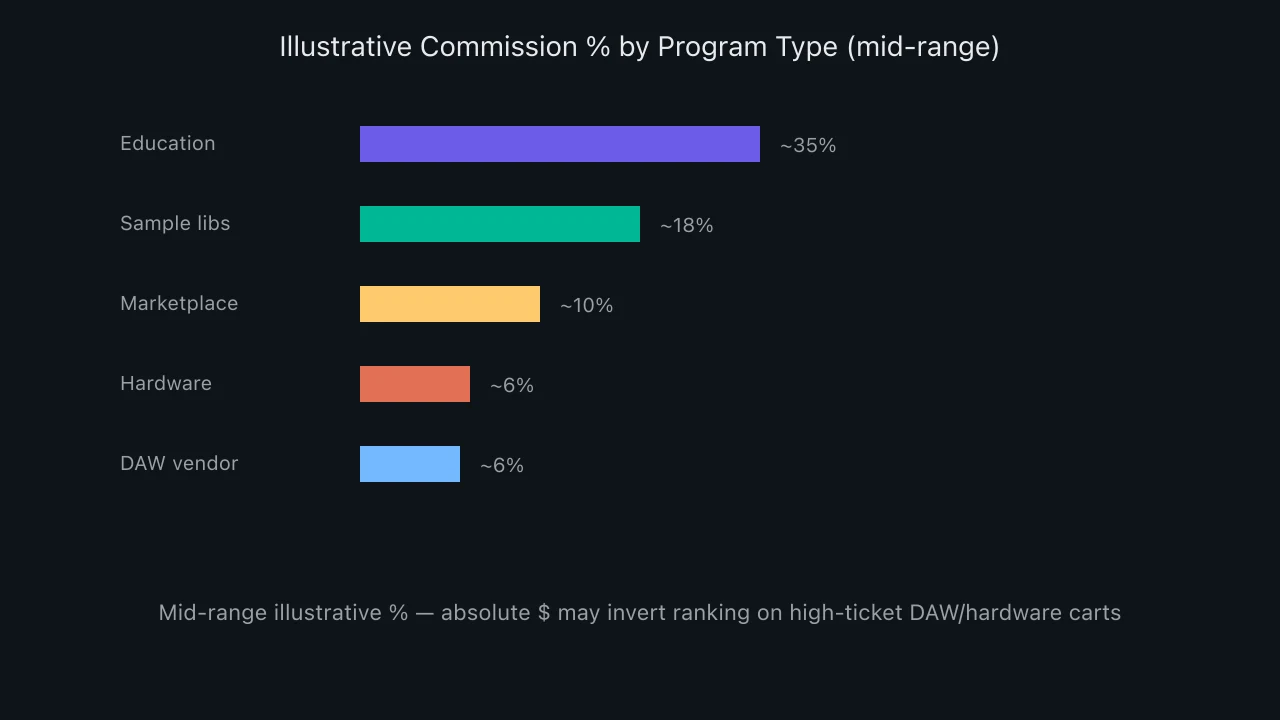
Illustrative commission comparison across audio affiliate program types
Percentage commission alone misleads: a 6% DAW crossgrade on a $299 SKU beats a 25% cut on a $29 utility. Model expected earnings per thousand clicks, not headline rates.
Stacking Programs Without Audience Fatigue
Mature engineer-creators often run two or three program types simultaneously—marketplace links for plugin sales, a hardware partner for interface upgrades, and a course affiliate for students. Stack vertically by funnel stage, not horizontally by spamming every post with five links.
Example stack: top-of-funnel YouTube tutorial (DAW template) → mid-funnel newsletter deep link to a specific compressor (marketplace) → bottom-funnel course teaching advanced bussing (education). Each step serves the same audience with escalating depth; each step carries one primary affiliate partner.
Avoid linking competing marketplaces in the same paragraph—buyers confuse carts and you split credibility. Pick a primary retail partner per quarter and rotate only when data says so.
Tracking, Reporting, and Forecasting
Export monthly earnings CSVs from each portal into one spreadsheet: clicks, conversions, earnings per click (EPC), average order value, and reversal rate. Chargebacks and refunds claw back commissions—high reversal categories include impulse hardware buys and courses with generous refund windows.
UTM parameters on top of affiliate links help Google Analytics attribute on-site behavior even when partner dashboards lag. Pattern: ?utm_source=newsletter&utm_medium=affiliate&utm_campaign=compressor-review appended before the redirect chain—check each program's linking rules; some prohibit altering URLs.
Forecast conservatively: many engineers earn 70% of annual affiliate income in November and December plugin sales. Smooth cash flow with retainer clients, not optimistic January projections from holiday spikes.
Case Study: Freelance Mixer
A freelance vocal mixer with 8,000 newsletter subscribers focused exclusively on marketplace and library affiliates for twelve months. Deep-linked three tools used on every session—de-esser, clipper, plate reverb—and published quarterly "chain refresh" posts. Average 2.1% click-to-purchase on newsletter traffic; EPC landed near $0.85 on marketplace links during non-sale months and $2.40 during Black Friday week.
Adding a hardware interface affiliate without disclosure discipline triggered one refund-heavy campaign; reversals erased a month of plugin commissions. After adopting FTC-clear banners and narrowing to gear personally used in the room, reversal rate fell and hardware bounties stabilized quarterly income.
Case Study: YouTube Educator
A part-time educator teaching home-studio production ran DAW crossgrade guides each summer sale. Videos were eight to twelve minutes, timestamped, with affiliate links only in description and pinned comment—never mid-roll verbal CTAs. Cookie windows on the DAW program were 14 days; publishing exactly on sale start date captured procrastinators who bought on day eleven.
Course platform affiliates underperformed until the educator offered a free PDF checklist gated behind email. Email subscribers converted at 3.4% to a $149 course versus 0.6% from raw YouTube description clicks—list ownership amplified education-category commissions despite lower public view counts.
Common Pitfalls
Promoting tools you do not own breeds comment-section backlash that kills future conversions. Bidding on branded keywords in Google Ads often violates program terms and burns accounts. Copying manufacturer marketing language without listening tests sounds hollow to engineer ears. Ignoring VAT and regional pricing means your "deal" post embarrasses EU readers paying different carts. Assuming one disclosure at site footer covers all posts fails FTC conspicuousness tests on mobile.
According to digital audio workstation market dynamics, platform switching costs remain high—DAW affiliate pitches should respect migration friction honestly instead of pretending every crossgrade is painless.
Program Selection Checklist
Before applying: confirm allowed promotion channels (paid search, coupon sites, email), read reversal policy, check minimum payout threshold and payment cadence (Net-30, Net-60), verify creative asset usage rights, and test your own purchase through the link in incognito mode. If attribution fails once, fix tracking before scaling content.
Prefer programs with responsive partner managers—audio is niche; human support resolves coupon conflicts faster than ticket portals built for fashion influencers.
Tax and Business Hygiene
Affiliate income is taxable in most jurisdictions. US creators typically receive Form 1099-NEC or 1099-MISC once thresholds are met. Track gross commissions and reversals separately for clean Schedule C reporting. LLC operators should separate payout deposits from personal accounts—even modest affiliate side income benefits from bookkeeping hygiene if audited.
This section is operational context, not tax advice; engage a CPA familiar with creator revenue if annual affiliate deposits exceed a few thousand dollars.
FAQ: Audio Software Affiliate Programs
How much can audio engineers earn from affiliates?
Highly variable. Niche educators with 20,000+ engaged subscribers often report mid four figures annually from stacked program types; engineers with small blogs may see under $200 until traffic compounds. Sale-season concentration means one good November can exceed eleven quiet months combined.
Which program type is best to start with?
Start with tools you already recommend daily—usually plugin marketplaces or sample libraries because engineers click those links during research. Add DAW or hardware programs once disclosure and tracking workflows feel automatic.
Do I need a large social following?
No. Focused email lists of 500 working engineers often outperform 50,000 passive followers. Depth beats reach in high-trust technical categories.
Can I accept free plugin licenses and still use affiliate links?
Disclose both the gifted license and the commission relationship. Many engineers accept NFR licenses for honest review; stacking undisclosed gifts plus hidden affiliate links crosses FTC lines and community norms.
What cookie length matters most?
Match cookie length to your content cycle. Educators publishing evergreen reviews need 30+ days; flash-sale streamers can profit from shorter windows if posts go live exactly when discounts open.
Do international audiences change program choice?
Yes. Regional pricing, VAT-inclusive carts, and currency swings alter effective commissions. Some hardware programs geo-restrict bounties—verify country lists before promoting globally.
Audio Software Affiliate Programs Summary
Audio software affiliate programs reward engineers who already guide purchase decisions—through plugin marketplaces, DAW vendors, sample libraries, hardware bundles, and education platforms. Percentage commissions mislead without order-value context; cookie windows and last-click rules determine whether your tutorial gets paid when the sale finally happens.
Disclose every material connection under FTC endorsement standards, promote only tools you trust in real sessions, and stack program types by funnel depth rather than link density. Build the spreadsheet, respect engineer skepticism with signal-path proof, and treat affiliate revenue as a disciplined complement to billable engineering work—not a lottery ticket taped to a generic gear list.


