

Music publishing metadata is the invisible plumbing between your song and the check a supervisor's license should trigger. When ISWCs disagree with PRO registrations, writer shares sum to 99%, or alt-titles miss the brief keyword, your composition does not read as unlicensable—it simply fails to clear in time. Supervisors move on. Money lands elsewhere. These seven rules protect sync income by making your catalog findable, quotable, and legally coherent before the pitch window closes.

Metadata errors leak sync fees long before anyone hears creative objections to your song.
Rule 1: Lock Writer Splits at Session
Every co-write session should end with a signed split sheet before anyone leaves the room. Percentages must sum to exactly 100% across writers and, if applicable, publisher designees. Ambiguous "we'll figure it out" splits kill sync deals when one writer ghosts during a network hold.
Digital signatures via DocuSign or HelloSign beat photo-of-notebook-page chaos. Store splits in your sync bible linked to the work title and PRO work ID once registered.
PRO Registration Alignment
Register the same percentages at ASCAP, BMI, SESAC, or PRS within 30 days of session. Mismatches between split sheet and PRO database are the number-one supervisor delay trigger.
Rule 2: One Canonical Title per Work
Choose one primary title per composition and register it consistently. Alternate spellings, parentheticals, and featured-artist variants belong in alias fields—not as separate conflicting works.
Supervisors search brief keywords. If your PRO lists "Midnight (Radio Edit)" and your admin pitch says "Midnight Drive," fingerprint systems may treat them as unrelated, fragmenting clearance history.
Alias Field Discipline
Log every legitimate alias in your metadata master sheet: stems version, foreign translation, abbreviation. Never register aliases as standalone works unless they are legally distinct compositions.
Rule 3: ISWC and PRO IDs Before Pitching
Do not pitch for sync until each work has a PRO work registration number and, where available, an ISWC. Supervisors and their clearance teams use these identifiers to confirm chain of title.
According to International Standard Musical Work Code standards, ISWCs uniquely identify compositions across societies—missing codes signal amateur catalog hygiene.
CWR delivery from your administrator accelerates ISWC assignment. Budget lead time; new works are not pitch-ready the day after upload.
Rule 4: Separate Composition from Master Metadata
Music publishing metadata governs the song. Master metadata—ISRC, recording artist, label—governs the specific recording. Sync deals need both lanes clean, but conflating them creates ownership confusion.
Your pitch email should state composition owner contacts separately from master owner contacts. One-stop shops still document both sides even if one entity signs.
ISRC Crosswalk
Maintain a table linking each pitch-ready master ISRC to its underlying composition work ID. Supervisors license compositions against picture; they still need the correct master for delivery.
Rule 5: Publisher and Admin Hierarchy
Every writer share should map to a publisher or self-published designee with contact info current within the last 90 days. Co-writes across three admins fail when one admin's email bounces during a Friday rush clearance.
Designate a lead administrator for sync quoting when multiple publishers share a work. Lead admin appears on one-sheet PDFs supervisors keep on file.
Rule 6: Territory and Rights Flags
Flag controlled territories, excluded media types, and pre-existing exclusive licenses in your metadata master. Nothing erodes supervisor trust faster than quoting a car category exclusive that conflicts with a signed soft-drink deal from 2023.
Rights flags should be human-readable and machine-exportable. JSON in your DAM beats sticky notes in a folder named "legal stuff."
Exclusivity Date Tracking
Record exclusivity category, brand, start date, and sunset date. Set calendar reminders 60 days before expiration to re-open pitching.
Rule 7: Quarterly Audit Cadence
Metadata decays. Writers change admins, publishers merge, PROs reassign work IDs after mergers. Quarterly audits reconcile split sheets, PRO registrations, ISWCs, ISRC crosswalks, and contact trees.
Assign one owner—writer, manager, or admin lead—with audit completion logged in a shared tracker. Unowned metadata rots by default.
Block ninety minutes per quarter on calendars. Treat it like tax prep—non-optional, recurring, and cheaper than emergency fixes during active holds.
Metadata Field Checklist Table
| Field | Required Value | Source of Truth | Failure Symptom |
|---|---|---|---|
| Canonical work title | Single primary title | Split sheet + PRO | Supervisor search miss |
| Writer names (legal) | IPI where available | PRO registration | Wrong payee on license |
| Writer share % | Sums to 100% | Signed split sheet | Hold collapses at legal |
| Publisher / admin | Current entity + email | Admin agreement | Bounced clearance contact |
| PRO work ID | Per society | PRO confirmation | Cannot verify ownership |
| ISWC | Unique composition ID | CWR / society | International confusion |
| ISRC (per master) | Linked to work ID | Distro / label | Wrong recording licensed |
| Alt titles / aliases | Controlled list | Metadata master | Fragmented work history |
| Exclusivity flags | Category + dates | Sync bible | Conflict quotes |
| One-stop status | Y/N + threshold % | Co-writer mandates | False fast-clearance promise |
Complete every row before adding a work to active pitch rotation. Incomplete rows belong in a "pre-pitch" queue, not supervisor inboxes.
Metadata Leakage Path Diagram
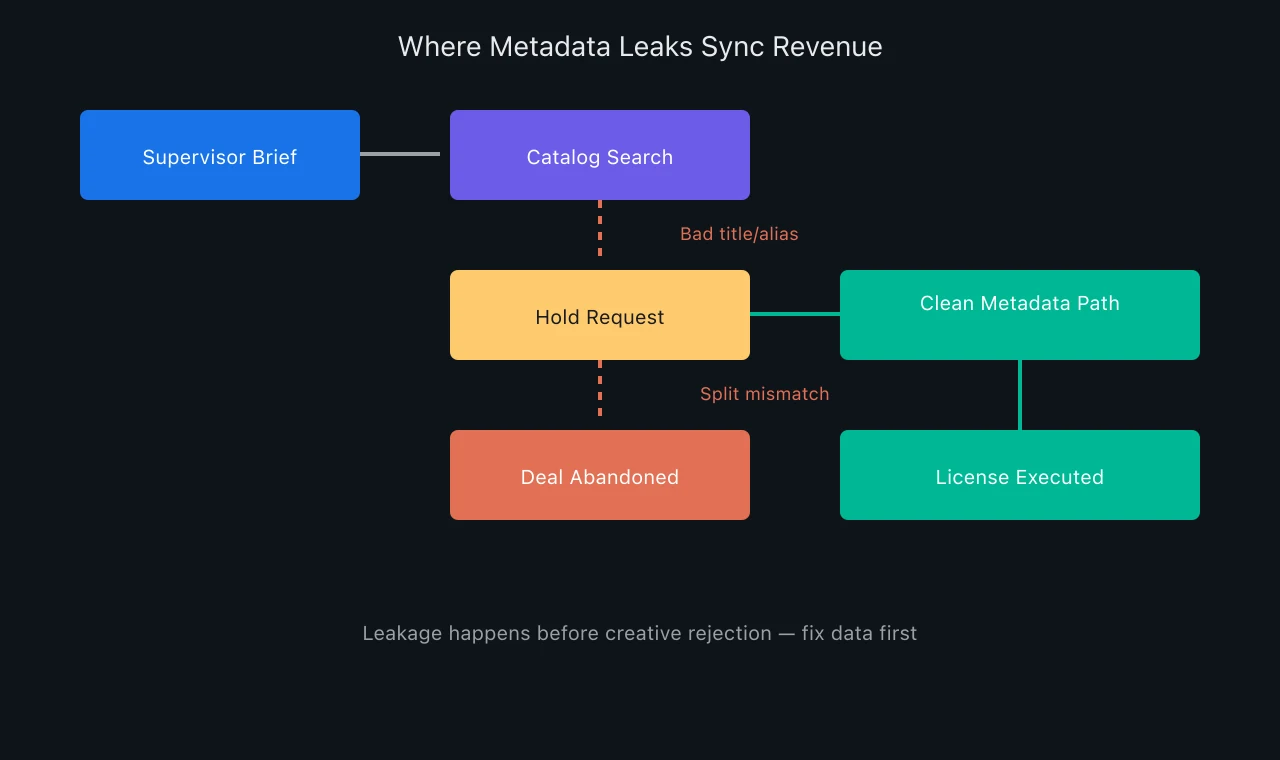
Music publishing metadata leakage path
Most leakage is operational, not artistic. Supervisors rarely reject songs they cannot find or clear in time.
CWR and Delivery Hygiene
Common Works Registration files communicate ownership updates to societies globally. Stale CWR deliveries propagate wrong shares into international collections and sync databases downstream.
After every admin change or split amendment, trigger CWR refresh within 14 days. Treat CWR like payroll—miss a cycle, pain compounds.
If your administrator does not support CWR, ask why—and consider whether society-direct registration gaps are costing international collections.
Instrumental and Alt-Version Labeling
Instrumentals need composition links identical to vocal masters with version type flagged. Supervisors searching "INSTR" or "No Vocals" should land on consistent naming: "Song Title (Instrumental)" not random internal bounce names.
Co-Writer IPI and Society Matching
IPI numbers identify writers across societies. Misspelled writer names without IPI cause duplicate writer records that split royalties and block clearance when societies disagree on identity.
Verify IPI at session for every collaborator. According to Interested Parties Information standards, IPI is the global key for rights holders.
Sync Bible Structure
Organize one master document or Notion workspace: works index, split PDFs, PRO confirmations, ISWC list, ISRC crosswalk, exclusivity log, contact tree, pitch history. Version-control changes with dates and owners.
Admins inheriting a structured sync bible quote faster than catalogs reconstructed from email archaeology.
Metadata Tools and DAMs
Digital asset managers with custom metadata fields beat generic cloud folders. Tag BPM, mood, exclusivity, one-stop status, and writer contacts on the audio asset itself.
Export supervisor-facing one-sheets automatically from DAM fields to eliminate copy-paste typos.
Sample and Interpolation Documentation
Works containing samples need clearance status flagged: cleared, pending, or prohibited for sync. Hidden sample chains explode deals at legal review.
Attach sample clearance PDFs to the work record. Supervisors will not guess.
Merger and Catalog Acquisition Updates
Publisher mergers reassign work admin contacts overnight. Subscribe to society bulletins and admin newsletters. Post-merger stale contacts are a metadata failure mode you can anticipate.
Lyric and Composition Consistency
Lyric text in PRO submissions should match official lyric sheets supervisors receive. Paraphrased choruses in registration create confusion when clearance teams search keywords from briefs. Store canonical lyrics in your metadata master alongside audio.
Translations and localized titles for international sub-publishers need explicit mapping to the primary work ID—not separate orphan registrations.
Contact Tree Refresh Protocol
Every contact in your clearance tree needs: name, role, email, phone, company, last-verified date. Quarterly audits ping each contact with automated confirmation request. Bounced emails get escalated within 48 hours, not at next pitch crisis.
Backup contacts matter. If lead sync agent is on leave, who signs holds? Single points of failure sink deals on deadline Fridays.
Version Control for Metadata Changes
Log every metadata amendment with date, author, and reason: split correction, publisher change, alias added. Unlogged changes produce disputes when two supervisors quote different shares from stale PDFs.
Git-style history for metadata sounds excessive until a $40,000 hold collapses because nobody knows which split sheet is current.
Supervisor-Facing One-Sheets
One-sheet PDFs should auto-pull from metadata master: title, writers, splits, PRO IDs, ISWC, publisher contacts, one-stop status, tempo, mood keywords, exclusivity flags. Manual one-sheets introduce typos that propagate across pitch cycles.
Update one-sheets within 24 hours of any metadata audit change. Pitching with old one-sheets wastes trust faster than pitching with no one-sheet.
International Sub-Publisher Alignment
Foreign sub-publishers receive ownership data through society feeds. If U.S. PRO data is wrong, international collections fragment. Quarterly audits should include at least one foreign society confirmation for top-earning works.
Sub-publisher contacts belong in metadata master with territory scope noted—APAC vs EU vs LATAM admin differs.
Pre-Pitch QA Gate
Institute a hard gate: no work enters active pitch rotation until checklist table rows are complete and a second human verifies. Solo writers can use 48-hour self-review delay—fresh eyes catch errors.
QA gate metrics to track: time from session to pitch-ready, audit correction count per quarter, holds lost to metadata vs creative.
Metadata for Streaming vs Sync
Streaming distributors want artist names and release dates; sync supervisors want writer splits and publisher contacts. Same song, different metadata consumers. Your master sheet should serve both without contradiction—Spotify display artist does not replace composer credit fields in PRO data.
Works-for-Hire Documentation
Works made for hire need explicit documentation in metadata: employer entity, date, and whether sync authority transferred. Work-for-hire ambiguity blocks licenses when employers and contractors disagree on who signs.
Collaboration With Master Owners
When labels or artists own masters, composition metadata must still stand alone for sync clearance. Share metadata master excerpts with master owners so pitch materials stay aligned—conflicting one-sheets between publisher and label confuse supervisors.
Metadata Training for Co-Writers
Not every co-writer understands PRO registration. Send a one-page onboarding doc after sessions: how to verify their share, where to find work IDs, who to email for corrections. Education reduces audit corrections and speeds holds.
Include a five-minute metadata walkthrough on session day while details are fresh. Waiting until release week guarantees someone registered wrong before you noticed.
Legacy Catalog Backfill
Older works often lack ISWCs and clean splits. Schedule backfill projects during quiet quarters—batch-register legacy works before pitching retrospective sync campaigns. Supervisors exploring 2010s indie nostalgia will not wait while you reconstruct session notes.
Black Box and Unmatched Royalties
Incorrect metadata routes royalties into society black boxes—unmatched pools distributed by market share, not to you. Clean metadata is the primary defense against black-box leakage. After audits, file society correction forms and track confirmation numbers.
Black-box recovery is slow and uncertain. Prevention through metadata discipline beats years waiting for society redistribution cycles.
Case Study: Hold Lost to Splits
A cable series requested hold on a moody indie cue. PRO registration showed Writer A 34%, Writer B 33%, Writer C 33%—total 100%. Split sheet said 34/34/32. Writer C's admin refused to sign until PRO corrected, taking nine days. Production switched to a competing track. Metadata fix cost $0; delay cost $18,000 sync fee.
Case Study: ISWC Rescue
A catalog admin ran quarterly audit, found 22 works missing ISWCs despite PRO registration. CWR batch refresh assigned codes within six weeks. Subsequent international sub-publisher statements matched works correctly—recovering $2,400 in previously misallocated foreign performance income unrelated to sync but proving audit ROI.
The same audit surfaced three conflicting titles that would have blocked a streaming-doc sync pitch the following month.
FAQ: Music Publishing Metadata Rules
What is music publishing metadata?
Structured data identifying your composition—titles, writers, splits, PRO IDs, ISWCs, publishers, and rights flags—that clearance teams use to license songs.
How soon should I register new works?
Within 30 days of creation, ideally before first sync pitch. Same-week is best for active pitch catalogs.
ISRC vs ISWC—which matters for sync?
Both. ISWC identifies the composition; ISRC identifies the recording. Sync needs composition clearance tied to the correct master.
Who should run quarterly audits?
Assign one accountable role—writer, manager, or admin—with logged completion dates.
How do I fix wrong PRO data?
File amendment with your society, update CWR, notify co-writers and admins, and pause pitching until confirmations match split sheets.
Does metadata replace great music?
No—but great music with bad metadata loses to adequate music with clean data when supervisors are on deadline.
Seven Rules Summary
Music publishing metadata is sync insurance. Lock splits at session, enforce canonical titles, secure ISWC and PRO IDs, separate composition from master data, maintain publisher hierarchy, flag territories and exclusives, and audit quarterly. Use the checklist table before pitching and trace leakage paths when deals stall. Supervisors reward catalogs they can clear—not catalogs they must investigate.
Invest one afternoon per quarter in metadata audits. The return is measured in holds that close, sync fees that arrive, and foreign royalties that match your works—not someone else's.
Seven rules, one principle: supervisors license data they trust as quickly as music they love.


