

Balancing Spotify playlists and algorithmic traffic is the central budgeting problem for modern release strategy: editorial and third-party playlists deliver immediate volume, while algorithmic surfaces—Discover Weekly, Release Radar, Radio, and related feeds—compound streams over months if listener intent signals are strong. Teams that overweight playlists chase spikes that decay in days. Teams that ignore playlists struggle to seed the listener pool algorithms need. The goal is a deliberate mix tied to save rate, skip rate, and velocity—not superstition.
This guide maps how playlist streams and algorithmic streams interact across a typical release cycle, gives ratio targets by genre cohort, and shows when to shift spend from pitching to retention.

Playlist placement opens the door; algorithmic pickup decides how long you stay in the room.
Two Traffic Engines on Spotify
Playlist traffic arrives when a curator adds your track to a list with existing followers. Listeners discover you inside someone else's sequence. Algorithmic traffic arrives when Spotify's recommendation models decide your song fits a listener's taste profile, regardless of playlist membership. The first is rented audience; the second is earned distribution.
Both appear in Spotify for Artists under source of streams. Editorial playlists, algorithmic playlists, listener playlists, and other categories each tell a different story. Your balance strategy starts by reading those lines daily in release fortnight.
Why Balance Matters Financially
Playlist spikes inflate week-one revenue and look impressive in artist updates, but if algorithmic share stays below fifteen percent by day fourteen, the track rarely sustains mid-tier earnings past day forty-five. Balanced releases show playlist share falling while algorithmic share rises—a handoff pattern healthy catalogs repeat release after release.
Playlist vs Algorithmic Mix by Release Phase
Use phase-based targets rather than one static ratio. Numbers below reflect independent pop and hip-hop catalogs; adjust from your own history.
| Phase | Days | Target Playlist Share | Target Algorithmic Share | Warning Sign |
|---|---|---|---|---|
| Launch | 0–3 | 55% – 75% | 8% – 15% | Algorithmic under 5% |
| Seeding | 4–10 | 40% – 55% | 18% – 28% | Playlist still above 70% |
| Handoff | 11–21 | 25% – 40% | 30% – 45% | Both declining together |
| Compound | 22–45 | 15% – 30% | 40% – 55% | Algorithmic flat under 25% |
| Catalog | 46+ | 10% – 25% | 45% – 60% | Total decay cliff |
If your handoff phase never arrives—playlist share stays dominant past day twenty-one—diagnose save rate and skip rate before pitching more lists. More playlist inventory on a weak intent signal can actually suppress algorithmic tests.
Visual Comparison: Healthy vs Unhealthy Handoff
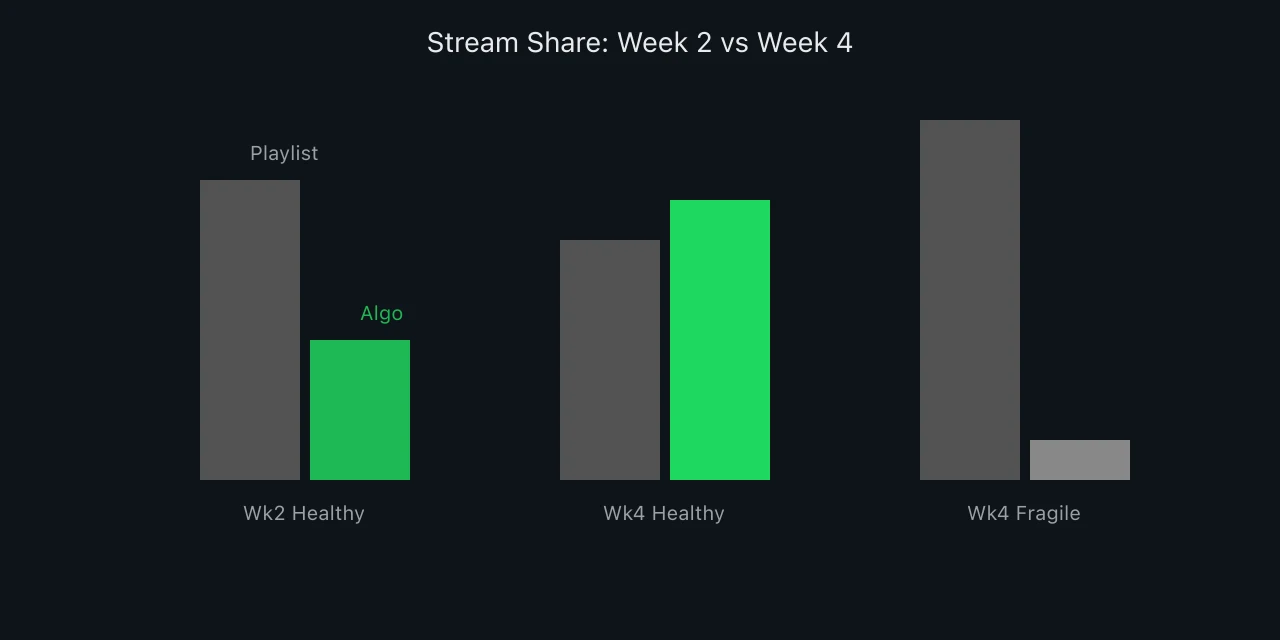
Playlist vs algorithmic share comparison
Healthy releases show gray playlist bars shrinking while green algorithmic bars grow. Fragile releases keep playlist dominance without algorithmic backfill—the pattern on the right.
Sequencing Playlist Pitches Without Cannibalizing Algorithms
Pitch editorial and high-reach user lists in week zero, but reserve niche algorithmic-adjacent lists—Discover Weekly feeders, genre micro-lists—for week two if early intent metrics are strong. Dumping every placement in day one can max passive streams before Spotify finishes testing save and skip behavior.
Space third-party paid playlist adds at least seventy-two hours apart so you can attribute velocity bumps. If two paid adds land the same day and saves lag, you will not know which list attracted passive listeners only.
Editorial vs User Playlists in the Mix
Editorial placements carry credibility and burst traffic. User playlists with engaged followers can produce higher save rates per stream. Balance both: editorial for reach, user lists for intent training the algorithm watches.
Algorithmic Surfaces You Are Balancing Toward
Discover Weekly introduces tracks to cold listeners with high taste match. Release Radar rewards followers and recent engagers. Radio and autoPlay extend session length. Each surface responds to different signals—Release Radar needs profile follows and pre-release engagement; Discover Weekly needs strong save velocity among strangers.
According to recommendation system design, platforms optimize for session satisfaction. Your balance goal is proving satisfaction outside playlist context so the system routes you into those feeds.
When More Playlists Hurt Algorithmic Chances
Low-intent playlist bundles—generic "chill vibes" lists with million-track libraries—can flood streams with skips. If skip rate in the first fifteen seconds spikes above fifty percent during a paid playlist campaign, pause new adds. The algorithm may interpret the track as broadly unappealing even if core fans love it.
Similarly, playlist clusters that share bot-like listener patterns have triggered scrutiny industry-wide. Protect balance by vetting playlist engagement: saves per thousand streams, follower growth organicism, and whether other credible artists appear on the list.
Budget Allocation Framework
Split release marketing into three buckets: playlist pitching and placement fees, content that drives saves and follows, and retargeting ads to listeners who already streamed. In week one, forty percent playlist, forty percent content, twenty percent retargeting is a common indie starting point. By week three, shift toward twenty percent playlist support, fifty percent content, thirty percent retargeting as algorithmic share should rise.
If algorithmic share exceeds targets early, reallocate playlist budget to touring content or profile conversion rather than buying more passive streams.
Case Study: Successful Handoff on an R&B Single
An R&B artist landed two editorial lists in week one—combined playlist share of sixty-eight percent on day five. Save rate held at 9.4%. By day twelve, playlist share fell to thirty-nine percent while algorithmic rose to thirty-one percent. Total streams dipped only eight percent week-over-week because algorithmic backfill arrived exactly as playlist decay began.
The manager credited spaced pitching: a third editorial list was held until day nine when save metrics cleared an internal gate. That list reinforced rather than replaced algorithmic momentum.
Measuring Balance in Weekly Reviews
Each Monday, chart playlist share, algorithmic share, and "other" (profile, external) for every active single. Compute week-over-week delta. Flag any track where playlist share fell more than fifteen points without algorithmic gaining at least ten—broken handoff.
Overlay save rate and skip rate in the same view. Balance without intent is illusion. A fifty-fifty split at day thirty means little if saves trail genre norms.
Genre Adjustments to Default Ratios
Dance and electronic catalogs often accept higher playlist dependency early because DJ and club lists recycle tracks. Singer-songwriter catalogs should chase algorithmic share sooner—playlist spikes are shorter. Hip-hop with strong featured artists may see algorithmic lift faster; adjust handoff targets five points earlier.
Document genre overrides in your release playbook so A&R and marketing share vocabulary.
Long-Term Catalog Balance
Tracks that never achieve algorithmic share above twenty percent become playlist-dependent catalog. Schedule annual re-pitches or remixes to reset discovery. Tracks with durable algorithmic share above forty percent at day ninety deserve sync pitching and physical merch pushes— they have proven broad taste match.
Team Roles for Maintaining Balance
Assign a "handoff owner" separate from the playlist pitcher. Pitcher optimizes week-one reach; handoff owner watches day-seven through day-twenty-one ratios and kills counterproductive placements. Creative produces save-focused assets when algorithmic lag appears. Analytics logs source mix daily. Clear roles prevent the pitcher from chasing vanity adds that break the mix.
Common Balance Mistakes
Treating all playlist streams as equal. Editorial, listener, and paid bundles carry different intent—segment them.
Ignoring profile and external sources. Strong profile traffic lowers playlist dependency naturally—celebrate it.
Comparing to major-label benchmarks. Majors buy volume you cannot replicate; compare to your own cohort.
Abandoning playlists too early. Algorithmic lift often needs a minimum listener puddle—starving playlists before seeding completes backfires.
Pre-Release Balance Checklist
Define phase targets for playlist and algorithmic share. Schedule pitches across weeks, not one dump. Set save and skip gates before week-two adds. Build a weekly source-mix chart template. Name a handoff owner. Review genre-adjusted ratios. Balancing Spotify playlists and algorithmic traffic is not a one-time decision—it is a weekly read of whether rented reach is converting into earned distribution.
Source-of-Stream Deep Dive in Spotify for Artists
Open your track, navigate to source of streams, and export mentally into four buckets: editorial and algorithmic playlists, listener playlists, algorithmic recommendations (Discover Weekly, Radio, etc.), and profile or external. Map Spotify's labels into your phase table weekly. Disagreements between team members usually come from inconsistent bucket definitions—publish a one-page glossary.
Listener playlists with high engagement sometimes behave like algorithmic feeders when they update frequently and attract saves. Tag unusually strong user lists separately in your internal tracker; they are strategic assets worth thanking publicly.
Paid Media and Mix Distortion
Meta and TikTok ads that land on Spotify profiles can spike profile and external shares while playlist share looks artificially low—not bad, but misread if you expect playlist dominance forever. Annotate ad flights on mix charts so Monday reviews interpret shifts correctly.
Conversely, ads that deep-link to playlists you do not control may inflate playlist share without training algorithms on your artist profile. Prefer ads that build profile visits when handoff is the strategic goal.
Catalog Rebalancing Campaigns
Older tracks stuck at eighty percent playlist dependency can receive targeted algorithmic nudges: Canvas refresh, behind-the-song content aimed at saves, and pitching to algorithmic-adjacent micro-lists in week one of a catalog push. Measure whether algorithmic share rises five points in thirty days before declaring success.
International Mix Variance
Latin American and Southeast Asian growth markets sometimes show higher playlist share due to telco bundles and editorial programs. US and UK algorithmic shares may lead earlier. Segment territory mix before applying global ratio targets—aggregate numbers hide actionable regional stories.
Stakeholder Reporting Language
Tell artists: "Playlist rented us an audience; algorithmic is where we earn stay." Show week-two handoff charts in every update. Investors understand funnel metaphors better than raw Spotify source labels. Consistent language reduces anxiety when playlist share drops but revenue holds.
Advanced Handoff Metrics
Compute handoff efficiency: algorithmic share gain divided by playlist share loss between week two and week four. Ratios above 0.7 indicate strong conversion of rented reach into earned distribution. Below 0.4 triggers creative and profile funnel review before more playlist spend.
Editorial Pitch Timing for Handoff
Hold secondary editorial pitches until day-seven source mix confirms save rate cleared internal gates. Early pitches maximize week-one playlist share but can prevent algorithmic tests from completing. Late pitches extend plateau when decay would otherwise begin—use when handoff metrics look strong.
Catalog-Wide Mix Health Score
Compute percentage of active catalog tracks with algorithmic share above thirty percent at day sixty. Rising catalog health score means your machine learns across releases; flat score means you repeat playlist-dependent one-offs. Executives track portfolio health, not just single spikes.
Discover Weekly Seeding Signals
Discover Weekly pulls from saves and listening similarity clusters. Tracks with high playlist share but low saves rarely seed Discover Weekly at scale. Watch for algorithmic playlist line items rising in source data—that often precedes Discover Weekly by several days. When pitching teams celebrate editorial adds, analytics should quietly check whether Discover Weekly impressions appeared within ten days.
Some genres seed faster: dance and hip-hop often show algorithmic playlist rises within a week; folk may take three weeks. Genre timing affects when you declare handoff failure—do not panic at day eight if your historical median seed day is fourteen.
Release Radar Prerequisite Behavior
Release Radar requires followers and recent engagement. Profile conversion and save campaigns in week zero increase Release Radar inventory on drop day. A release with eighty percent playlist share and tiny Release Radar slice suggests you rented listeners without converting them—next single should front-load follow CTAs before chasing more lists.
Autoplay and Radio Mix
Autoplay and Radio streams count toward algorithmic share in most breakdowns. They indicate session extension—listeners who did not skip and accepted similar tracks. Rising Radio share with stable saves is a healthy long-tail pattern for electronic and ambient catalogs especially.
Friday Release Source Mix Ritual
Every Monday during campaign season, export source-of-stream percentages for all active singles. Color cells that miss phase targets. Discuss only red cells in standup—prevents hour-long meetings rehashing healthy tracks. This ritual is how balancing Spotify playlists and algorithmic traffic becomes habit rather than theory.
Summer and holiday periods distort mixes—annotate seasonality on the spreadsheet tab so October retrospectives do not compare unfairly to July campaigns launched during playlist refresh cycles.
Closing Balance Thoughts
The healthiest independent campaigns treat playlist placement as ignition and algorithmic growth as cruise control. Neither alone sustains a career. Weekly source-mix reviews, honest cohort tables, and handoff metrics keep teams honest when vanity streams tempt bigger ad spends. Your next release deserves a written phase plan before pitch emails go out—not a vague hope that Discover Weekly notices you.
Handoff Milestone Celebration
When algorithmic share crosses thirty percent while playlist share falls below forty percent, send internal win note to artist team—positive reinforcement builds analytics culture and reminds everyone balance goals are achievable with discipline.
Portfolio Balance Review
Quarterly, chart each roster track's latest playlist versus algorithmic share in one scatter plot. Clusters in the healthy quadrant validate label strategy; outliers schedule creative postmortems before next fiscal planning cycle begins.


