

Best CPA music industry is not a Yelp search—it is a diligence question about whether your accountant can reconcile a SoundExchange statement, a PRO writer royalty, and a tour settlement in the same month without treating your catalog LLC like a coffee shop. Small businesses in music—indie labels, artist management companies, production libraries, touring LLCs, and songwriter S-corps—run accounting systems that look nothing like retail or SaaS. Royalty accounting is accrual-heavy, multi-entity, and littered with 1099s from collaborators who never sent a W-9 until April.
This article compares what generalist CPAs miss against what music-specialized firms deliver, quantifies typical fee and error-cost tradeoffs, and outlines how to evaluate a CPA before you hand over three years of unbooked distributor deposits.

The best CPA for music small businesses reads royalty statements as fluently as a P&L.
Why Music Accounting Is Different
Music revenue arrives in fragments: streaming mechanicals, neighboring rights, sync fees, merchandise, ticket sales, sponsorship, and advances that may never recoup. Each stream has different timing—quarterly PRO distributions, monthly distributor statements, annual neighboring-rights settlements. A generalist CPA books a Stripe deposit as "sales" and moves on. A music-industry CPA maps that deposit to the correct catalog entity, splits writer share from publisher share, and accrues unrecouped advance balances.
According to music royalties practice, the same song can generate income through multiple rights layers simultaneously. Your accountant must understand which layer hit which bank account.
Small Business Structures in Music
Most music small businesses operate through layered entities: a personal loan-out S-corp for performance income, a separate LLC for masters, a publishing entity for writer share, and sometimes a touring LLC that employs crew. Entity choice affects self-employment tax, QBI deduction eligibility, and how tour income flows to principals.
LLC vs S-Corp for Artists
Single-member LLCs default to pass-through taxation—simple, but all net profit may face self-employment tax. S-corp election can split reasonable salary from distributions, reducing SE tax when profits exceed salary bands. The wrong structure costs five figures annually for mid-tier touring acts; the right structure requires payroll discipline your CPA must maintain.
Catalog and Publishing Entities
Catalog entities hold masters; publishing entities hold writer and publisher shares. Commingling them destroys clean buyer diligence when you sell a catalog. Your CPA should maintain separate chart of accounts per entity and never sweep royalties into one operating account without allocation logic.
Royalty Accounting Fundamentals
Royalty accounting is the core competency that separates music CPAs from generalists. It includes statement ingestion, rate validation, recoupment tracking, and cross-entity allocations.
PRO and Mechanical Statements
ASCAP, BMI, SESAC, and international PRO societies distribute on different cycles with different statement formats. Mechanical royalties flow through the MLC, Harry Fox, or direct label deals. Your CPA should reconcile PRO work numbers against registered works—not just deposit totals.
Distributor and Neighboring Rights
Spotify, Apple Music, and distributor portals (DistroKid, TuneCore, CD Baby, label distributors) report in net terms after fees. SoundExchange covers digital performance; neighboring-rights societies cover broadcast and some international uses. Each needs distinct revenue accounts and withholding treatment where applicable.
Sync and Licensing Income
Sync fees often split master use from sync license, with backend performance royalties trailing months later. Session work and production music libraries add buyout vs royalty-reserved contracts. Music CPAs track deal memos against cash, not just invoices.
CPA Comparison: Generalist vs Music Specialist
| Capability | Generalist CPA (Small Business) | Music-Industry CPA | Impact on Music SMB |
|---|---|---|---|
| Royalty statement reconciliation | Books gross deposits; rare line-level review | Maps streams to works, rates, and entities | Prevents silent revenue leakage |
| Multi-entity structure | Single LLC default | Loan-out, pubco, touring, catalog splits | Tax optimization + clean diligence |
| 1099 / W-9 workflow | Year-end scramble | Ongoing contractor tracking by project | Avoids penalties and audit triggers |
| Tour settlement integration | Treated as miscellaneous income | Per-show P&L, crew payroll, per diems | Accurate routing profitability |
| Recoupment & advances | Often ignored until cash dries up | Balance-sheet tracking per deal | Prevents surprise "where did the money go" |
| State nexus (tour tax) | Home state only | Multi-state apportionment review | Reduces exposure on tour income |
| Typical annual fee (artist LLC + S-corp) | $3,500–$6,000 | $6,500–$14,000 | Higher fee, lower error cost |
| Estimated error / missed deduction cost | $4,000–$18,000/year | $500–$2,500/year | Specialist pays back in year one |
Illustrative fee bands assume U.S.-based artist with one publishing entity, quarterly royalties, and moderate tour activity. Complexity scales with roster size for management companies and catalog depth for labels.
Revenue Mix: Where Generalists Misbook
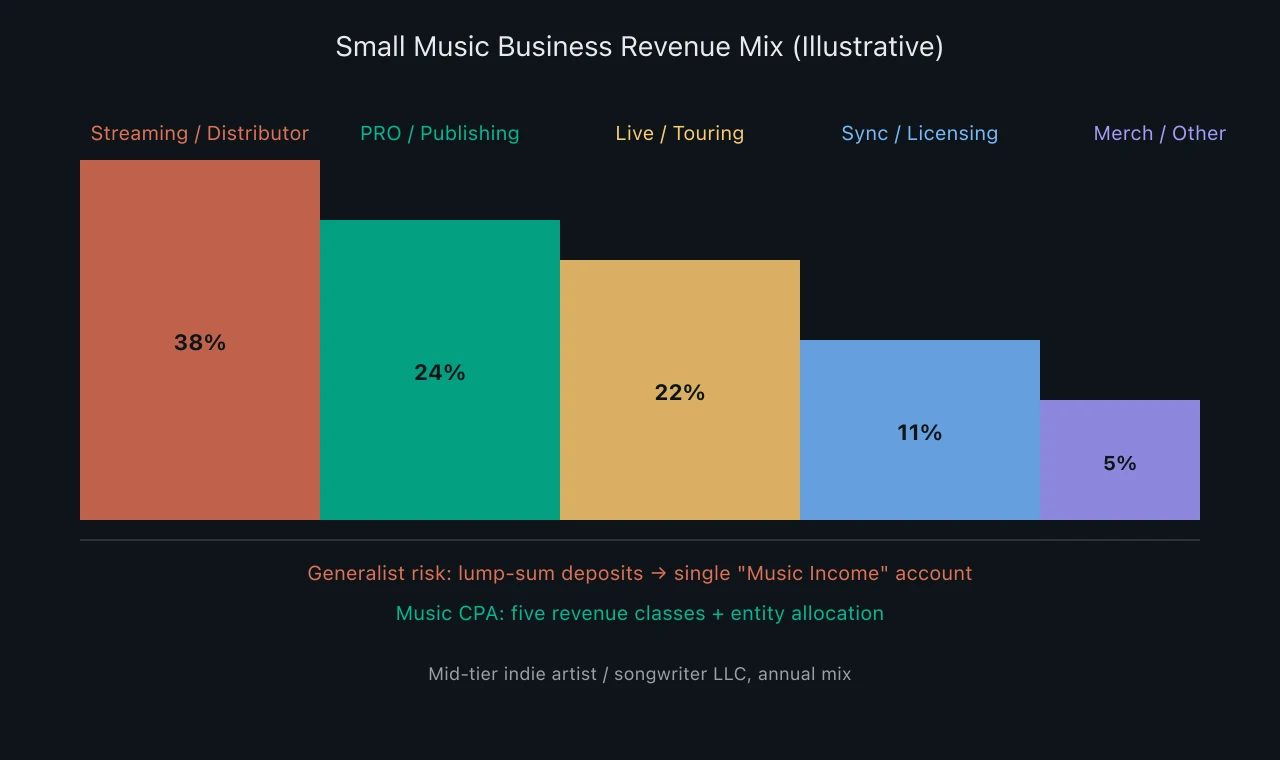
Music small business revenue mix and CPA misbooking risk
When every deposit hits one revenue line, you lose visibility into which income stream funds which entity—and you cannot defend deductions tied to specific business activities at audit.
Tour Income and Settlement
Touring small businesses face per-show settlements, guarantee vs percentage deals, merch splits, and crew classified as employees or contractors. Settlement sheets list deductions—production, catering, runner, venue fees—that must flow to correct expense categories for Schedule C or corporate returns.
Tour nexus tax adds complexity: performing in multiple states can create filing obligations beyond your home state. A music CPA coordinates with tour accountants and flags nexus thresholds; a generalist often files only where the LLC is domiciled until a state notice arrives.
Contractor 1099 Compliance
Music small businesses pay producers, mixers, session players, designers, and marketing freelancers constantly. IRS rules require 1099-NEC when payments exceed $600 to non-corporate payees. Music projects blur lines—royalty points vs work-for-hire fees vs recoupable production costs.
The best CPA music industry firms run contractor databases tied to projects, collect W-9s before first payment, and separate royalty participants from service vendors. Year-end fire drills with 40 missing W-9s are a symptom of generalist workflow, not music business chaos you must accept.
Deductions Music Businesses Miss
Legitimate deductions generalists overlook include home studio allocations, instrument and gear depreciation, union dues, PRO membership fees, travel between business locations (not commuting to a day job), and marketing spend tied to releases. Touring deductions span per diems, crew wages, bus lease vs ownership treatment, and insurance.
Label and Management Company Needs
Indie labels and management companies are small businesses with payroll, roster royalty accounting, and multi-artist allocation. Label CPAs track artist contract types: distribution deals, net profit deals, 360 deals with carve-outs. Management commissions must align with management agreements and not absorb pass-through tour reimbursements.
Roster Royalty Accounting
Labels owe artists royalty statements with catalog-level detail. Your CPA should integrate with royalty software or build reconciliation workflows—not export bank CSVs once a year. Investors and distributors diligence label books; messy roster accounting kills deals.
Management Commission Flows
Management companies typically earn 10–20% on defined earnings bases. The base definition matters: does commission run on gross guarantees or net after production? Music CPAs document commission bases per contract and automate calculations from categorized income.
Quarterly Planning and Cash Flow
Royalty seasonality wrecks cash flow for small businesses. PRO quarters cluster; streaming pays monthly but lags; sync fees arrive in spikes. Music CPAs build quarterly tax payment models from accrual forecasts, not last month's bank balance.
Estimated tax penalties hit artists who had a streaming spike in Q1 and spent it before Q3 tax payments. Specialist firms project from royalty history and tour calendars; generalists send generic vouchers.
Audit Readiness and Documentation
IRS audits and state inquiries target cash-heavy businesses with weak substantiation. Music businesses mix personal and business constantly—studio in home, vehicle for tour and errands, meals with collaborators. Audit-ready documentation means contemporaneous logs, separate accounts per entity, and deal memos filed with sync contracts.
According to IRS recordkeeping guidance, adequate records must support income and deductions. Music CPAs implement monthly close processes; generalists reconstruct at year-end from bank feeds.
When to Hire a Music CPA
Hire before your first significant royalty quarter closes—not after two years of commingled deposits. Triggers: crossing $75K net music income, forming a second entity, hiring tour crew as employees, signing a label or distribution deal with reporting requirements, or receiving sync income with backend participation.
Management companies and labels should engage music-specialized CPAs at formation. Retroactive cleanup of entity structure and royalty history costs more than starting clean.
Evaluating CPA Candidates
Interview questions separate performers from generalists marketing "we do creatives."
Technical Screening Questions
Ask how they reconcile a distributor statement to individual tracks, how they treat unrecouped producer advances, and how they handle tour income across states. Ask for a sample royalty chart of accounts. Vague answers about "creative industry experience" without music specifics are red flags.
Software and Workflow
Music-friendly firms use QuickBooks or Xero with custom classes, royalty platforms (Curve, Reprtoir, or label-built systems), and payroll for S-corp salaries. They should accept CSV exports from PRO portals and distributors without manual re-keying everything.
Referrals and Reputation
Ask business managers, entertainment attorneys, and peer artists—not Instagram ads. Firms serving Nashville, LA, and NY music communities often publish client types: songwriter, indie label, production music, influencer-artist hybrid.
In-House Bookkeeper Plus CPA
Many small businesses hire a bookkeeper for monthly categorization and a CPA for tax filing and advisory. That works when the bookkeeper understands music categories and the CPA reviews quarterly—not when both are generalists. Define handoff: bookkeeper tags deposits by source; CPA validates rates and entity allocation at quarter close.
International and Withholding
Foreign PRO income, European neighboring rights, and cross-border tours trigger withholding and treaty questions. U.S. artists earning abroad may need foreign tax credit coordination. Non-U.S. artists with U.S. touring income face FIRPTA and withholding rules on certain payments.
Music CPAs with international client bases understand W-8BEN workflows; generalists treat foreign deposits as domestic miscellaneous income.
Catalog Sales and Exit Planning
Selling masters or publishing catalogs requires clean financial history—three years of statements, recoupment schedules, and entity-level P&Ls buyers can diligence. Generalist books that never separated catalog from operating company create discount risk at sale.
Music CPAs model capital gains treatment, installment sale elections where applicable, and coordination with attorneys on deal structure. Exit planning starts years before LOI—not at signing.
Common Mistakes With Generalists
Artists report recurring failures: S-corp election filed late or never optimized for salary; tour van expensed incorrectly; merch income booked net without COGS; sync fees missing backend accruals; duplicate income when personal and LLC accounts both feed one QuickBooks file.
Switching CPAs mid-year is painful but cheaper than carrying three years of unreconciled royalties into a catalog sale or investor round.
Fee Structures and Engagement Letters
Music CPAs charge fixed annual packages, per-entity surcharges, and hourly for cleanup projects. Read engagement letters for scope: Does quarterly planning include or cost extra? Are royalty reconciliations capped at hours? Is IRS representation included?
Building Your Finance Stack
Ideal stack for a music small business: separate bank accounts per entity, accounting software with class tracking, document storage for contracts and statements, royalty tracking where roster size warrants it, and a music-industry CPA for tax, entity, and advisory.
Your business manager handles deal flow and cash distribution; your CPA handles compliance and defensible books. Blurring those roles creates gaps neither side owns.
Case Study: Songwriter S-Corp
A mid-level film/TV songwriter with $180K annual PRO plus sync income operated as a single-member LLC for three years. A generalist filed returns but never elected S-corp status or optimized salary. After switching to a music CPA, S-corp election, reasonable compensation modeling, and separated publishing LLC reduced self-employment tax burden by approximately $11,400 annually—against $8,200 in incremental professional fees.
Case Study: Indie Label
A ten-roster indie label used a local CPA who booked all distributor deposits as label revenue without artist participations. Roster royalty liabilities were wrong for two years; two artists threatened breach. Music-specialized firm rebuilt chart of accounts, integrated royalty software, and implemented monthly participant statements. Cleanup cost $14,000; ongoing fees rose 40% but investor diligence cleared for a $500K catalog financing round.
Red Flags in CPA Selection
Avoid firms that guarantee specific refund amounts, refuse to e-file without explanation, cannot name PRO and distributor statement types, treat all music income as Schedule C without entity discussion, or lack errors-and-omissions insurance. Avoid anyone who says tour nexus "does not apply to small acts"—thresholds vary by state and volume.
FAQ: Best CPA for Music Industry Small Businesses
What makes a CPA a music industry specialist?
Demonstrated royalty reconciliation, multi-entity structure experience, tour and 1099 workflows, and client references from labels, artists, or management—not generic "creative" branding.
How much more does a music CPA cost than a generalist?
Typically 50–100% higher annual fees for comparable entity count, but error and missed tax savings often exceed the premium in year one.
Do I need a CPA or just a bookkeeper?
Bookkeepers handle monthly categorization; CPAs handle entity elections, tax strategy, and audit defense. Music businesses need both or a firm offering both—with music-specific training on the bookkeeping side.
When should I switch from my current CPA?
When royalty deposits are unreconciled, entities are commingled, tour nexus was never discussed, or 1099 compliance is annual panic. Before catalog sale or fundraising is the latest you should switch.
Should my artist business be an LLC or S-corp?
Depends on profit level, payroll tolerance, and state fees. Music CPAs model break-even profit thresholds for S-corp election—typically evaluated when consistent net profit exceeds salary and admin costs.
Do I need royalty software if I have a music CPA?
Labels and multi-split songwriters benefit from dedicated royalty systems; solo artists with few works may use CPA-built spreadsheets if reconciled monthly. Software plus CPA beats either alone for roster businesses.
Best CPA Music Industry Summary
The best CPA for small businesses in the music industry reads royalty statements, tour settlements, and entity structures as one integrated system—not a shoebox of deposits at tax time. Compare generalist vs specialist capabilities honestly, invest in royalty accounting before complexity compounds, and evaluate candidates on music-specific technical answers rather than creative-industry marketing.
Entity structure, 1099 discipline, and tour nexus planning belong in quarterly conversations—not April emergencies. The right music CPA costs more upfront and returns margin through defensible deductions, clean diligence, and fewer silent bookkeeping failures.
Your catalog, roster, and touring income deserve accountants who know the difference between a mechanical royalty and a guarantee—and book each accordingly.


