

Corporate business travel agency partnerships sound like procurement theater until a hailstorm cancels three flights into Nashville and your tour manager is on hold with airline IVR while load-in starts in four hours. Online booking tools excel at buying tickets; they do not own rebooking authority, negotiated entertainment waivers, or a 24/7 desk that knows your drummer's bass is cabin-approved on Delta but not United. Hiring a travel management company (TMC) or specialized entertainment travel desk is a vendor decision—not a software subscription—and touring acts that treat it as such protect margin, crew morale, and duty-of-care obligations simultaneously.
This article explains why to hire an agency for tour travel, how to run an RFP that surfaces real capability, what fee models actually cost, and where DIY platforms stop being enough. It complements managed travel program design; here the focus is agency selection and the business case for professional booking partners.

Hiring a corporate business travel agency turns reactive tour chaos into accountable crew travel operations.
Why Hire an Agency, Not a Tool
Consumer and corporate self-booking portals—Concur, Navan, direct airline apps—solve purchase friction. They do not solve touring complexity: multi-city open-jaw routing tied to hold dates, instrument policies that vary by aircraft, hotel attrition blocks near load-in docks, or mass rebooking when weather shutters a hub. A corporate business travel agency assigns human agents with GDS access, airline desk relationships, and entertainment-specific playbooks.
According to travel management company practice, the agency's value is negotiated inventory, policy enforcement, reporting, and incident response—not merely displaying fares. Touring managers who conflate "we have a corporate card and Expedia login" with managed travel discover the gap at 2 a.m. when half the crew is stranded and nobody has authority to rebook without card limits.
Hire an agency when party size, routing complexity, or duty-of-care expectations exceed what a tour manager can monitor while advancing shows. The break-even is often lower than acts assume once change fees, baggage, and labor hours enter the calculation.
Agency vs DIY Booking Tools
DIY corporate tools work for predictable, low-disruption travel: A&R flying to two conferences, label exec on a standard client visit. Tours violate every assumption those tools encode: irregular schedules, same-day routing pivots, oversized checked cases, and crew members who are not employees of a single legal entity.
Agencies bring after-hours staffing, waiver negotiation history, and consolidated billing. DIY tools bring speed for simple legs and lower visible fees—until disruption costs dwarf subscription savings.
Where DIY Tools Still Win
One-off promo flights, single traveler legs, and van-tour gas/hotel bookings under $200/night may stay in DIY lanes with policy guardrails. Keep the agency focused on tour-critical air blocks and complex international routing.
Agency-Exclusive Capabilities
Entertainment desks hold airline station manager contacts, pre-cleared instrument manifests, group PNR management, and crisis rebooking SLAs measured in minutes—not business hours. No self-serve portal rebooks eighteen passengers through a single hub closure while preserving hotel block integrity.
Agency vs DIY Comparison Table
| Capability | DIY Corporate Tool | Corporate Business Travel Agency | Touring Impact |
|---|---|---|---|
| After-hours disruption response | Email/chat bots; next-day queues | 24/7 live agents with rebooking authority | Show-day saves vs missed load-in |
| Negotiated entertainment fares | Generic corporate rates | Tour-volume and vertical-specific deals | 15–30% airfare delta on busy legs |
| Instrument / gear policies | Traveler self-attestation | Pre-cleared carrier rules per case type | Fewer gate conflicts, less gear risk |
| Hotel block attrition | Individual bookings only | Negotiated blocks + attrition management | Lower nightly rates, flexible release |
| Mass itinerary changes | One PNR at a time | Bulk rebooking across party | Hours saved on weather events |
| Duty-of-care tracking | Basic itinerary share | Live location dashboards + escalation | Insurer and label compliance |
| Billing consolidation | Card sprawl across crew | Single invoice + tour cost attribution | Faster settlement, cleaner tax docs |
| Crisis rebooking SLA | None contractual | Contracted response times (e.g., 30 min) | Accountability when stakes peak |
| Visible software fees | $8–$25/user/month | Transaction + management fees | Agency wins on total cost at scale |
Compare total cost of ownership—fares, fees, change penalties, and tour manager labor—not sticker price of SaaS seats.
Agency Selection Scoring Diagram
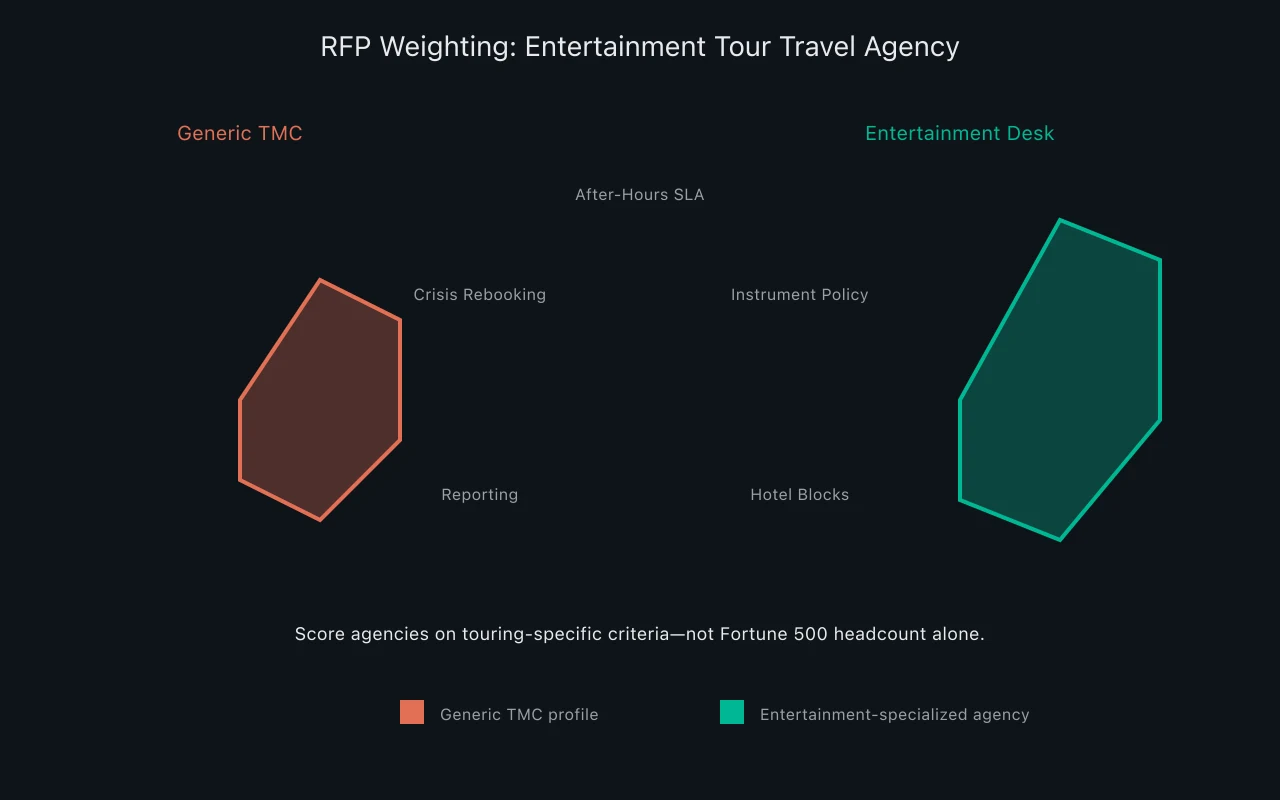
Corporate business travel agency RFP scoring for tours
RFP scoring should overweight crisis response, gear logistics, and tour billing—not generic corporate travel volume metrics that touring accounts will never match.
What an Entertainment Travel Desk Delivers
Entertainment desks within larger TMCs—or boutiques like those serving Broadway, orchestras, and touring acts—understand carnets, work permits, backline truck coordination, and the difference between a festival hold and a confirmed show. Generic corporate agencies optimize road-warrior sales reps on recurring city pairs; entertainment desks optimize irregular geographic arcs with gear constraints.
Ask prospects for touring client references at your scale: club circuit, theater package, festival fly-dates. A desk strong on arena rock may be weak on jazz combo cabin baggage. Reference checks reveal whether "entertainment vertical" is a brochure line or staffed expertise.
According to concert tour economics, travel is the second-largest variable cost after production on many fly-date packages—agency specialization directly affects net show margin.
RFP Criteria for Touring Agencies
Issue a structured RFP before signing multi-year agreements. Minimum criteria categories:
Operational Capability
24/7 staffing model, average speed-to-answer, GDS coverage, mobile agent access during load-in hours, and language support for international legs.
Entertainment Experience
Portfolio of touring clients, instrument policy documentation, festival season surge capacity, and hotel block negotiation examples near venues—not CBD business districts.
Technology Integration
API or export compatibility with tour management platforms, single sign-on for tour managers, real-time itinerary feeds, and approval workflow customization by role (crew, management, artist principal).
Financial Transparency
Fee schedule disclosure, markup policies on published vs negotiated fares, rebate pass-through percentages, and sample invoices annotated for tour settlement.
Compliance and Duty-of-Care
Traveler tracking methodology, GDPR or regional privacy compliance, insurance coordination, and documented escalation paths for medical or security incidents.
Weight criteria explicitly in scoring matrices. Agencies that excel at reporting but lack crisis SLAs fail touring RFPs even if their corporate NPS scores impress procurement.
Crisis Rebooking SLAs
Service-level agreements for crisis rebooking define how fast an agency acknowledges and resolves mass disruptions. Contract language matters: "commercially reasonable efforts" is not an SLA. Demand measurable commitments—initial response within 15–30 minutes of notification, rebooking options presented within 60–90 minutes for parties under twenty travelers, dedicated escalation line bypassing general queues.
SLAs should cover weather, mechanical cancellations, crew illness requiring replacement travel, and security events. Include credit remedies when agencies miss SLAs on show days: fee credits, waived transaction charges, or management fee reductions for the affected month.
Tour managers should run annual tabletop exercises with agency partners: simulate hub closure, verify after-hours numbers connect to humans, confirm rebooking authority without secondary management approval up to defined fare deltas.
Agency Fee Models Explained
Corporate business travel agency compensation stacks multiple layers. Understanding them prevents surprise invoices and enables apples-to-apples RFP comparison.
Transaction Fees
Per-ticket, per-segment, or per-PNR charges—typically $15–$45 per air transaction for entertainment accounts. High-volume tours negotiate caps or blended rates.
Management Fees
Monthly or annual program fees covering account management, reporting, policy consulting, and technology access. Touring accounts may pay $500–$3,000/month at mid-tier scale, higher for global programs.
Markups and Rebates
Agencies may retain portions of airline commissions or overrides. Transparent contracts pass through agreed rebate percentages or credit them against management fees. Opaque rebate retention inflates effective fare cost.
Project Fees
One-time onboarding, RFP response, or international routing project charges. Clarify what is included in base management vs billed separately.
Build a total-cost model: agency fees plus expected fare savings plus avoided change penalties plus tour manager hours reclaimed. A $2,000/month management fee is inexpensive if it saves $8,000 in fares and 30 hours of labor per leg.
Building the Business Case
Present agency hiring to business managers and label partners as ROI math, not convenience. Document baseline fragmented spend from prior tours: retail fares, baggage, change fees, hotel scatter, and tour manager booking hours valued at loaded labor cost.
Project agency scenario with conservative savings assumptions—15% airfare, 40% change-fee reduction, 25% hotel block improvement—and add agency fees. Most fly-date tours cross positive ROI between legs three and five of a typical six-week run.
Include intangible benefits with dollar proxies: avoided show delays (guarantee at risk), crew retention (rehire cost), and insurer satisfaction (premium stability). According to business travel duty-of-care norms, documented agency programs reduce liability exposure when incidents occur.
Red Flags When Evaluating Agencies
Reject or downgrade agencies exhibiting these patterns during RFP and reference calls:
No dedicated after-hours entertainment team—only offshore general queue. Inability to provide touring client references within two weeks. Vague instrument policy answers ("travelers should check with the airline"). Markup policies hidden behind "industry standard" language. Crisis stories where reference clients rebooked themselves during disruptions. Technology portals that lack mobile-friendly itinerary views for crew without corporate email domains.
Also beware agencies that outsource entertainment work to subcontractors without disclosure. Your RFP contract should name the executing desk and prohibit silent reassignment.
Contract Terms That Protect Tours
Minimum contract protections for touring accounts:
Named account team with backup coverage; termination for convenience with 60–90 day notice; data portability on exit (itinerary history, negotiated rate codes); SLA remedies with fee credits; confidentiality for routing and artist travel schedules; liability caps balanced against errors-and-omissions insurance proof; and annual rate benchmarking clauses triggering rebid if savings fall below agreed thresholds.
Negotiate most-favored-customer language only if you commit to volume thresholds—otherwise focus on transparent fee schedules and rebate pass-through.
Onboarding a Travel Agency
Onboarding timelines run four to eight weeks for full programs; crisis-only interim arrangements can start faster. Phase one: traveler profiles, policy document, payment method, emergency contacts. Phase two: negotiated rate activation, portal training for tour manager and coordinator. Phase three: integration with tour budget and settlement coding.
Provide agencies advance routing windows—even tentative hold dates—so they can pre-position inventory options. Agencies cannot optimize what they learn about the same day fans do.
Run a low-stakes shakedown leg before festival season: book a short crew movement, test after-hours contact, validate invoice format against settlement expectations.
Tour Manager and Agency Governance
Hiring an agency does not absolve tour managers of oversight—it reallocates labor from fare hunting to governance. Weekly syncs during active legs: upcoming routing, budget variance, policy exceptions, crew changes. Define decision rights: agency proposes, tour manager approves within policy; exceptions escalate to business manager.
Prevent back-channel bookings that bypass the agency. One rogue first-class upgrade bought on a personal card to "save time" undermines negotiated reporting and duty-of-care tracking. Policy plus culture keeps the partnership intact.
Crew Travel Experience Standards
Agency hiring should specify crew experience standards in the RFP: maximum layover durations, minimum connection buffers for international legs, hotel star ratings by city tier, and proximity rules to venues or airports. Cheap fares with brutal connections burn crew faster than moderate fare premiums with sane routing.
Entertainment desks familiar with touring know that a 6 a.m. checkout after a midnight encore is a retention problem, not a savings win. Encode humane routing standards in policy so agents optimize within constraints that protect show quality.
International Tours and Agency Expertise
Cross-border touring amplifies the case for agency hire. Visas, carnets, work permits, VAT reclamation, and multi-currency billing exceed DIY tool capabilities. Agencies with global entertainment desks coordinate document timelines against routing—preventing arrivals where gear clears customs but work permits have not.
Verify agency international capabilities separately from domestic RFP scores. A strong U.S. desk may partner with weak EU subcontractors. Ask who executes rebooking in Tokyo at 3 a.m. local when your U.S. account team sleeps.
Measuring Agency Performance
Quarterly business reviews with KPIs keep agencies accountable:
Average fare vs published benchmark for comparable legs. Change-fee incidence rate. SLA compliance percentage on disruption events. First-contact resolution rate for after-hours calls. Invoice accuracy and dispute rate. Tour manager time spent on travel tasks (target: declining over first two tours). Crew travel satisfaction pulse (simple post-leg survey).
Publish scorecards internally. Agencies that miss KPIs two consecutive quarters enter remediation or rebid—loyalty without measurement becomes expensive complacency.
Hybrid Agency and DIY Models
Some labels run hybrid models: agency for tour air and hotel blocks, DIY tools for off-tour promo and low-complexity legs. Hybrids work with strict policy fences—defined spend caps, traveler categories, and booking channels per trip type. Without fences, hybrid becomes fragmented by another name.
Agencies often accept hybrid structures if they retain majority of tour spend; negotiate fee caps reflecting reduced volume. Ensure duty-of-care coverage extends to whichever channel books—gaps appear when promo travel sits outside agency tracking during active tour windows.
When to Delay Agency Hire
Van tours with no scheduled air, parties under four flying fewer than four legs annually, or single-city residency runs may defer agency hire. Start with hotel block training from a la carte agency consultations if full retainer feels premature.
Deferral ends when fly-dates multiply, international routing begins, or insurers and labels contractually require documented duty-of-care programs. Graduation from van to fly-date is the highest-risk moment for DIY persistence—habits formed on fragmented tools persist into higher-stakes routing.
Case Study: Mid-Tour Agency Onboarding
An eleven-person indie pop act self-booked the first three legs of an eight-week U.S. run. Fragmented fares and hotel scatter ran $6,400 over budget with two missed-connection near-misses. They issued an expedited RFP to three entertainment desks, onboarded the winner in twelve days, and saved $4,900 on remaining legs—net of agency fees—while cutting tour manager booking time from nine hours weekly to two.
Crisis SLA proved value on leg six: Denver hub weather cancellation affected seven travelers; agency rebooked through alternate hub within 47 minutes while tour manager advanced load-in with venue. DIY history on earlier legs suggested same event would have cost a show delay.
Case Study: Festival Season Surge
A management company representing three DJ acts consolidated travel under one corporate business travel agency before festival season. Combined spend unlocked better override tiers; shared after-hours desk handled overlapping routing peaks. Management fees dropped per-act because volume pooled; each act still received dedicated routing contact.
Consolidation also standardized crisis rebooking SLAs across rosters—business managers compared agency scorecards apples-to-apples instead of juggling three DIY toolchains.
Rebidding and Agency Loyalty
Rebid every two to three years even when satisfied. Markets shift: airlines renegotiate override tables, boutiques launch entertainment desks, mega-TMCs acquire specialists. Incumbent agencies should earn renewal with documented savings and SLA performance—not relationship inertia.
Structure contracts with clean exit ramps so rebid fear stays mutual. Long tenures reward agencies that invest in your routing patterns; they punish you if service atrophies and switching costs rise.
Insurance and Agency Coordination
Tour insurers and travel assistance providers increasingly ask whether professional travel management supports duty-of-care. Agency dashboards supply location data and communication logs that DIY bookings scatter across personal inboxes.
Align insurer assistance hotlines with agency crisis desks in onboarding docs. Crew wallet cards should list both numbers with clear sequencing: airline disruption calls agency first; medical evacuation triggers insurer pathway per policy.
Tax and Settlement With Agency Billing
Agency consolidated invoicing accelerates tour settlement and year-end tax prep. Export charges by show date, city, and traveler role; map to budget lines business managers already track. Fragmented card receipts from DIY booking require reconstruction—accountant hours billed back to the tour invisibly.
Negotiate invoice cadence in contracts: weekly during active legs, monthly off-tour, with CSV exports matching your settlement software fields.
Sustainability Reporting Through Agencies
Festivals and sponsors increasingly request travel emissions data. Agencies aggregate flight segments, distances, and cabin classes from centralized bookings—DIY scatter forces manual reconstruction or incomplete disclosure.
Include sustainability reporting deliverables in RFP if your routing story competes for eco-conscious sponsorship. Entertainment desks can model routing options that trade marginal cost for emissions reduction when schedules allow.
FAQ: Hiring a Corporate Business Travel Agency for Tours
Why hire an agency when we have corporate booking tools?
Tools buy tickets; agencies own disruption response, negotiated entertainment fares, gear policies, hotel blocks, and duty-of-care accountability. Tours need the latter daily.
What is an entertainment travel desk?
A specialized team within a TMC—or a boutique agency—focused on touring, live events, and production travel rather than generic corporate road warriors.
How long should an RFP take?
Four to six weeks for structured evaluation: requirements doc, three to five agency responses, reference calls, pilot leg, contract negotiation. Expedited onboarding can follow in two weeks for crisis hires.
What crisis rebooking SLA should we demand?
Initial human response within 15–30 minutes and rebooking options within 60–90 minutes for parties under twenty travelers on show weeks—with contractual fee credits if missed.
What do agency fees typically cost touring acts?
Transaction fees of $15–$45 per air booking plus $500–$3,000/month management fees at mid-tier scale. Total cost should still fall below fragmented retail spend plus labor on fly-date tours.
Can we keep DIY tools for some travel?
Yes, with strict policy fences for low-complexity off-tour legs. Tour-critical air and hotel blocks should stay with the agency to preserve negotiation leverage and duty-of-care.
How soon before a tour should we hire?
Ideal: eight weeks before first air leg. Minimum: four weeks for onboarding plus shakedown booking. Mid-tour switches remain viable for remaining legs.
Corporate Business Travel Agency Summary
Hiring a corporate business travel agency for tours is a procurement decision with direct P&L and duty-of-care consequences—not a software upgrade. Run RFPs weighted toward crisis rebooking SLAs, entertainment desk experience, instrument policies, and transparent fee models. Compare agency total cost against DIY tools plus labor plus disruption risk, not portal subscription prices alone.
Contract SLAs, measure KPIs quarterly, and rebid periodically to keep incumbents honest. Hybrid models work with policy fences; defer agency hire only while travel complexity genuinely stays van-tour simple.
The guarantee you negotiate deserves partners who answer at 2 a.m. when the hub closes—not portals that ticket your frustration for next business day.
Issue your first entertainment-travel RFP before festival routing locks; savings and crew sanity compound from leg one, not leg six after a postmortem.
A corporate business travel agency is tour infrastructure—hire it with the same rigor you apply to booking agents, insurers, and backline vendors.


