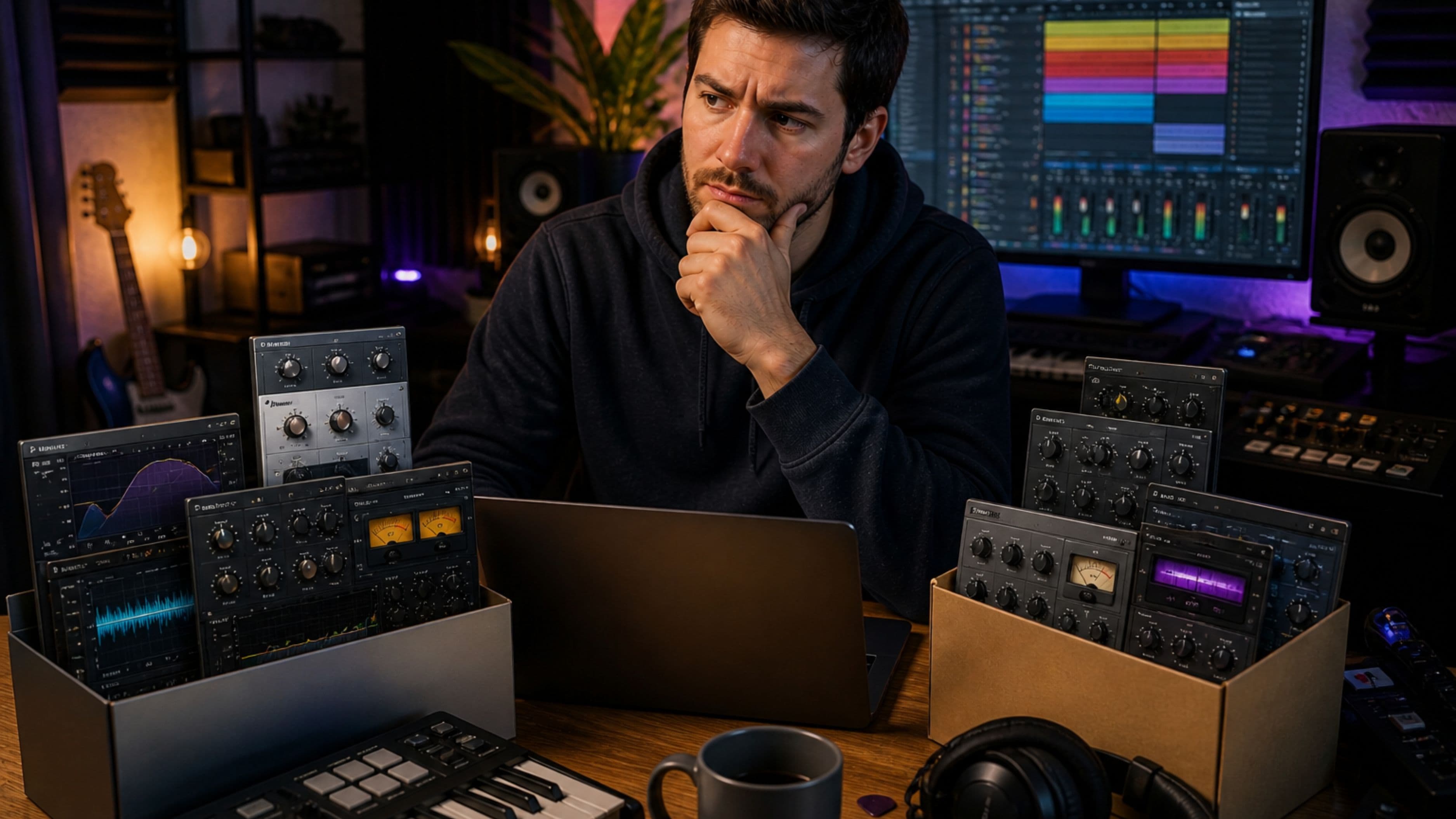
This is the most common story in music production software, and it plays out enough times that it's worth examining honestly. Plugin bundles can represent genuine value or a more expensive version of buying nothing at all, depending entirely on how you evaluate them and what you actually need.
What Plugin Bundles Actually Are
A plugin bundle is a collection of instruments, effects, or both sold together under a single price rather than individually. They range from tight, curated collections of related tools (all the compressors a mastering engineer might need, for instance) to enormous catch-all packs containing dozens of processors across every category. The business model behind them is straightforward: individual plugins are sold at higher per-unit margins, while bundles offer lower effective per-plugin pricing in exchange for volume. The manufacturer moves more product and the producer theoretically gets more tools for less money.
The operative word is theoretically. The math that makes a bundle look like a deal only holds if you actually use what you're buying. A bundle that costs $150 and contains 25 plugins you use one each of has an effective cost-per-used-plugin of $150. An individual plugin at $100 that you use on every mix has an effective cost somewhere close to zero over enough sessions. Price-per-plugin is a marketing metric that measures potential value, not actual value.
When Bundles Genuinely Make Sense
There are specific scenarios where a plugin bundle is clearly the right purchasing decision, and it's worth distinguishing those from the impulse-buy scenarios that dominate most producers' plugin histories.
The clearest case for a bundle is when you're building out a new DAW setup and need coverage across multiple categories simultaneously. If you've just moved to a new DAW or stripped your plugin folder back to basics, buying individual best-in-class tools across EQ, compression, saturation, reverb, and limiting separately would cost considerably more than a well-curated bundle that covers all of those categories at a solid standard of quality. The Native Instruments Komplete collection, iZotope's Music Production Suite, and Waves' various bundles exist in this category – they're designed to provide functional coverage across a full production and mixing workflow for a price that would only buy two or three premium individual plugins separately.
The second strong case is when the bundle comes from a manufacturer whose individual tools you already know and trust, and the bundle simply packages several of them together at a discount. If you've been using Plugin Alliance's Brainworx bx_digital EQ for years and their bundle includes six other tools you've tried and liked in trial versions, the bundle pricing makes obvious sense. You're buying known quantities at a better price – that's a straightforward value calculation.
The third case is genre-specific sound libraries. Sample-based bundles, expansion packs for virtual instruments, and genre-focused synthesis collections have a clearer value case than general-purpose effect bundles because the selection is specific. A hip-hop producer buying a bundle of 808 kits, boom bap drum samples, and vintage soul loops has a reasonable expectation of using most of the content because it's all relevant to what they actually make. General-purpose bundles containing compressors, filters, reverbs, virtual analog synths, orchestral samples, guitar amps, and mastering tools assume a breadth of use that most producers don't actually have.
The Bundle Trap – Why Most Don't Pay Off
The sale psychology around plugin bundles is among the most effective in any software category, and understanding it protects your wallet better than any buying guide.
The anchor price is the first mechanism. When a bundle's "regular price" is displayed prominently at $1,200 before showing the sale price of $79, the $1,200 figure establishes a reference point that makes $79 feel like a rational bargain regardless of whether the plugins in the bundle are actually worth $1,200 to you individually. Plugin manufacturers set their catalog prices knowing these will primarily be displayed as comparison points during sales, not as prices anyone pays. The regular price is marketing infrastructure.
Perpetual sale cycles compound this. Waves, one of the most sale-driven plugin brands in the industry, has run continuous promotions for years to the point where their standard pricing is effectively whatever the current sale price is. Plugins that nominally cost $199 regularly appear at $29. Waiting for sales is rational behavior given this market structure, but it also creates a buying pattern where you accumulate plugins continuously because there's always another deal that feels urgent. Many producers discover at some point that they own hundreds of plugins and use fewer than twenty regularly.
The novelty effect is a real psychological force that inflates how useful a new plugin seems immediately after purchase and deflates it once the novelty fades. A new reverb plugin sounds inspiring the first week because you're actively listening to what it does. By week three, it sounds exactly like the other reverbs you own, and you've returned to the one you already knew. Bundles amplify this effect by providing multiple novelty hits in sequence – you explore each new plugin briefly before moving on, rarely developing deep fluency in any of them.
Deep fluency matters more than most producers account for when evaluating tools. A plugin you know inside and out – where you understand intuitively how it responds to different input material, which settings you actually use, how it interacts with the things around it in a chain – is worth considerably more than a technically superior plugin you're still exploring six months in. Owning fewer plugins and knowing them deeply almost always produces better mixing results than owning many and knowing them shallowly.
What the Actually Useful Bundles Have in Common
Looking at which bundles producers consistently describe as worth the money reveals a few common characteristics.
Tight thematic focus is the most reliable indicator. Bundles built around a specific function or sonic character – all the tools needed for vocal production, or a complete channel strip collection with EQ, compression, and saturation from a single manufacturer with consistent signal flow design – tend to see higher usage rates than omnibus collections. The producer who buys a dedicated mastering bundle knows exactly why they bought each tool. The producer who buys a 40-plugin general production bundle often can't articulate why they'd use more than a handful of them.
Consistent quality level across the collection is the second indicator. The best-value bundles come from manufacturers whose individual plugins consistently deliver at a high standard, meaning the bundle price buys you several strong tools rather than a few standout tools padded with mediocre ones. iZotope's RX audio repair suite is frequently cited as worth the bundle price specifically because every tool in it is best-in-class for its function. Contrast that with bundles from brands where three plugins are genuinely excellent and the rest are filler that inflates the nominal plugin count.
Trial availability before purchase is worth treating as a baseline requirement for significant bundle purchases. Any reputable plugin manufacturer offers demo versions with limited functionality or time restrictions. If you can't trial the individual plugins in a bundle before buying, you're purchasing based on marketing rather than actual experience with the tools. Buying a significant bundle without trialing the key plugins first is the single most common source of bundle regret.
Practical Framework for Evaluating a Bundle
When you encounter a bundle deal that looks compelling, a few questions restructure the decision from impulse to considered evaluation.
Start by listing which specific plugins in the bundle you would buy individually at full price if the bundle didn't exist. Not "might use someday" – specifically would buy because they address a current, concrete need in your production workflow. If that number is two or more plugins, price those tools individually and compare to the bundle price. If the bundle costs less than those two tools alone, the additional plugins are effectively free and the bundle makes straightforward economic sense.
If you can only identify one plugin you'd buy individually, the bundle math gets murkier. A single plugin you'd pay $99 for, bundled with 19 others at $129 total, looks like a $99 tool with a $30 bonus – but only if you'd genuinely pay $99 for that specific plugin, which requires honest self-assessment about the difference between "I want this" and "I would pay full price for this."
Ask yourself when you last opened your most recent plugin purchase and actually used it in a track. If the answer is vague or uncomfortable, that's diagnostic information about your plugin usage patterns that should factor into any new purchase decision. The producers who consistently report getting value from bundles are also the producers who regularly open and experiment with new tools rather than installing them and returning to familiar ones.
Consider subscription models as an alternative to outright purchase for bundles you're uncertain about. Plugin Alliance, Native Instruments, Waves, and iZotope all offer subscription tiers that provide access to large plugin collections for monthly fees. These can make genuine sense for producers who want access to a wide range of tools without the financial commitment of ownership, particularly if the workflow involves client work where specific tools are occasionally needed rather than used regularly.
The Built-In Tools Question
An honest evaluation of any plugin bundle has to include an honest assessment of what's already in your DAW. Logic Pro, Ableton, and FL Studio all ship with built-in instruments and effects that are production-ready for most applications. Logic's built-in Compressor, EQ, Reverb, and Space Designer are legitimate tools that professional engineers use on released music. Ableton's Wavetable synthesizer and built-in audio effects are capable across a wide range of applications.
Many producers buy third-party bundles to replace built-in tools with alternatives they perceive as better, before developing sufficient skill with the built-in tools to evaluate whether that perception is accurate. The compressor in your DAW probably compresses just fine. The reverb probably sounds good. Before spending money on replacements, the productive question is whether you've actually explored what you have deeply enough to identify specific limitations, or whether you're buying something new because it feels like progress.
Third-party tools genuinely earn their place when they do something your built-in tools don't do well or at all. A specific vintage hardware emulation, a granular synthesis engine your DAW doesn't include, a spectral repair tool for audio restoration – these address genuine gaps. A compressor bundle that replicates the function of your existing compressors with different interface aesthetics is harder to justify unless you've found specific situations where your current options fall short.
What to Avoid
Buying anything during a sale that expires in 48 hours without having researched and trialed it beforehand is almost always a mistake. Time pressure is a sales mechanism, not a genuine reflection of value. Plugins that go on sale regularly will go on sale again. If you didn't know you wanted this bundle before the email arrived, the email created the desire – which is useful to recognize.
Accumulating free plugins from giveaways and promotional downloads without regard for whether they fit your workflow creates a plugin folder full of tools you'll never open, which paradoxically makes your workflow less efficient because the cognitive load of navigating a vast collection is real. Occasionally declining a free plugin because you don't actually need it is a reasonable practice.
Replacing your existing tools with bundle alternatives before mastering what you have delays skill development. The mixing engineer who knows one compressor deeply produces better results than the one who owns forty and knows each shallowly.
FAQ
Are Waves plugins worth buying? Waves makes genuinely useful tools – the SSL E-Channel, CLA compressors, and API collection are widely used by professional engineers. Their value proposition depends entirely on waiting for sale pricing (their standard prices are high relative to competitors at equivalent quality) and being selective about which specific tools you actually need rather than buying large bundles. Many of their individual plugins are worth the $29–$49 sale price. Their larger bundles are harder to justify unless you're building from scratch.
Is Native Instruments Komplete worth it for beginners? Komplete is frequently cited as one of the better bundle values in production software because of the breadth and quality of its content – particularly Kontakt, Battery, and the synthesis instruments. The introductory Komplete Select tier provides genuine coverage for a reasonable entry price. The higher Komplete and Komplete Ultimate tiers are harder to justify for beginners because the additional content requires enough production experience to use effectively. Starting with Komplete Select and upgrading when you've genuinely outgrown it is a more sensible approach than buying the top tier before you know what you need.
Do professional producers use expensive plugin bundles? Professional engineers and producers use a mix of built-in DAW tools, a relatively small collection of trusted third-party plugins they know deeply, and occasionally specialized tools for specific applications. The correlation between plugin collection size and production quality is essentially zero. What correlates with production quality is how well someone knows the tools they use, not how many tools they have.
When is a plugin subscription worth it over purchasing? Subscription models make the most sense for producers who need occasional access to a wide range of tools (client work, varied genres), producers who want regular access to the latest versions without upgrade fees, and beginners who want to explore a broad collection before committing to ownership of specific tools. They make less sense for producers with stable, defined workflows who consistently use the same set of plugins and prefer ownership to ongoing fees.
The honest answer to whether plugin bundles are worth it is: sometimes, with specific conditions, for specific producers. The bundle that provides genuine value is the one that addresses multiple concrete needs you can name before you buy it, from a manufacturer whose quality you've verified through trial, at a price that reflects what you'd pay for those tools individually. Everything else is a more expensive version of a plugin folder you don't fully use.
📚 Sources
Native Instruments Komplete Bundle Overview: https://www.native-instruments.com/en/catalog/komplete
iZotope Music Production Suite Features: https://www.izotope.com/en/products/music-production-suite.html
Waves Plugins and Bundle Pricing: https://www.waves.com/bundles
Plugin Alliance Subscription and Bundle Options: https://www.plugin-alliance.com/en/subscription.html
Logic Pro Built-in Instruments and Effects – Apple: https://www.apple.com/logic-pro/plugins-and-sounds
Berklee Online – Music Production Tools and Workflow Guide: https://online.berklee.edu/takenote/beginners-guide-to-music-production