

Financial auditing music catalog deals is not glamorous work. It is late-night CSV reconciliations, split sheets that contradict PRO registrations, and earnout clauses that only make sense once you stress-test them against three years of normalized cash flow. When a private equity fund or strategic buyer pays eight figures for a songwriter's back catalog, the investment committee sees a multiple on NPS. The audit team sees whether that multiple survives contact with reality.
This deep dive walks through how financial auditing firms actually audit music catalog deals—from royalty statement sampling and split verification through PRO and mechanical reconciliation, chain-of-title diligence, earnout testing, and multiples pressure-tests. If you are on the buy side, sell side, or advising a catalog owner preparing for M&A, this is the diligence map institutional buyers run whether you hire them or not.

Catalog M&A closes on paper; value holds only if royalty economics survive audit scrutiny.
Catalog Equity in Motion
Before the sampling worksheets open, it helps to see the asset the way operators feel it—cash flowing through masters, publishing, and administration in real time. The brief below is atmospheric context for the diligence map that follows; it does not replace statement evidence.

Portfolio lens — sync, masters, and administration cash flows under diligence.
Why Catalog Deals Attract Audit Scrutiny
Music catalog M&A accelerated as streaming matured and interest rates made predictable cash flows attractive relative to speculative growth equity. Publishing catalogs trade on multiples of net publisher's share (NPS). Master catalogs trade on multiples of net artist royalties or label share. Both look like annuity businesses until you discover a co-writer owns 50% of your top-earning song, a PRO registration lags two years behind actual splits, or a TikTok spike in 2024 will not repeat in an earnout period.
Financial auditing firms—often engaged by buyers, lenders, or sellers preparing for sale—apply the same skepticism they bring to recurring-revenue SaaS or healthcare roll-ups. Revenue must be evidenced, splits must be contractual, title must be clean, and projections must survive downside scenarios. According to music publishing economics, the asset is a bundle of contractual cash-flow rights, not the recordings themselves. Auditors test those contracts against cash received.
Sellers who treat diligence as a paperwork exercise lose deals or eat purchase-price adjustments. Buyers who skip sampling invite post-close royalty leakage that destroys IRR. The audit is the deal.
Royalty Statement Sampling Methodology
Royalty statement sampling is the foundation of every catalog royalty audit. No firm recalculates every line item across ten years of statements—that would be cost-prohibitive and low yield. Instead, auditors design a stratified sample: top revenue songs, mid-tier stable earners, long-tail titles, and songs with known anomalies (covers, samples, disputed splits).
A typical publishing diligence sample might include the top 20 songs by trailing-twelve-month NPS, representing 60–80% of catalog revenue, plus 30–50 random mid-tail titles and every song above a dollar threshold in the earnout basket. Master-side audits weight DSP statements, sync licenses, and neighboring-rights collections similarly.
For each sampled title, auditors request source statements from administrators (Kobalt, Sony, Universal, Downtown, etc.), PRO detail (ASCAP, BMI, SESAC, PRS, GEMA), mechanical collections (MLC, HFA, direct licenses), and sync deal files. They tie statement line revenue to contract splits and flag immaterial rounding only after material exceptions are resolved.
Statistical sampling standards from general audit sampling practice apply: sample size scales with revenue concentration and control risk. A catalog where five songs drive 90% of NPS gets heavy top-song weighting. A diversified 5,000-song catalog gets broader random coverage.
Auditors also test cutoff—whether revenue near transaction close is complete in the data room. Sellers who pull trailing-twelve-month figures from June when the deal signs in October must provide stub-period detail or restate NPS. Seasonality matters: Q4 sync revenue from holiday campaigns can inflate annualized figures if auditors fail to check prior-year comparatives.
Statement format consistency is underrated. When five years of Kobalt exports use different column headers, auditors spend days normalizing before sampling begins. Sellers who deliver a single normalized schedule—song ID, title, income type, territory, period, gross, net—compress diligence timelines and reduce professional-fee leakage on both sides.
Sampling Red Flags Early
Auditors escalate immediately when sampled songs show revenue without matching chain-of-title documents, when administrator statements disagree with PRO statements by more than contractual lag, or when gross numbers on seller-provided summaries do not foot to underlying CSV detail. Those findings often pause confirmatory diligence until resolved.
Split Verification and Contract Forensics
Split verification is where catalog deals live or die. A song listed at 100% writer share in a seller deck may be 33.33% net publisher share after co-writers, producer agreements, and pre-1978 reassignment quirks. Auditors pull split sheets, collaboration agreements, producer deals, sample clearances, and work-for-hire determinations for every sampled high-value title.
They verify splits against PRO work registrations (IPI numbers, share percentages, territory flags) and administrator cue sheets. Mismatches are common and not always fraud—delayed registrations, informal co-writes later formalized, or estate transfers mid-period all create noise. Material mismatches are another matter. If the seller claims 75% NPS on a song generating $400,000 annually but PRO data shows 50%, the valuation multiple must reset or the song exits the earnout base.
Producer and artist royalty side letters often sit outside main publishing agreements. Master catalog audits hunt for uncapped producer points, 360-deal participations, and label recoupment positions that reduce net master royalties below seller representations.
Split verification also catches controlled composition clauses and statutory mechanical rate elections that affect mechanical income—relevant when buyers model total publishing economics, not just performance royalties.
PRO and Mechanical Reconciliation
PRO and mechanical reconciliation closes the loop between what societies pay and what administrators report. Performance royalties flow through ASCAP, BMI, SESAC, and international PROs via reciprocal agreements. Mechanical royalties in the U.S. increasingly flow through the Mechanical Licensing Collective for streaming, while sync and physical may route through HFA or direct licenses.
Auditors match quarterly PRO statements to administrator performance lines by work ID, territory, and period. Lag is expected—PRO distributions can trail usage by 6–18 months depending on territory and society—but the lag should be consistent and directionally accurate. Persistent gaps suggest mis-registered works, wrong writer shares, or black-box leakage where royalties sit unmatched.
Mechanical reconciliation tests whether streaming mechanicals reported by DSPs through the MLC align with publisher statements. Discrepancies often trace to incorrect ownership percentages in MLC database filings—a fixable but valuation-relevant item if the buyer inherits cleanup cost.
International reconciliation adds FX and society-specific rules. A song earning meaningfully in Germany, France, and Japan requires GEMA, SACEM, and JASRAC statement pulls, not just U.S. PRO summaries. Buyers underwriting global multiples need global reconciliation, not extrapolation from ASCAP/BMI alone.
Black-box and unmatched royalty pools deserve explicit attention. Societies hold funds when work registrations are incomplete; redistributions occur on schedules that may not align with seller reporting periods. Auditors ask administrators for black-box recovery history—material recoveries can inflate trailing NPS if treated as recurring. Conversely, unrecovered black-box balances represent upside not in seller models; buyers may credit that optionality only after registration remediation is costed.
Catalog Diligence Audit Scope Table
| Diligence Workstream | Primary Documents | Typical Finding Rate | Valuation Impact |
|---|---|---|---|
| Royalty statement sampling | Admin CSVs, DSP statements, 3–5 year history | 15–25% of samples have exceptions | High if top songs affected |
| Split verification | Split sheets, PRO registrations, producer deals | 10–20% material mismatch | Direct NPS haircut |
| PRO / mechanical reconciliation | Society statements, MLC data, HFA logs | 5–15% lag or % drift | Medium; often fixable |
| Chain of title | Assignments, wills, divorce decrees, LLC docs | 5–10% defect or gap | Dealbreaker if core assets |
| Sync and alternative income | License agreements, cue sheets, ad campaign data | 20–30% incomplete files | Earnout risk |
| Earnout testing | Base vs pro forma models, waterfall schedules | Varies by deal structure | Post-close dispute risk |
| Multiples pressure-test | Normalized NPS, growth/decay curves, discount rates | N/A—analytical | Bid/ask spread driver |
Finding rates are illustrative based on mid-market catalog transactions. Clean heritage catalogs with single PRO affiliations and centralized admin trend toward the low end; songwriter estates and multi-administrator portfolios trend high.
Chain of Title and Acquisition Diligence
Chain of title diligence asks a blunt question: does the seller legally own what they are selling? For publishing, auditors trace copyright assignments from writers to publishers, publisher-to-publisher transfers, reversion events, and estate distributions. For masters, they review recording agreements, label assignments, buy-back exercises, and termination rights under U.S. copyright law.
Common chain-of-title defects include missing assignments from co-writers, unsigned split sheets relied upon verbally, matrimonial property disputes, and LLC operating agreements that do not authorize the signatory. Each defect is a contingency item—curable with a quitclaim or estoppel letter, or fatal if a co-owner refuses.
Acquisition diligence also covers encumbrances: existing catalog financing (Kobalt advances, Reservoir credit facilities, hipgnosis-style securitizations), exclusive administration terms, reversion triggers, and right of first refusal held by former labels or co-writers. A catalog under a 20-year admin deal with a change-of-control clause may not be freely transferable without counterparty consent.
Title insurance is rare in music; legal opinions and bring-down certificates substitute. Financial auditors coordinate with entertainment counsel—auditors quantify revenue at risk; lawyers quantify legal enforceability.
Earnout Testing and Waterfall Modeling
Earnout testing matters because a growing share of catalog deals include contingent consideration. Sellers receive upfront cash plus earnouts tied to NPS or sync income exceeding thresholds over two to five years. Auditors build independent earnout models from sampled data—not from seller spreadsheets—and stress-test triggers.
Key earnout audit steps include defining the revenue base (gross vs net, inclusions/exclusions of one-time sync), confirming which songs count toward thresholds after split adjustments, modeling decay on aging catalogs, and testing whether 2023–2024 streaming spikes create unsustainable baselines. A catalog up 40% because one track went viral on TikTok may earnout in year one and collapse in year three. Auditors run decay scenarios—5%, 10%, 15% annual NPS decline on non-viral cores—to see if earnout ceilings still protect the buyer.
Waterfall modeling allocates proceeds correctly among multiple sellers, estate beneficiaries, retained admin interests, and tax partnerships. K-1 structures and blocker corps appear in larger transactions; earnout payments must follow cap table reality, not handshake summaries.
Post-close royalty audits—distinct from transaction diligence—often revisit earnout calculations. Clear earnout definitions in the purchase agreement reduce M&A litigation. Vague "catalog revenue" language invites disputes auditors profitably resolve years later.
Multiples Pressure-Tests and Valuation Bridge
Multiples pressure-tests translate audit findings into bid discipline. If a seller markets a catalog at 16× NPS on $2.1 million normalized NPS ($33.6 million headline), auditors rebuild normalized NPS from sampled statements and split-verified shares. A 12% NPS haircut from split corrections drops NPS to $1.85 million. At the same multiple, value falls to $29.6 million—a $4 million gap before growth assumptions.
Pressure-tests also apply multiple sensitivity. Aging catalogs with declining streaming curves may not justify 14–18×; stable sync-heavy estates might support premium multiples. Auditors bridge seller EBITDA-style NPS to buyer underwriting cases: base, downside, upside. Lenders in catalog-backed facilities often covenant on debt service coverage using downside NPS—audit output feeds those models directly.
Discount rate and terminal value debates mirror private equity norms. A catalog growing 8% with concentration risk in five songs warrants different pricing than a diversified 3,000-song portfolio growing 2%. Financial auditing firms do not set purchase price—they arm investment committees with defensible ranges.
Comparable transaction analysis often anchors seller expectations. Auditors scrutinize whether cited comps share income mix—sync-heavy estates versus streaming-native catalogs, or hip-hop producer catalogs versus Broadway songwriter portfolios. A 17× comp on a catalog with 40% sync income does not justify 17× on a streaming catalog decaying 6% annually. Segmentation by genre, vintage, concentration, and admin structure produces tighter comp sets and fewer emotional bid/ask gaps.
Terminal decay assumptions deserve documentation. Many catalog models assume perpetual 2–3% annual decline after year five; auditors test whether historical curves support that or whether steeper decay is prudent. Overpaying upfront on optimistic tails is how funds lose LP confidence despite technically accurate current-year NPS.
Catalog Audit Revenue Bridge Diagram
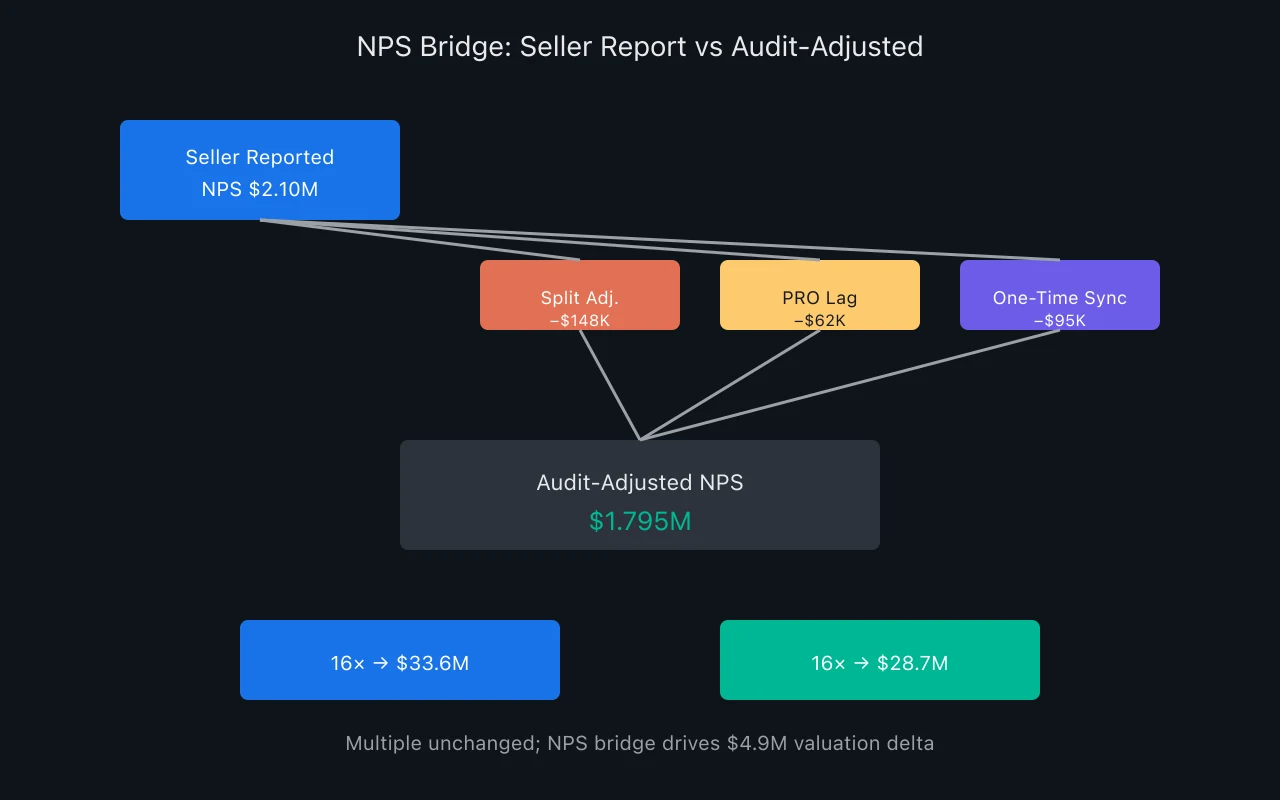
Music catalog audit NPS bridge
The bridge diagram is how audit teams communicate findings to non-technical deal principals. Dollars move valuation more persuasively than percentages on a split sheet.
Red Flags That Stop Deals
Experienced catalog auditors maintain a mental red-flag list. Some findings warrant price chips; others warrant walk-away.
- Top-five song split uncertainty. If ownership on songs driving 50%+ of NPS is litigated or undocumented, the deal pauses.
- Administrator disconnect. Revenue claimed from an admin relationship the administrator does not confirm.
- PRO registration desert. High-earning works missing from all PRO databases—signals black-box risk or fraud.
- Seller-prepared summaries without CSV backup. PDF totals that cannot be tied to underlying data.
- Sync revenue without contracts. Large ad-campaign income with no license files invites clawback.
- Change-of-control blockers. Admin or label agreements prohibiting transfer without consent withheld from data room.
- Earnout baseline inflated by non-recurring events. Film trailer sync, TV finale, or game placement counted as recurring NPS.
- Estate and heir disputes. Unsigned probate distributions among multiple beneficiaries.
- Sample and uncleared interpolation exposure. Mechanical and sync liability not reserved.
- Artificial streaming or playlist manipulation history. DSP fraud clawbacks can retroactively reduce catalog earnings.
Red flags do not always kill deals—they reprice them. Sellers who front-load transparency in the data room close faster and retain more headline value than sellers who bury issues until week six of confirmatory diligence.
Administration Agreement Review
Catalog economics do not exist in a vacuum—they flow through administration agreements governing collection commissions, retention of sub-publishers, audit rights, and reversion. Financial auditors read admin contracts alongside royalty statements because the net number in your NPS bridge is post-commission.
Standard admin rates run 10–20% of collections, but tiered schedules, minimum annual fees, and sync commission overrides (sometimes 15–25% on placements) change effective yields. A catalog paying 12% admin on performance but 20% on sync looks different from blended-rate summaries sellers present in teasers.
Change-of-control and assignment clauses determine whether the buyer can consolidate admin post-close or must inherit legacy terms for years. If the admin agreement grants the administrator a matching right or consent veto, closing mechanics and synergy models shift. Auditors flag admin deals expiring within 24 months—renewal economics may differ from trailing averages.
Sub-publishing and collection society deductions outside the main admin agreement also reduce net NPS. A U.S. publisher collecting through sub-publishers in Europe at 50/50 splits must show those splits in the reconciliation, not bury them in net figures.
Post-Close Royalty Audits
Transaction diligence is not the end. Purchase agreements often grant buyers—or sellers verifying earnout payments—the right to conduct post-close royalty audits of administrators and labels. These audits resemble record-label audit practice codified in recording industry standards: multi-year lookbacks, contractual interest on underpayments, and recovery negotiations before arbitration.
Post-close audits catch administrator allocation errors, territory misallocations, black-box recoveries not passed through, and sync fees booked net of excessive commissions. For catalog funds holding dozens of acquisitions, systematic post-close audit programs recover 2–5% of collected royalties—material at scale.
Sellers retaining admin income or backend participations should expect buyers to audit pass-through calculations. Transparency on admin fees, sub-publishing commissions, and collection society charges prevents bilateral audit wars.
Buy-Side vs Sell-Side Audit Posture
Buy-side auditors assume skepticism. Sell-side readiness audits—sometimes called sell-side quality of earnings for catalogs—preempt buyer findings. A seller who commissions a royalty audit before marketing the catalog enters negotiations with a verified NPS figure, documented splits, and a data room organized for rapid buyer sampling.
Sell-side work costs $40,000–$150,000+ depending on catalog size—a rounding error against purchase-price volatility from avoidable surprises. Julian Cole's rule in catalog M&A: fix splits before the teaser, not during legal review.
Buy-side fees scale similarly but multiply when auditors chase incomplete records. Incomplete data rooms extend billable hours and deal timelines—bad for both sides.
Technology and Data Room Hygiene
Modern catalog diligence relies on structured data. Auditors prefer five years of administrator CSV exports with consistent ISWC, ISRC, work title, territory, income type, and gross-to-net columns. PDF statement scans without machine-readable extracts slow sampling by weeks.
Data room hygiene checklist: indexed split sheets per song, PRO registration screenshots with timestamps, sync contracts tagged by revenue year, assignment chain PDFs with recording dates, and a single catalog schedule tying internal song IDs to external identifiers. Buyers model faster; auditors sample deeper within fixed fee caps.
Some funds ingest catalog schedules into royalty analytics platforms for anomaly detection—sudden territory spikes, income-type mix shifts, and concentration drift across quarters. Technology does not replace forensic split work; it prioritizes human attention.
Case Study: Split Correction Repricing
A mid-career songwriter marketed a 180-song publishing catalog at $18 million on 15× reported $1.2 million NPS. Buy-side auditors sampled the top 25 songs. Three co-write splits were wrong—seller held 50% NPS, not 66.67%, on songs totaling $310,000 gross publisher income. After PRO reconciliation and removal of a one-time Super Bowl sync, audit-adjusted NPS landed at $1.02 million. At 15×, implied value fell to $15.3 million. The deal closed at $15.8 million with a reduced earnout and seller indemnity for pre-close registration corrections. Without sampling, the buyer would have overpaid roughly $2 million on multiples math alone.
Case Study: Earnout Dispute Prevention
A master catalog transaction included a three-year earnout on streaming royalties above a $1.4 million annual threshold. Sell-side advisors had defined "eligible revenue" as net receipts per distributor statements excluding sync. The purchase agreement draft said "catalog gross revenues." Auditors flagged the gap before signing. Defined terms were tightened: distributor net per CSV, sync excluded, fraud clawbacks deducted, new releases post-close excluded. Year-two earnout triggered cleanly. Had definitions stayed vague, a $400,000 dispute would have likely landed in arbitration—costing more than the earnout delta.
Lender and Securitization Diligence
Catalog-backed debt—whether warehouse facilities for acquisition funds or artist estate liquidity loans—triggers auditor engagement similar to corporate lending. Lenders want downside NPS, concentration limits on top songs, and verification that royalty collection accounts pledge correctly. Split and title defects are covenant breaches waiting to happen.
Securitization pools aggregate hundreds of catalogs; auditors sample representative slices and test pooling criteria. A single defective title chain can disqualify a tranche if concentration thresholds are breached. Financial auditing at pool level is portfolio risk management, not song-by-song romance.
International Catalog Complexity
Cross-border catalogs multiply reconciliation work. Sub-publishing agreements in Europe, Latin America, and Asia allocate percentages that must tie to local society statements. FX translation matters when earnouts are USD-denominated but collections arrive in EUR, GBP, and JPY. Auditors apply consistent FX policies—spot at collection or average quarterly—and flag mismatches with seller models.
Termination and reversion rights differ by jurisdiction. A U.S.-centric diligence team without local counsel oversight misses UK reversion rules or German author rights that can return ownership to heirs—crushing long-term NPS assumptions.
Neighboring rights and master-side performer royalties add another layer when master catalogs include participation income from PPL, SoundExchange, or international neighboring-rights societies. These collections do not always appear on standard distributor statements; auditors request society-specific reports to avoid understating or double-counting master economics in blended catalog deals that include both publishing and recording rights.
Preparing Your Catalog for Audit
Whether you are selling or defending value in a partnership buyout, prepare as if a Big Four-style royalty team arrives next month.
- Normalize five years of NPS by income type; explain one-time spikes in writing.
- Reconcile top 50 songs: split sheet, PRO registration, admin statement—all three must agree.
- Resolve co-writer and producer claims before marketing—not during exclusivity.
- File MLC and PRO corrections for known errors; bring proof of filing.
- Organize sync contracts by year with gross fees and commission rates stated.
- Document chain of title for every song above 2% of catalog NPS.
- Model earnout scenarios yourself so purchase-price negotiation is informed.
- Retain a sell-side auditor if headline value exceeds $10 million—ROI is obvious.
Preparation does not inflate value—it defends real value against unnecessary haircuts from fixable noise.
FAQ: Financial Auditing Music Catalog Deals
Who audits music catalog deals?
Specialized royalty audit firms, big-four transaction services groups, and entertainment-focused forensic accounting practices. Buyers, lenders, and sophisticated sellers all engage them.
How long does catalog diligence take?
Four to eight weeks for mid-size catalogs with clean data rooms; twelve weeks or more if records are fragmented across multiple administrators and estates.
What is normalized NPS?
Net publisher's share adjusted for one-time sync income, split corrections, known decay, and sustainable run-rate—excluding anomalies buyers should not capitalize at steady-state multiples.
Can split errors be fixed during a deal?
Often yes—PRO amendments and administrator updates cure registration drift. Uncured co-writer disputes cannot be papered over with indemnities alone if the co-writer is uncooperative.
What does a catalog audit cost?
Buy-side or sell-side engagement commonly runs $50,000–$200,000 depending on catalog size, song count, administrator count, and international scope.
How is a royalty audit different from transaction diligence?
Transaction diligence validates economics before close. Post-close royalty audits recover underpayments from administrators and labels under contract audit clauses—different scope, similar forensic skills.
What red flag should make a buyer walk away?
Fundamental title failure on core assets—if the seller cannot legally transfer top-earning songs, no multiple is safe.
Financial Auditing Music Catalog Summary
Financial auditing music catalog deals converts marketing decks into defensible cash-flow rights. Royalty statement sampling, split verification, and PRO and mechanical reconciliation establish what the catalog actually earns. Chain-of-title and acquisition diligence establish what the seller can actually transfer. Earnout testing and multiples pressure-tests establish what the buyer can actually underwrite.
Red flags are features, not bugs—they reprice risk before close. Sellers who organize data rooms and pre-audit their NPS close cleaner. Buyers who respect audit findings avoid IRR erosion from preventable royalty leakage. In catalog M&A, the multiple is only as credible as the sample behind it.
Whether you are bidding on a legacy songwriter estate or preparing your own catalog for first-time institutional interest, run the audit logic before the other side does. The numbers will not get more favorable with time—only more expensive to fix.


