

Release week, Thursday, 2:14 p.m.: the tour routing CSV has twelve confirmed markets, the Spotify for Artists listener map shows a warm cluster in Phoenix that never made the routing sheet, and the Google Ads account is still set to "United States" with a flat bid. That mismatch—where fans actually stream versus where media budget defaults—is where geo targeting strategies Google Ads either align spend with listener density or subsidize impressions in zip codes that will never buy a ticket, save a track, or show up on a merch table.
This article is a location playbook for label marketers, indie growth leads, and agency buyers running music campaigns on Google Ads. You will not find CPV waterfall math or in-stream versus discovery format debates here—those belong in sibling guides. Instead: how to overlay streaming heat maps onto campaign geography, how to draw radius rings around tour cities, how to exclude dead markets before they drain learning phase, and how bid modifiers translate fan geography into auction discipline. Julian Cole's media-ops lens treats location as a budget allocation layer—not a checkbox you set once at campaign creation and forget until the postmortem.
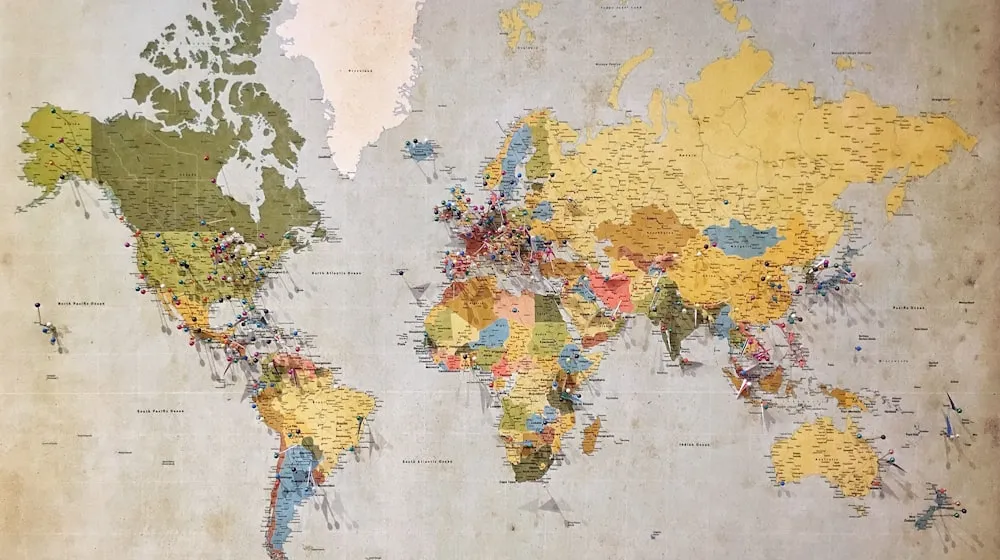
Geo targeting strategies Google Ads teams use start with listener maps and tour routing—not national defaults copied from the last artist account.
Why National Defaults Leak Music Budget
Music audiences are geographically lumpy. A breakout single might concentrate saves in Sun Belt suburbs while tour routing only covers coastal rooms. National targeting feels efficient in the setup wizard—one toggle, maximum reach—but it sends the same bid into markets with zero historical engagement, markets where the artist has never played, and markets where streaming velocity flatlined three releases ago.
Google Ads location targeting does not automatically know your fan map. The platform optimizes toward the conversion event you pay for within the geography you permit. If you permit an entire country, the algorithm will find cheap inventory wherever auction pressure is lowest—often far from your actual listener clusters. For music campaigns, that drift shows up as acceptable platform metrics with weak downstream signals: flat pre-save curves, ticket pages with traffic from states not on the routing sheet, and remarketing pools polluted by low-intent geographies.
According to Google Ads guidance on location targeting, you can target by country, region, city, postal code, radius, and custom polygon. Music buyers rarely need the full cartographic toolkit on day one—but they always need more granularity than "nationwide." The operational question is which geo layer matches the campaign objective: release discovery across proven stream clusters, ticket conversion in tour markets, or catalog maintenance in stronghold cities that anchor algorithmic playlists.
Presence vs Interest: A Music-Specific Read
Google Ads distinguishes people in your targeted location from people searching for or showing interest in your targeted location. For touring artists, "presence" usually wins for ticket and local-show campaigns—you want people physically near the venue. For streaming discovery on a new single, a blended approach can work early: presence in proven stream clusters plus interest in tour markets where you will need demand in six weeks. Document the choice in the campaign brief; account managers switching between presence and interest without telling the buyer is a classic source of inexplicable geo performance swings.
Streaming Heat Map Overlay: Build the Geo Brief
Before touching bid modifiers, assemble a fan geography brief from sources the artist already has. This is the overlay step most teams skip—and the step that separates intentional location strategy from guessing.
Data Sources for Heat Maps
Pull from Spotify for Artists audience geography first—tier cities into A (above median share), B (growth velocity), and C (fading). Cross-check Apple Music and YouTube Analytics because secondary markets differ by platform. Add CRM subscriber geos for superfan clusters, historical ticket sales for tour-weighted tiers, and prior paid social geo learnings so each channel does not rebuild geography from scratch.
Overlay Workflow
Plot Tier A and B markets onto a working map—spreadsheet columns work fine: city, state, tier, stream share, ticket history, proposed bid modifier. Compare against the tour routing CSV. Flag gaps: warm stream cities absent from routing (opportunity for geo-heavy release spend before routing expands) and routed cities with cold stream signals (need awareness creative, not ticket-heavy CTAs).
Julian Cole's overlay rule: never run a tour ticket campaign geo wider than the routing sheet without a documented reason. Never run a release prospecting campaign narrower than Tier A stream clusters unless budget is severely constrained. The overlay aligns two truths—where ears are and where feet will be—that national defaults conflate.
Third-party analytics platforms documented in the broader music streaming ecosystem can supplement first-party dashboards when label deals grant access. Treat them as validation, not replacement, for artist-owned exports.
Geo Heat Rings: Tour Radius Visualization
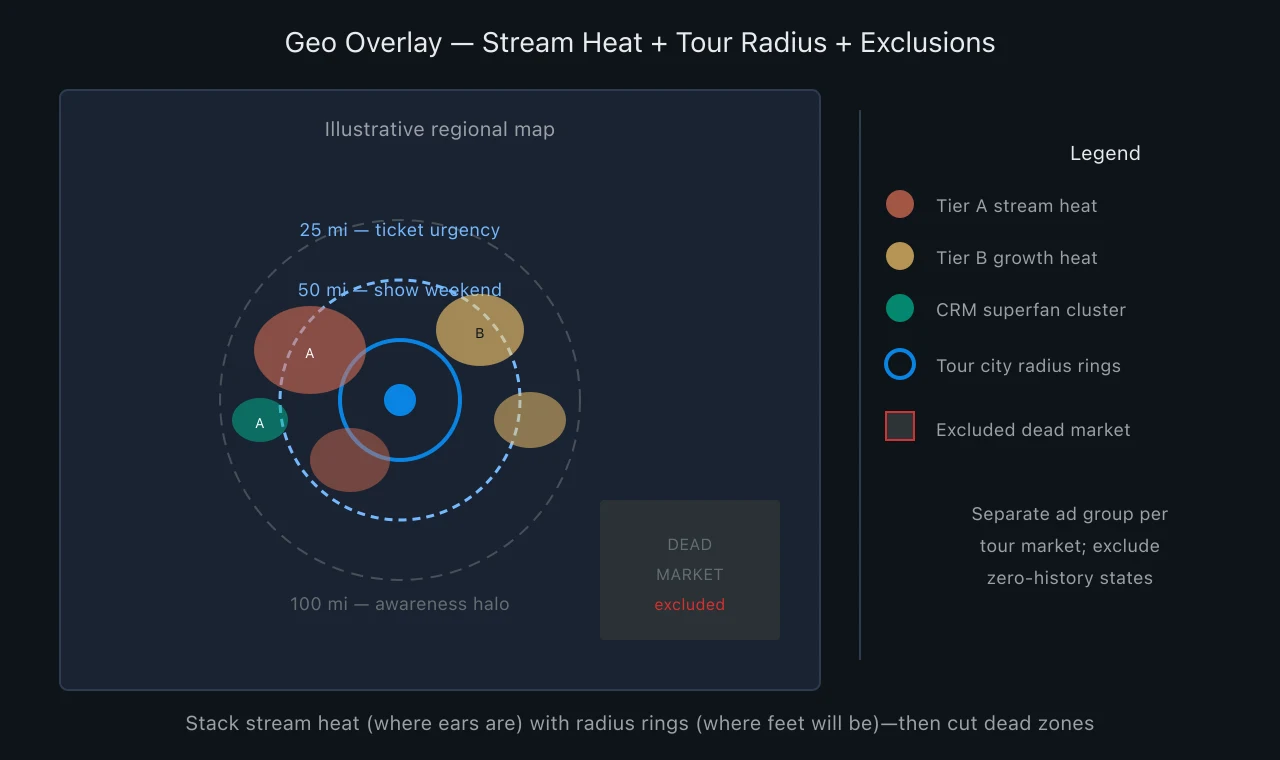
Music campaign geo heat map with tour radius rings and market exclusions
The diagram is illustrative—not a substitute for your actual map export—but the logic is stable. Heat blobs show where streaming and CRM data justify positive bid modifiers. Concentric rings around each tour city encode how aggressively you bid by distance: tight radius for ticket urgency, wider halo for awareness ahead of on-sale. Grey excluded blocks are markets with negligible stream share, no ticket history, and no strategic expansion plan. Running national campaigns without this overlay is how music accounts fund other artists' local audiences by accident.
Radius Bidding Around Tour Cities
Tour campaigns are the clearest use case for Google Ads radius targeting. Each show is a date-bound conversion event with a geographic center—the venue. Radius targeting lets you bid as if distance from the room matters, because it does.
Radius Distances by Venue Tier
Club and theater rooms (under 2,000 cap) — 25-mile core for tickets, 50-mile awareness halo, 100-mile outer ring only without a conflicting nearby date; keep outer bids negative. Arena runs — extend core to 35–50 miles and exclude non-routed coasts on regional tours. Festival one-offs — target the festival metro; exclude other tour markets that week.
Ad Group Structure per Market
One ad group per tour market when budget allows—localized copy, matching show URLs. Raise modifiers three to seven days before on-sale, taper after the first sellout wave. When stream heat and routing align, stack positive modifiers below +50% until conversion volume proves stability; cold-stream routed cities get awareness creative and conservative bids first.
Reference Google Ads bid adjustments for how percentage modifiers compound across device, audience, and location—music campaigns often run location and device modifiers together, and compounding surprises buyers who set each in isolation.
Geo Tactic → Use Case → Bid Modifier
| Geo Tactic | Use Case | Bid Modifier (Illustrative) |
|---|---|---|
| Tier A stream cluster (city target) | New single prospecting where saves historically concentrate | +15% to +30% |
| Tier B growth market (city target) | Test spend for emerging listener velocity before routing confirms | +5% to +15% |
| 25-mile tour radius core | Ticket on-sale week; venue-local urgency creative | +20% to +40% |
| 50-mile tour halo | Drive-time awareness; weekend-of-show reminders | 0% to +10% |
| 100-mile outer ring | Filler reach only when no conflicting tour date nearby | −10% to −25% |
| CRM superfan postal clusters | Retargeting and launch-week priority markets | +25% to +45% |
| State exclusion (dead market) | Zero stream share and no tour plan for 12+ months | Excluded (−100%) |
| Competitive metro exclusion | Prevent ad spend leaking into rival show same night | Excluded or −50% |
| International English-language test | Secondary territories with proven save lift on YouTube | +10% to +20% on kept geos |
| Daypart + geo stack (weekend evenings) | Youth genres in suburban stream clusters | +10% to +18% on Fri–Sun window |
Modifiers are hypothesis bands for planning—not guarantees. Google Ads applies them on top of base bids; a +30% location adjustment in a dead auction still wastes money if creative and audience layers are misaligned. Review geo performance weekly at city granularity during release and tour windows, not monthly at country rollup.
Exclusions for Dead Markets
Exclusion is the most underused geo tactic in music accounts. Buyers focus on where they want to be seen and forget to cut where history proves silence. Dead markets are not merely low-tier—they are negative-value: impressions that consume frequency caps, pollute remarketing pools, and dilute geo reporting.
Defining "Dead" for Music Campaigns
A market is dead when it fails all three checks: below-median stream share, no ticket or merch revenue in eighteen months, and no routing or promo planned within two quarters. Future routing moves a city to watch list—not Tier A.
Exclusion Mechanics
Exclude states, DMAs, or cities at campaign level. For tour flights, cut non-routed states entirely—cleaner than −90% modifiers that still earn stray impressions. Maintain a living exclusion sheet: market, date, rationale, review date. Apply dead-market cuts before launch; batch mid-learning changes once at day four if needed.
International Exclusions
Indie budgets should use country allowlists—United States, Canada, United Kingdom, Australia—not worldwide with scattered negatives. Allowlists force overlay discipline and avoid rights contexts you cannot serve.
Campaign Types and Geo Architecture
Geo strategy differs by objective—one national structure for every flight leaks efficiency.
Release Prospecting Geo
Anchor on Tier A and B stream clusters; exclude dead states. Group ad groups by region when creative references local playlist culture so reporting stays legible.
Tour Conversion Geo
Radius around venues with market-specific ad groups, conflict exclusions, and on-sale modifier ramps. Landing pages must resolve to the correct show—geo-perfect targeting still wastes spend on wrong URLs.
Catalog and Hold Geo
Narrow catalog spend to markets above your monthly-listener floor. Dead-market exclusions matter most here—do not subsidize nostalgia-free geographies.
Location Reporting Hygiene
Export location reports at city and DMA granularity weekly. Track impressions, clicks, conversions, cost, and conversion rate by location—then cross-check saves by market, ticket sales by city, and email signups when UTM discipline holds.
Flag anomalies early: spend spikes in cities with no stream history usually mean targeting drift, not breakout demand. Archive geo briefs with tiers, modifier rationale, and exclusion dates so buyer handoffs do not reopen dead markets. Julian Cole's handoff standard: undocumented geography is luck, not strategy.
Geo Test Calendar for Music Campaigns
Week zero — compile heat tiers, routing, CRM clusters, and exclusion list; assign modifiers from the tactic table. Week one — launch with exclusions locked; review location reports day four; batch ±10% modifier moves day seven only. Week two — trim failing cities; shift ten to fifteen percent budget toward Tier A clusters with save lift; ramp tour cores entering on-sale. Week three — scale proven cities if marginal CPA holds; trim outer-radius rings before core tour geos. Week four — archive exports, update dead-market sheet, clone radius ad groups for new routing instead of widening national ad groups.
FAQ: Geo Targeting Strategies Google Ads for Music
Should I start narrow or wide on geo?
Start narrow on exclusions—cut dead markets day zero—then start moderate on positive targets: Tier A and B clusters plus tour radii. Expand only from proof, not from anxiety about reach.
How many miles of radius should club shows use?
Twenty-five miles for core ticket bidding is a sane default; fifty miles for awareness. Beyond seventy-five miles for sub-2,000-cap rooms rarely pays back unless data proves drive-time behavior.
What if stream heat and ticket heat disagree?
Split objectives. Release prospecting follows stream tiers; tour campaigns follow routing and box office history. Use separate ad groups so modifiers do not fight.
Is excluding entire states too aggressive?
Not for indie budgets with clear dead zones. State exclusions simplify reporting and stop bleed. Revisit quarterly when catalog or routing changes.
Is there a cap on bid modifiers?
Platform limits apply, but operational cap matters more: avoid stacking location, device, and audience modifiers past +50% combined without conversion proof—diminishing returns and CPC spikes follow.
Presence or interest for touring campaigns?
Presence for ticket urgency near the venue. Interest can supplement early awareness in feeder cities if you lack radius coverage—document the blend and review weekly.
How do I geo-target a release with no tour announced?
Follow stream heat and CRM clusters only. Exclude dead markets. Leave tour-radius architecture dormant until routing exists—do not invent radii without a venue anchor.
Geo Targeting Strategies Summary
Geo targeting strategies Google Ads campaigns can use begin with an overlay: streaming heat maps, tour routing, and CRM clusters plotted against the same spreadsheet—not a national default carried over from the last account. Draw radius rings around tour cities with core, halo, and outer tiers; apply bid modifiers from proof, not hope; exclude dead markets before learning phase spends into silence. Separate ad groups by market, export location reports weekly, and batch geo changes so the auction can learn. Music media buyers who treat geography as a living brief—updated each release and each routing pass—buy fewer impressions in places where the artist's name means nothing and more where ears and feet already align.


