

Master license for film clearance is the step that trips student directors, brand filmmakers, and experienced supervisors alike: you can have publisher sync approval in hand and still lack rights to the actual recording heard on the master. Film and video projects need a documented master use license from whoever controls that sound recording—label, artist, estate, or distributor—before festivals, streamers, or clients accept delivery.
This walkthrough covers identification, outreach, negotiation, contracts, and delivery timelines so your project survives legal review and insurance underwriting.

Master clearance belongs on the same calendar as picture lock—not the week before export.
What a Master License for Film Means
A master use license grants permission to reproduce a specific sound recording synchronized with your film or video. It does not replace composition sync from the publisher. Film projects using original commercial recordings almost always need both.
Scope covers media types (theatrical, festival, SVOD, educational), territories, term length, promotional uses, and sometimes volume caps for ad-supported streams.
Step 1: Identify the Master Owner
Start with discography metadata: label credit on the release, distributor notice, or PRO cue sheet from a prior licensed project. Search label sync portals (Sony, UMG, Warner, indie aggregators) and rights databases like Rightsify or Songdex.
Independent artists may own masters but owe distribution exclusivity—confirm with written chain of title before paying anyone who cannot grant rights.
Ownership Red Flags
Re-recorded deluxe editions, label buyouts, and bankruptcy estates delay responses months. Flag early if the track changed hands since chart peak.
Step 2: Prepare a Clearance Brief
One page: production title, scene synopsis, duration of use, dialogue overlap, lyrics on screen, media list, territories, term, trailer needs, and rough budget. Labels prioritize professional briefs—vague student emails sink to bottom of queue.
Attach scene still or timecode clip when use is emotional or controversial; transparency speeds legal review.
Step 3: Run Parallel Sync Outreach
Contact publisher for sync while master owner researches proceed. Labels often withhold master quotes until sync path looks viable—especially for co-written songs with multiple publisher holds.
Music supervisors run both tracks simultaneously to shave weeks off sequential clearance.
Step 4: Request Master Quote
Email label sync department or artist rights contact with brief and ask for all-in vs master-only fee. Request turn-around time and required approvals (artist, estate, band members).
Quote valid thirty days standard—expired quotes restart queue during busy award seasons.
Step 5: Negotiate Scope and Fee
Reduce cost by narrowing territory, shortening term, excluding broadcast, or limiting promotional uses. Festival-only with one-year SVOD option costs less than perpetual worldwide all-media.
Most-favored-nations clauses link multiple songs—negotiate package if soundtrack carries five needle drops.
Step 6: Execute Master Use Agreement
Review grant of rights, warranties, indemnities, credit requirements, and delivery specs. Align definitions with sync agreement—mismatched SVOD definitions void one license while other appears valid.
Production counsel should countersign anything over internal risk thresholds or with personal guarantees.
Step 7: Deliver Masters and Archive
Receive broadcast-quality WAV or FLAC per technical rider. Store executed PDF, invoice, and scene map in E&O data room. Update cue sheet for PRO submission.
Never ship exhibition masters until both sync and master licenses are fully executed.
Master License Fee Ranges by Project Type
| Project Type | Obscure Indie Master | Mid-Tier Catalog | Major Hit Recording |
|---|---|---|---|
| Student / short film | $500 – $2,500 | $3,000 – $8,000 | Often declined or $15,000+ |
| Indie feature (festival) | $2,000 – $8,000 | $8,000 – $25,000 | $30,000 – $100,000+ |
| Documentary (limited run) | $1,500 – $6,000 | $6,000 – $20,000 | $25,000 – $75,000+ |
| Brand / commercial | $5,000 – $15,000 | $20,000 – $75,000 | $100,000 – $500,000+ |
| SVOD series episode | $3,000 – $12,000 | $15,000 – $50,000 | $75,000 – $250,000+ |
| Trailer (all-media) | $2,000 – $10,000 | $15,000 – $40,000 | $50,000 – $200,000+ |
Ranges are market illustrations—heritage status, exclusivity, and scene prominence move quotes outside brackets fast.
Clearance Timeline Table
| Stage | Typical Duration | What Slows It Down |
|---|---|---|
| Ownership research | 1 – 5 business days | Sampled songs, estate disputes |
| Initial quote response | 5 – 15 business days | Holiday freeze, artist approval |
| Negotiation | 3 – 10 business days | Multi-party publishers, MFN bundles |
| Contract drafting | 5 – 20 business days | Label legal backlog |
| Artist / estate sign-off | 0 – 30+ days | Touring schedule, grief protocols |
| Master file delivery | 1 – 3 business days | Archive retrieval from legacy catalog |
| Total realistic window | 3 – 8 weeks | Major hits often 10+ weeks |
Start twelve weeks before picture lock for recognizable catalog; eight weeks minimum for indie masters with responsive owners.
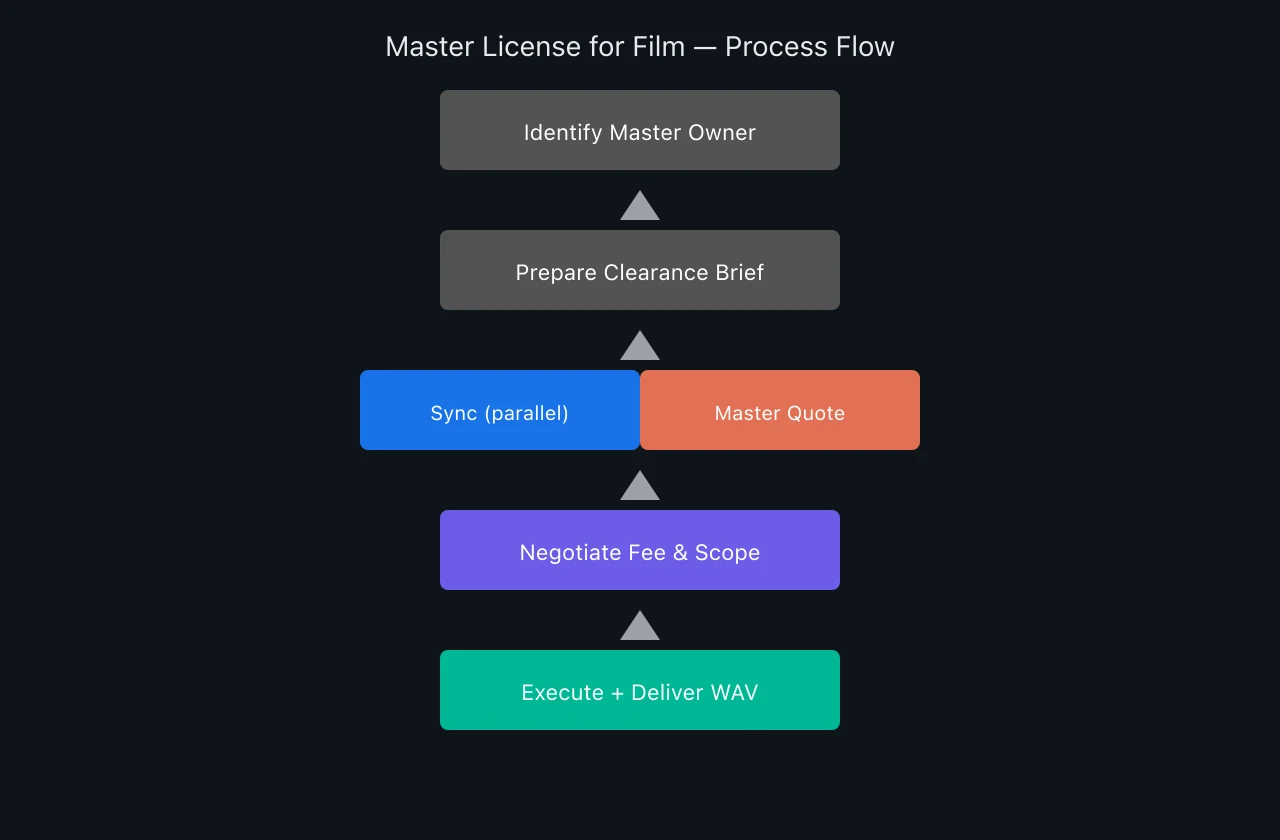
Master Clearance Process Flow
Master license for film process flow
Parallel sync and master tracks prevent sequential bottlenecks that blow festival submission deadlines.
Label Sync Portals
Major labels operate online sync intake forms with rate guidance for indie film tiers. Use portals instead of cold LinkedIn messages when available—requests enter CRM with legal routing.
Indie labels may lack portals; polite email to label manager with brief and IMDb or project link still works.
When to Re-Record Instead
If master license for film quotes exceed ten percent of total music budget, model cover session cost plus sync only. Lose sonic fingerprint, gain schedule control. Documentary and essay films use re-records routinely.
Festival Legal Review
Sundance, SXSW, TIFF, and peers request rights documentation. Missing master paperwork triggers replacement deadlines or disqualification. Upload licenses when submitting—not after acceptance.
SVOD Delivery Requirements
Netflix, Amazon, and Apple commission legal deliverables lists. Master licenses must name platform categories explicitly. Generic "all media" language from 1990s deals may fail modern SVOD riders—amend before delivery.
Trailer Separate Clearance
Trailers are promotional media. Many film master licenses exclude trailers or charge uplifts. Clear trailer uses upfront—marketing teams often cut trailers before legal finishes feature licenses.
International Distribution
Worldwide master grants cost more than U.S.-only. If sales agent sells territory by territory, structure options: festival year North America, option for EU upon deal. Saves upfront cash.
According to music supervisor practice, option structures are standard on indie features with uncertain distribution.
Estates and Legacy Catalog
Deceased artist estates route through lawyers with emotional and reputational filters. Allow extra weeks and avoid scenes with violence or politics conflicting with estate brand guidelines—even when budget is fair.
Indie Artist Direct Deals
Artists who own masters can sign directly—often faster and cheaper than label paths. Still verify no exclusive distribution deal blocks film grants. Written warranties matter for E&O.
Payment and Invoicing
Labels invoice fifty percent on signing, fifty percent on delivery—or full prepayment for indies. Wire fees and currency conversion sit on production budget. Late payment voids licenses silently until legal chases.
Credit and Promotional Obligations
Master owners may require on-screen credit, soundtrack album participation, or social mentions. Flag marketing commitments before legal execution—post-production cannot invent credit slots easily.
Errors and Omissions Insurance
E&O carriers require complete chains for every cue. Master license for film paperwork must map scene timecode to agreement exhibit. Missing pages invalidate policies at claim time.
Student Film Strategies
Ask labels about student tiers with limited festival run and no commercial SVOD. Some grant reduced fees with enrollment proof. Never assume fair use covers commercial recordings—almost never does for scored scenes.
Corporate Video Pitfalls
Internal training videos using hit recordings need master licenses too—not just YouTube Content ID luck. Corporations face higher damages; labels price accordingly.
Case Study: Documentary
A music documentary licensed a live performance recording owned by a mid-size indie label. Master license: $14,000 for North America theatrical and SVOD two years. Sync from publisher: $9,000. Total $23,000 and seven weeks—within budget because research started at rough cut, not final mix.
Case Study: Short Film
A short film chased a 90s hip-hop master. Label quoted $45,000—all media perpetual. Producer re-recorded with $5,500 session and $3,200 sync. Festival premiere proceeded; only sync credit changed. Master license for film lesson: start early enough to pivot.
Working With Artist Reps
Managers and agents accelerate responses when creative alignment benefits artist (festival prestige, brand fit). Cold legal-only emails stall. Pair creative pitch with clearance brief.
Technical Delivery Specs
Request 48kHz/24-bit WAV when mixing in theatrical 5.1 or Dolby Atmos. Lo-res MP3 temp tracks in edit bay are not delivery masters. Technical rider prevents last-minute remix.
Chain of Title Documentation
Gather: master agreement, sync agreement, assignment docs if artist bought masters back, sample clearances if applicable. Distributor legal reviewers index by scene number.
According to synchronization rights frameworks, incomplete chains are the top cause of delivery delays on licensed soundtracks.
Music Supervisor RFP Template
When hiring a supervisor, request proof of prior master license for film clearances in your budget band. RFP should list scene count, recognizable-track appetite, and re-record fallback authority. Supervisors who only handle sync leave producers holding master gaps at delivery.
Temp Track Ethics and Cost
Directors fall in love with temp tracks. Budget master license for film scenarios before picture lock—or contractually authorize re-record fallback if quotes exceed cap. Temp love without budget realism is the leading cause of festival delivery scrambles.
Crowdfunded Film Budgeting
Crowdfunded features should disclose music clearance line items in campaign pages. Backers expect recognizable songs; producers discover master fees exceed entire campaign raise. Set music expectations in crowdfunding copy: licensed score, library, or re-record—not unbudgeted heritage masters.
Archive Footage and Existing Masters
Documentaries licensing archive TV footage may embed uncleared music from original broadcast. Separate master license for film on embedded recordings from news clips—sync in footage does not transfer to your documentary distribution.
Multi-Episode and Anthology Series
Anthology series using one song across episodes need master licenses covering series-wide use or per-episode fees multiply. Negotiate series blanket when show bible repeats motif—cheaper than per-episode quotes.
Insurance Audit Pre-Delivery
Schedule E&O insurance audit four weeks before distributor delivery. Master license for film paperwork missing scene exhibits fails audit with enough lead time to re-clear or substitute cues. Last-week audit guarantees emergency re-edit.
Currency and Withholding
International label invoices may arrive in euros or pounds with withholding tax riders. Model FX and tax in master budget—not just quoted USD sync fee. Payment delays void licenses and freeze festival premieres.
FAQ: Master License for Film
Is sync enough if I already paid the publisher?
No for original recordings. Publisher sync does not grant master rights. You need a master license for film from the recording owner.
How long does master clearance take?
Plan three to eight weeks for indie catalog; ten or more for major hits requiring artist approval.
Do labels offer student discounts?
Sometimes, with festival-only scope and no commercial SVOD. Ask formally—do not rely on informal promises.
Can I avoid master license with a cover?
Yes—use a new recording you own or commission, plus composition sync. You lose the original sonic identity.
Is trailer use included in film master licenses?
Often no. Specify trailer, promotional, and clip rights explicitly in the grant.
Soundtrack Album and Mechanical Royalties
Releasing a soundtrack album with licensed masters requires separate mechanical and distribution clearances beyond film scene master license for film use. Labels may charge soundtrack album uplifts. Budget album rights during initial master negotiation—not after festival buzz requests vinyl.
Director and Producer Sign-Off Chain
Labels increasingly require director or producer confirmation that music use matches creative brief before countersigning master license. Build sign-off chain into timeline table—creative delays are legal delays.
Festival World Sales Cascade
Winning a festival premiere triggers sales agents who need worldwide master rights estimates for buyers. Secure option-priced master license for film early—buyers model MG advances assuming music costs are bounded. Unbounded temp-track love kills distribution deals.
ADR and Music Replacement Costs
Replacing uncleared music in ADR or recut sessions burns post budget faster than upfront master quotes. Model replacement editor hours at union rates when evaluating whether to pay label master fee or re-record—sometimes label fee is cheaper than re-edit labor.
Episodic Television vs Feature Film
TV episode counts multiply master license fees when deals are per-use. Features buy scene-based grants; series need per-episode or season blanket quotes. Master license for film budgeting templates do not transfer to episodic without renegotiating volume tiers with label sync desk.
Clip License and Social Cut-Downs
Marketing teams cut thirty-second social clips from licensed scenes. Master license for film grants must include social cut-down rights and platform-specific volume if clips use the same master. Trailer and clip rights are frequent uplifts—budget them in fee range table contingencies. Assume clips will be made even if the distribution agreement does not mention TikTok or Reels explicitly.
Master License for Film Summary
Securing a master license for film means identifying the recording owner, briefing professionally, running parallel sync clearance, negotiating scope against fee tables, executing aligned contracts, and delivering broadcast masters into your E&O archive. Start early, model re-record fallback, and treat master clearance as non-optional whenever the timeline plays the commercially released recording. Every week of delay narrows re-record options before delivery deadlines harden.


