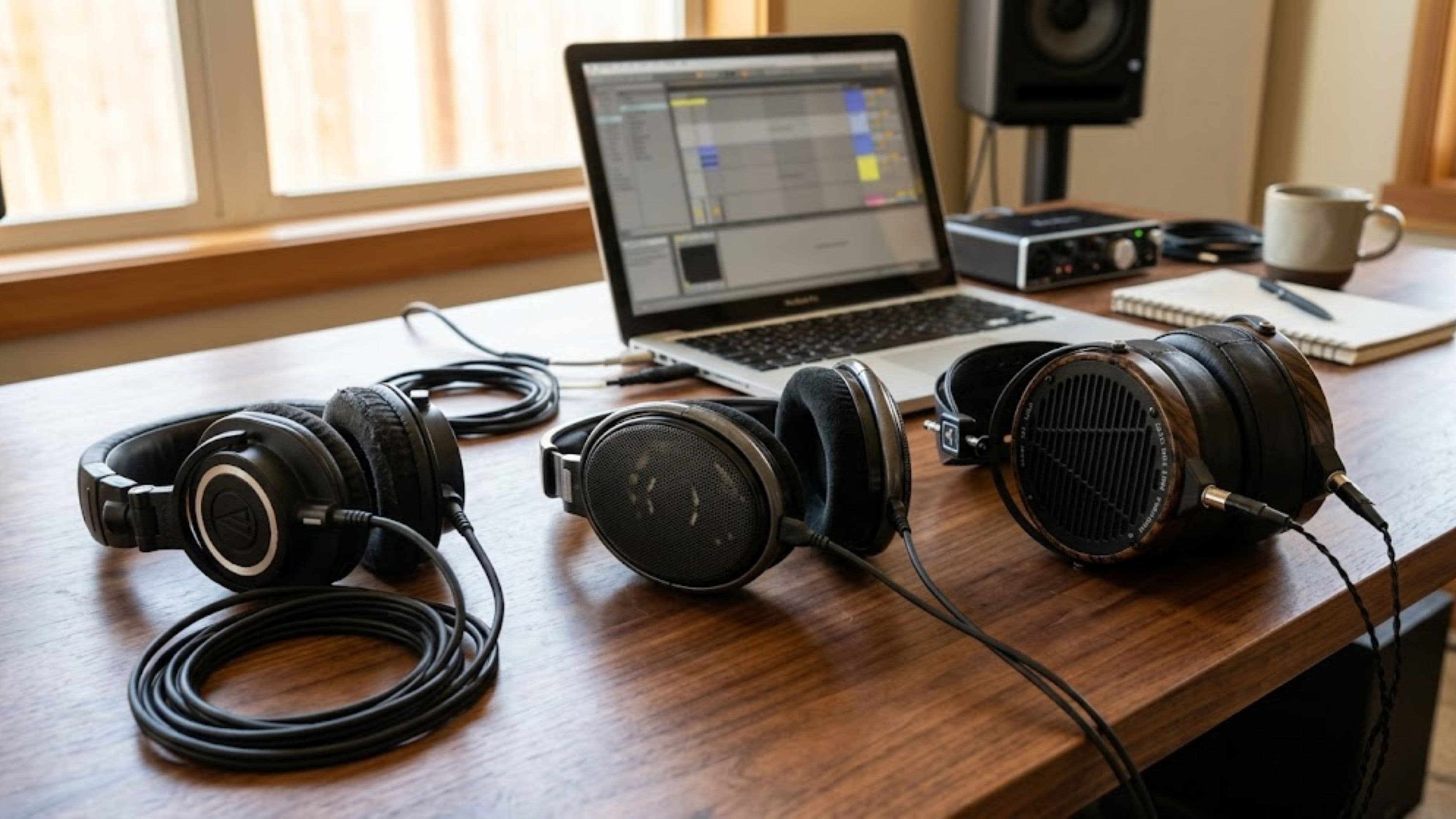
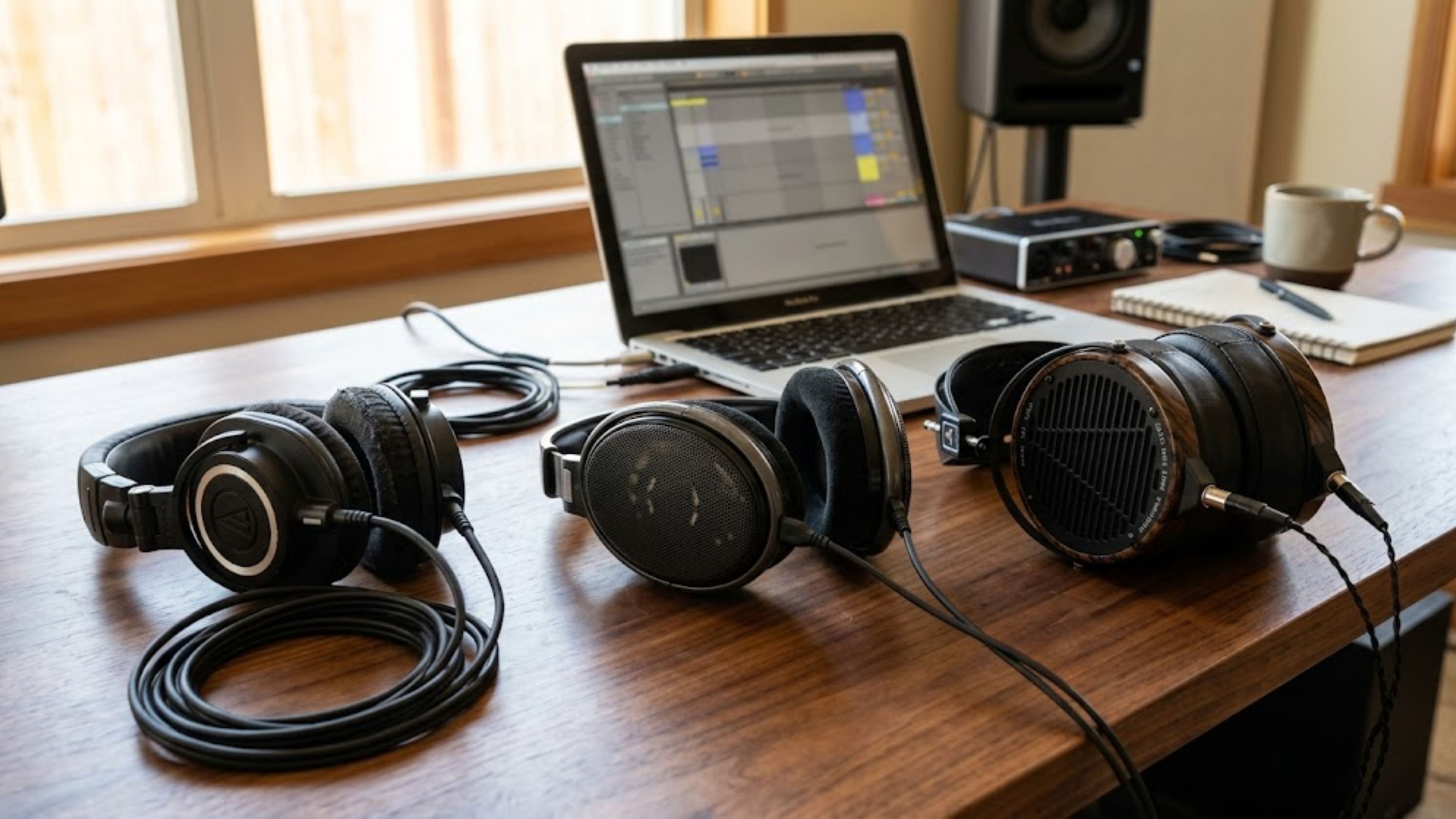
Production headphones need to be flat, detailed, and honest. Here's what's worth buying at every budget level in 2026.
What Makes a Headphone Good for Production
Before the recommendations, a quick orientation on what separates production headphones from listening headphones – because it changes how you evaluate everything.
Flat frequency response is the core requirement. A headphone that exaggerates low end or rolls off high frequencies gives you a false picture of your mix. You want headphones that reproduce the signal accurately so what you hear reflects what's actually in the audio, not what the manufacturer decided would sound appealing.
Open-back vs. closed-back is the other major decision. Open-back headphones have perforated ear cups that let air flow freely, which creates a more spacious, natural soundstage that's easier to mix on for long sessions. The trade-off is that they leak sound in both directions – you can hear the room and people nearby can hear your audio. Closed-back headphones provide isolation, which makes them better for tracking (recording while listening to a guide track) and for mixing in noisy environments. Most serious producers own both; if you're starting with one, your use case determines which to prioritize.
Driver size and impedance matter at higher price points. Higher impedance headphones (150 ohms and above) require more power to drive properly and won't perform well plugged directly into a phone or laptop – they need a dedicated headphone amplifier or audio interface with enough output power. Entry-level production headphones are typically lower impedance and work fine straight out of an interface.
Under $100: Sony MDR-7506
The Sony MDR-7506 has been a studio workhorse since 1991 and remains the most recommended closed-back headphone under $100 for good reason. You'll find these on the heads of broadcast engineers, sound mixers on film sets, and home producers worldwide. They're not glamorous and they haven't changed much aesthetically in decades – but the frequency response is honest, the detail retrieval is strong for the price, and the build is rugged enough for daily professional use.
The MDR-7506 has a slight brightness in the upper midrange and high frequencies, which actually helps with detail work – picking out sibilance in a vocal, hearing subtle reverb tails, identifying harshness in a synth patch. That brightness can cause ear fatigue over very long sessions, so they reward taking breaks rather than marathon mixing runs. The closed-back design makes them well-suited for tracking and for producers working in shared spaces.
The coiled cable is one of those things you either appreciate (it keeps tangle to a minimum on a desk) or find annoying depending on your workflow. Replacement ear pads are widely available as the originals compress over time. At under $100, this is the most reliable entry point into proper production monitoring with headphones.
Best for: Beginners, tracking sessions, mixing in noisy environments, anyone who needs a durable daily driver.
Type: Closed-back
Impedance: 63 ohms (interface or laptop friendly)
Price range: Around $80–$100
Under $150: Audio-Technica ATH-M50x
The ATH-M50x is the most widely recommended production headphone in the sub-$200 category, and it earns that reputation. It's a closed-back design with a frequency response that's significantly flatter than most consumer headphones at this price while still being detailed enough to make real mixing decisions on. The bass is present but controlled, the midrange is clear, and the high-frequency response doesn't fatigue the way some budget options do.
What separates the M50x from the MDR-7506 is its slightly warmer tonal character and its more comfortable fit for extended sessions. The rotating ear cups fold flat for portability, the build quality is solid, and it comes with three detachable cables (straight short, straight long, and coiled) which is practical. It handles both tracking and mixing comfortably, making it a versatile single-headphone option for producers who don't yet have multiple pairs.
One honest note: like most closed-back headphones, the soundstage on the M50x is narrower than open-back alternatives. Stereo placement decisions – panning, width, depth – are harder to judge accurately on closed-backs in general. If stereo mix decisions are a priority, consider pairing these with a budget open-back option rather than relying on them for all mixing work.
Best for: Home producers, singer-songwriters tracking their own sessions, producers who need versatility in one pair.
Type: Closed-back
Impedance: 38 ohms (interface or laptop friendly)
Price range: Around $130–$150
Under $200: Beyerdynamic DT 770 Pro (80 ohm)
Beyerdynamic's DT series has been a professional studio staple for decades and the DT 770 Pro represents one of the best value propositions in the closed-back category. The 80 ohm version is the right choice for home studio use – it provides enough of the DT 770's characteristic detail and soundstage without requiring a dedicated headphone amp to drive it properly.
The DT 770 Pro's standout quality is its bass response. It has a slight low-end emphasis compared to a completely flat reference headphone, but it's controlled and defined rather than bloated – the kind of bass that lets you make confident low-end decisions rather than muddying your judgment. The high frequencies are extended and detailed, which reveals elements in a mix that cheaper headphones smooth over. The velour ear pads make them noticeably more comfortable over long sessions than the leatherette pads on the Sony and Audio-Technica options.
The build is primarily plastic with metal headband reinforcement, and the non-detachable coiled cable is the one genuine design limitation – if the cable goes, repair requires sending the headphones back or DIY soldering. For producers doing mostly tracking and mixing in a fixed home studio setup, this matters less than it would in a touring context.
Best for: Producers who prioritize comfort for long sessions, anyone working heavily with electronic music and needing reliable low-end reference.
Type: Closed-back
Impedance: 80 ohms (works well with most audio interfaces)
Price range: Around $160–$180
Under $200 (Open-Back Alternative): Sennheiser HD 400 Pro
If your workflow is primarily mixing and you can record in a quiet space, the Sennheiser HD 400 Pro is the most compelling open-back option under $200 and a significant step up in soundstage accuracy over any closed-back at this price. The open-back design creates a more natural stereo image that makes panning decisions, reverb placement, and depth feel much closer to what you'd hear on a decent set of monitors.
The HD 400 Pro replaced the widely respected HD 380 Pro and brings Sennheiser's reference-grade tuning philosophy to a more accessible price point. The frequency response is genuinely flat through the critical midrange, with a slight presence lift that aids detail work without causing fatigue. The build includes swiveling ear cups, a detachable cable, and replaceable ear pads – all of which extend the practical lifespan significantly.
The limitation is what all open-back headphones share: you can hear your environment, and your environment can hear you. For tracking (recording while monitoring), open-backs are impractical – the sound from the headphones bleeds into the microphone. For dedicated mixing sessions in a quiet home studio, they're simply better than closed-backs for most people.
Best for: Mix-focused producers, anyone prioritizing accurate stereo imaging, home studios where sound isolation isn't a concern.
Type: Open-back
Impedance: 120 ohms (check your interface's output power)
Price range: Around $150–$180
Under $300: Beyerdynamic DT 990 Pro (250 ohm)
Moving into the $250–$300 range, the Beyerdynamic DT 990 Pro open-back is the most recommended step-up option for producers ready to invest in a dedicated mixing headphone. The 250 ohm version requires a proper headphone amplifier or a quality audio interface with sufficient output (Focusrite Scarlett 2i2 and above handle it well) – this is not a headphone to drive from a phone or a cheap interface.
With adequate amplification, the DT 990 Pro delivers a spacious, detailed soundstage with an extended high-frequency response that reveals mix elements that lower-tier headphones miss entirely. The slightly V-shaped frequency response (elevated bass and treble relative to the midrange) is worth knowing about – it's not perfectly flat, which means it takes some calibration time before you can trust your mix decisions. Producers who've used them for a few weeks typically develop an accurate mental map of the coloration and compensate naturally.
The velour ear pads and adjustable headband make them exceptionally comfortable for multi-hour sessions. Beyerdynamic manufactures replacement parts for the DT 990 Pro directly, which means a pair bought today can be maintained almost indefinitely.
Best for: Producers ready to invest in a dedicated open-back mixing headphone, electronic music producers, anyone with a quality interface to drive them properly.
Type: Open-back
Impedance: 250 ohms (requires quality interface or headphone amp)
Price range: Around $170–$200 (street price has dropped significantly)
Under $500: Sennheiser HD 650
The HD 650 has been a reference standard in audiophile and professional circles since its introduction in 2003. It remains one of the most transparent headphones available at any price, with a midrange reproduction that is widely considered among the most accurate in its class. For producers working in acoustic music, jazz, classical, and where midrange clarity is critical, the HD 650 represents a significant jump in mix translation over anything below $300.
The frequency response has a gentle warmth in the low midrange and a natural, non-fatiguing high end – it's not the last word in high-frequency sparkle, but it's a headphone you can mix on for hours without your ears crying. The open-back design and large velour ear pads create one of the most comfortable long-session experiences available. At 300 ohms, it needs a dedicated headphone amp to perform properly – plugging it into a laptop headphone jack undersells it significantly.
Sennheiser has released the HD 660 S and HD 660 S2 as nominal successors, but the HD 650 remains available and is often found at a lower price than its newer siblings. For the right producer, it's a long-term investment rather than a gear upgrade – a headphone that will likely outlast multiple studio setups.
Best for: Serious producers investing in long-term reference monitoring, acoustic and organic music genres, anyone pairing with a dedicated headphone amplifier.
Type: Open-back
Impedance: 300 ohms (requires dedicated headphone amp)
Price range: Around $300–$400
What to Watch Out For
Consumer headphones positioned as "studio" gear are worth approaching with skepticism. The word "studio" on a pair of headphones is not a specification – it's a marketing category. Always look for frequency response graphs from independent sources (sites like rtings.com publish detailed measurements) rather than relying on manufacturer descriptions. A graph showing a significant bass hump or recessed midrange tells you more than any product copy.
Mixing on headphones alone is a known limitation. Even the most accurate headphones create a different stereo image than speakers because each ear hears both channels simultaneously on speakers but only one channel on headphones. Important mix decisions – particularly stereo width, mono compatibility, and low-end balance – should be cross-checked on reference speakers or in a car stereo before calling a mix done.
Buying high-impedance headphones without checking your interface's output power is a common and frustrating mistake. A 250 or 300 ohm headphone driven by insufficient power sounds thin and quiet – not a faithful representation of the headphone's actual quality. Check your interface's headphone output specs before purchasing anything above 80 ohms.
FAQ
Do I need both open-back and closed-back headphones?
Ideally, yes – they serve different purposes. Closed-back for tracking (recording), open-back for mixing. If you're starting with one pair and mostly making beats or producing without live instrument recording, an open-back mixing headphone is the more useful single purchase. If you're recording vocals or instruments, closed-back comes first.
Can I mix professionally on headphones without monitors?
Many producers do, especially in the bedroom studio and electronic music space. The limitation is mix translation – headphone mixes don't always translate perfectly to speakers. Cross-checking on multiple playback systems (monitors, earbuds, car speakers, phone speakers) compensates for this significantly and is good practice regardless of your setup.
How important is a headphone amplifier?
For lower-impedance headphones (under 80 ohms), your audio interface's headphone output is typically sufficient. For 150 ohms and above, a dedicated amp makes a noticeable difference. For 250–300 ohm headphones, it's essentially required to hear what the headphone is actually capable of.
Are wireless headphones usable for music production?
Not for critical monitoring. Bluetooth audio introduces latency and compression artifacts that interfere with both tracking (the delay makes monitoring uncomfortable) and mixing (the compression changes what you're hearing). Wired headphones remain the standard for production work.
How do I know if my headphone mix will translate to other systems?
Cross-check on as many different playback systems as you can – reference monitors, earbuds, laptop speakers, a car stereo, a Bluetooth speaker. If it sounds good on all of them, your mix is translating. The more different systems you reference on, the more confident you can be in the result.
📚 Sources
Beyerdynamic – "DT 770 PRO" – beyerdynamic.com https://www.beyerdynamic.com/dt-770-pro.html
Sennheiser – "HD 650" – sennheiser.com https://www.sennheiser.com/en-us/catalog/products/headphones/hd-650/hd-650-506502
Audio-Technica – "ATH-M50x" – audio-technica.com https://www.audio-technica.com/en-us/ath-m50x
Sony – "MDR-7506" – pro.sony https://pro.sony/ue_US/products/headphones/mdr-7506
RTINGS – "Headphone Measurement Methodology" – rtings.com https://www.rtings.com/headphones/tests/sound-quality/frequency-response
Sennheiser – "HD 400 Pro" – sennheiser.com https://www.sennheiser.com/en-us/catalog/products/headphones/hd-400-pro/hd-400-pro-509182