

Most music blogs treat keyword research like a set list: pick ten obvious titles, publish, hope AdSense notices. That workflow ignores the ledger—the running account of which search phrases carry high CPC keywords music production advertisers actually bid on, and which queries only ever attract informational curiosity with pennies on the click.
This article is that ledger. Not a gear roundup, not a tour ops playbook. A commercial intent map for publishers who want music blogs monetization to reflect buyer psychology: plugin trials, DAW crossgrades, interface comparisons, and course enrollments that move real budgets—not passive readers hunting free presets.

A keyword ledger tracks intent and bid pressure—not vanity traffic totals.
The Ledger Method: Intent Before Volume
Traditional SEO dashboards rank opportunities by monthly search volume. Music production monetization inverts the priority: start with cost-per-click signals and commercial proximity, then filter for rankability. A query with 800 monthly searches and a $4.50 illustrative CPC in the plugin category often out-earns a 12,000-volume tutorial phrase where display RPM flatlines because no one is buying.
The ledger has four columns every strategist should maintain: cluster (plugin, DAW, gear, education), intent label (transactional, commercial investigation, informational-commercial hybrid), illustrative CPC band (disclosed as composite 2026 ranges—not scraped auction data), and monetization fit (AdSense display, affiliate, hybrid). Update quarterly; bid landscapes shift when retailers run Black Friday plugin sales or when a major DAW releases a version bump.
According to Google Ads guidance on keyword match types, advertisers segment queries by purchase stage. Your content calendar should mirror that segmentation instead of publishing another undifferentiated "mixing tips" post that never intersects a shopping cart.
Commercial vs Informational Intent in Production Search
Informational intent answers how without implying which product. "What is sidechain compression" sits here. Readers learn; advertisers for premium bus compressors rarely pay aggressive CPCs because the query does not signal imminent purchase. These pages still build topical authority and internal link equity—ledger them as support assets, not primary revenue drivers.
Commercial investigation sits mid-funnel: "FabFilter Pro-Q 3 vs Pro-Q 4," "best audio interface under $500," "Ableton vs FL Studio for hip hop." Searchers compare before spending. Affiliate programs and comparison ad units thrive here because the audience self-identifies as buyers-in-waiting. Illustrative CPC bands for strong commercial-investigation phrases in the production niche often land between $1.80 and $6.50—higher when the query names a specific SKU or price ceiling.
Transactional intent is bottom-funnel: "buy UAD Spark subscription," "Plugin Boutique coupon code," "Native Instruments Komplete sale." Volumes shrink; CPC and conversion rates spike. Retailers bid hard because the click is one step from checkout. Music blogs that rank transactional terms need crisp disclosure and deep-link accuracy—stale coupon posts erode trust faster than in generic lifestyle niches.
A practical split for mature production blogs: forty percent commercial investigation, twenty-five percent informational-commercial hybrids (tutorials that naturally embed one recommended tool), twenty percent pure informational for authority, fifteen percent seasonal or deal-led transactional captures during sale windows.
Keyword Intent Funnel: Where CPC Pressure Peaks
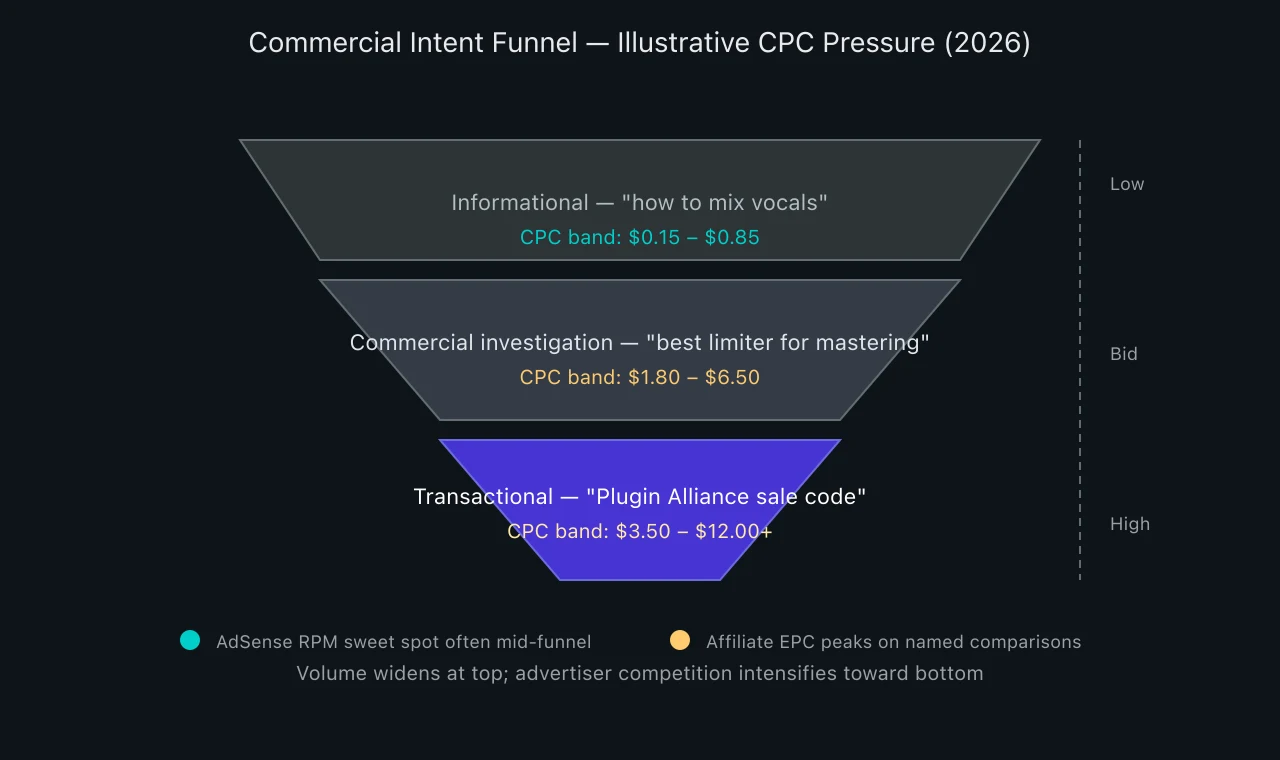
Music production keyword intent funnel with illustrative CPC bands
The funnel is illustrative—your ledger should plot actual phrases you can rank, not abstract tiers. Notice the asymmetry: mid-funnel comparisons often deliver the best blended RPM for music blogs because they combine display ads from multiple competing vendors with affiliate deep links.
High-CPC Keyword Clusters: Illustrative Ledger Entries
The table below lists composite cluster patterns observed across production-adjacent publishing and ad-auction tooling in 2025–2026 cycles. Figures are illustrative bands for planning—not claims of live bid exports from any single account.
| Cluster | Example Query Pattern | Intent Label | Illustrative CPC (USD) | Monetization Fit |
|---|---|---|---|---|
| Plugin — channel strip | "best SSL bus compressor plugin" | Commercial investigation | $3.20 – $7.80 | Affiliate + display |
| Plugin — subscription | "UAD Spark vs Plugin Alliance bundle" | Commercial investigation | $2.90 – $6.10 | Affiliate comparison |
| DAW — crossgrade | "Ableton Live upgrade price from Intro" | Transactional lean | $4.00 – $9.50 | Vendor affiliate |
| DAW — genre fit | "best DAW for electronic music 2026" | Commercial investigation | $2.10 – $5.40 | Hybrid |
| Gear — interface | "best audio interface for home studio" | Commercial investigation | $2.50 – $8.20 | Retail affiliate |
| Gear — monitoring | "KRK vs Yamaha HS5 for mixing" | Commercial investigation | $1.90 – $5.60 | Hybrid |
| Education — course | "online mixing masterclass worth it" | Informational-commercial | $2.80 – $7.00 | Course affiliate |
| Education — certification | "audio engineering certificate online cost" | Transactional lean | $5.50 – $14.00 | Lead-gen / affiliate |
| Deal — seasonal | "Black Friday plugin deals list" | Transactional | $3.80 – $11.50 | Marketplace affiliate |
| Utility — metering | "Youlean loudness meter alternative paid" | Commercial investigation | $1.40 – $4.20 | Display + affiliate |
Ledger discipline: when a cluster's illustrative CPC band drops below your target floor for two consecutive quarters, demote it in the content queue unless it feeds a high-converting affiliate SKU you can prove with EPC data.
Plugin, DAW, and Gear Cluster Anatomy
Plugin clusters fragment by processor type and by brand specificity. Generic "best reverb plugin" queries attract wide competition from major retailers and YouTube creators; CPC stays moderate. Named-product comparisons—"Ozone 12 vs Pro-L 2"—narrow the bidder pool to vendors with SKUs in the ring, which can raise effective CPC while shrinking volume. Your ledger should track both variants under one cluster with sub-tags.
DAW keywords behave differently. Switching costs are high; readers research for weeks. Crossgrade and upgrade-price queries carry transactional lean even when the phrasing sounds informational. According to digital audio workstation market structure, a handful of platforms dominate mindshare—meaning "best DAW" listicles face entrenched SERPs but still attract mid-funnel ad spend from vendors protecting category share.
Gear clusters split into USB interfaces, microphones, monitors, and control surfaces. Interface queries consistently show strong CPC because average order values exceed plugin carts. Microphone content can monetize well when queries include use-case modifiers—"podcast," "vocals," "streaming"—that signal kit-build intent rather than academic curiosity about polar patterns.
Cluster Overlap Traps
Avoid cannibalizing your own ledger by publishing five posts targeting "best audio interface" variants without distinct angles. Merge overlapping entries into one definitive comparison with satellite posts for price tiers ($200, $500, $1000) so each URL maps to a defensible intent label.
Course Keywords and Education Bid Dynamics
Production education is a parallel auction market. Bootcamps, university extensions, and creator-led memberships bid on phrases that sound like product reviews: "mixing course for beginners," "mastering class online," "learn Ableton fast." Illustrative CPC bands run higher than generic tutorial queries because customer lifetime value justifies aggressive lead acquisition.
Informational-commercial hybrids dominate here. Searchers ask whether a course is "worth it"—a skepticism signal that converts well when your content names curriculum modules, refund windows, and prerequisite skill levels. Pure transactional course keywords ("enroll in XYZ academy") are scarce; capture them in landing pages linked from comparison posts rather than forcing blog tone into sales-copy shape.
Affiliate fit is strong when programs pay on first enrollment with 30–90 day cookies; ledger those separately from AdSense-only informational pages. Education advertisers also buy display across production blogs during January and September enrollment spikes—calendar those windows in your commercial intent map.
"Best X for Y" Patterns That Attract Bids
The "best X for Y" template is the workhorse of commercial investigation SEO—and the phrase shape advertisers mirror in paid search. In music production, the Y modifier determines CPC more than the X product category. "Best compressor" is crowded; "best compressor for drill vocals" narrows audience and often raises relevance scores for niche plugin makers willing to bid.
Strong Y-modifiers for ledger entries: genre (hip hop, metal, ambient), workflow (podcast, live stream, film scoring), environment (home studio, bedroom, mobile), and skill tier (beginner, professional mastering). Weak modifiers—"2026," "free," "cheap"—shift intent. "Best free EQ" pulls freeware hunters; CPC and affiliate EPC typically underperform paid-SKU comparisons unless you monetize upsell paths honestly.
Structure these posts as decision matrices, not ranked hype lists. Tables with intent-aligned columns (use case, CPU load, sale frequency, learning curve) match how commercial searchers scan SERPs and how structured data rich results extract comparable attributes.
SERP Features and CPC Reality
High CPC in a keyword tool does not guarantee high RPM on your URL. SERP features intercept clicks: featured snippets, People Also Ask boxes, video carousels dominated by long-form YouTube reviews, and retailer sitelinks for branded queries. Ledger each target keyword's SERP layout before writing—if the first screen is entirely video, your blog post competes for residual clicks unless you embed complementary media.
Shopping and product panels appear on gear-heavy queries, pushing organic results below the fold. That compression can lower AdSense impressions per visit even when CPC benchmarks look attractive—track revenue per thousand impressions (RPM) at the page level, not keyword tool exports alone.
AI Overviews and summarization layers add volatility in 2026. Defensive strategy: target queries where your first-hand signal-path tests, downloadable presets, or session screenshots supply experiential detail summarizers struggle to replicate—protecting click-through on high-CPC clusters you already rank for.
CPC vs Competition: Where to Publish Next
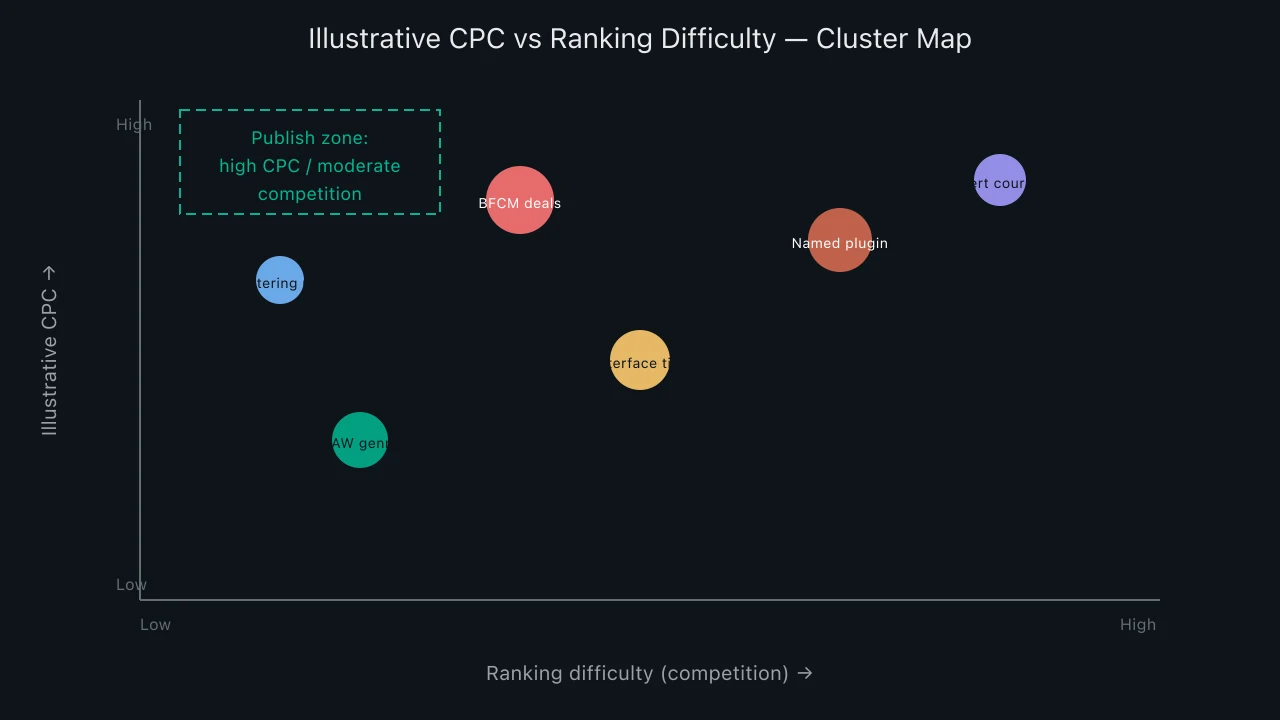
CPC versus competition scatter for production keyword clusters
The scatter map is a prioritization lens, not a data feed. Clusters landing in the upper-left quadrant—healthy illustrative CPC, moderate competition—deserve draft slots first. Upper-right clusters (certification courses, flagship plugin versus-plugin battles) may require link equity or expert authorship before they move.
Content Gap Mining From the Ledger
Gap mining starts by exporting competitor URLs that rank for your target cluster, then diffing their headings against your ledger entries. Tools in the Ahrefs, Semrush, and Moz ecosystems surface "missing" keywords; interpret results through intent labels, not raw export lists. A gap keyword with high volume but informational intent belongs in the support tier—not your monetization core.
Forum threads on Gearspace, VI-Control, and subreddits like r/audioengineering reveal pre-search language: how buyers phrase friction ("CPU hungry," "ilok headache," "apple silicon native"). Mapping that vernacular to commercial investigation queries produces titles competitors' keyword tools under-report.
Refresh gaps quarterly. Plugin version bumps orphan old comparison posts; your ledger should flag URLs whose target SKUs were discontinued or renamed, triggering updates before CPC-rich rankings decay.
AdSense vs Affiliate Keyword Fit
AdSense rewards pages where multiple advertisers bid across a session—broad commercial investigation posts with diverse display demand. Affiliate rewards pages where one clear SKU path converts—named reviews with deep links and proof-of-use screenshots. The ledger column "monetization fit" prevents forcing affiliate links onto informational queries where readers resent the pitch and EPC flatlines.
Hybrid pages work when structure separates layers: educational walkthrough up top, comparison table mid-page, affiliate disclosure adjacent to actionable buy modules. Avoid stacking five unrelated program links; match one primary affiliate path to the dominant intent label.
RPM from Google AdSense fluctuates with geography and season; US and UK traffic on gear comparisons typically outperforms global tutorial traffic on pure mixing theory. Tag ledger entries by primary geo if your analytics show skew—some high-CPC US keywords underperform when majority traffic arrives from regions with lower display bids.
Seasonal Spikes: BFCM and Plugin Sale Cycles
Black Friday and Cyber Monday reshape the production keyword ledger every November. Transactional and deal-led queries—"plugin sale," "50 off FabFilter," "Komplete upgrade sale"—see illustrative CPC and search volume spikes of 200–400 percent versus Q2 baselines in composite retail cycles. Publishers who pre-publish comparison and wishlist content three weeks before doors open capture cookies and rankings before SERPs saturate.
Secondary spikes cluster around NAMM announcements, major dot-release launches, and retailer-specific events (Plugin Boutique birthday sales, Summer of Sound). Ledger these as seasonal overlays on evergreen clusters rather than one-off posts disconnected from your comparison hub.
Post-sale content matters: "was X worth it" retrospectives and "what we bought" debriefs ride informational-commercial intent while audiences still have buyer's remorse energy—affiliate return windows and upsell paths stay active.
Ledger Maintenance Workflow
Assign one row per URL in your CMS mirror of the keyword ledger: target cluster, intent label, illustrative CPC at time of publish, affiliate programs linked, last SERP check date, and RPM or EPC trailing ninety days. Monthly, reconcile tool estimates with actual analytics—keyword tools lie kindly; your bank account does not.
When a post exceeds RPM threshold, clone its intent pattern—not its exact keyword—into adjacent clusters. When it underperforms despite high illustrative CPC, audit SERP features, page speed, and disclosure placement before abandoning the cluster entirely.
Questions Strategists Ask the Ledger
Why does my ledger show high illustrative CPC but the post earns little?
Usually SERP interception (video carousel, snippets), geo mismatch, or intent mislabeling—you published informational depth on a query Google classifies as transactional, splitting relevance signals. Re-read the live SERP and align format.
Should informational clusters stay in the ledger at all?
Yes, as support assets with explicit zero-CPC-revenue expectations unless display RPM surprises you. They feed internal links into commercial investigation hubs—the ledger tracks portfolio value, not isolated page RPM.
Is one cluster enough to sustain music blogs monetization?
Rarely. Plugin-only blogs miss interface sale seasons; gear-only blogs miss course enrollment spikes. Diversify across three clusters minimum while keeping intent labels strict per URL.
Keyword tools disagree on CPC— which number goes in the ledger?
Record a band, not a point estimate. Note source and date. Reconcile quarterly against page-level RPM; over time your first-party data outweighs any third-party export.
When should BFCM ledger entries go live?
Three weeks before major retailer teases, with updates on cart links and pricing disclaimers weekly through Cyber Monday. Early publication captures rising bid pressure and affiliate cookie windows before creator SERPs clog.
Find High CPC Keywords Music Production Blogs Need Now — Summary
High CPC keywords music production publishers should target live in commercial investigation and transactional-lean clusters—plugin comparisons, DAW upgrade paths, tiered gear guides, course-worth-it reviews, and seasonal deal hubs—not in volume-chasing tutorial head terms alone. The keyword ledger framing forces intent labels, illustrative CPC bands, and monetization fit before anyone writes a headline.
Build the funnel and scatter views into your planning rhythm, mine gaps with forum vernacular and SERP reality checks, split AdSense breadth from affiliate depth, and overlay Black Friday plugin sales spikes as calendar events—not surprises. Music blogs monetization that respects buyer psychology outlasts another generic gear list that ranks without earning.


