

Master use vs sync license confuses filmmakers, ad producers, and first-time music supervisors because both permissions touch recorded music—but they govern different rights, different owners, and different paychecks. Mixing them up produces cleared compositions with uncleared masters, or paid labels with angry publishers. This guide separates the two licenses in plain language so you can plan clearance before picture lock.
This article is educational information, not legal advice. Consult a qualified attorney for your specific project.

Two licenses, two owners—budget and timeline both depend on getting this right.
Two Sides of One Song
Every commercial recording carries two copyrights: the musical composition (lyrics, melody, arrangement) and the sound recording (the specific master). A sync license covers composition use timed to picture. A master use license covers the particular recording you hear on the track.
You often need both. Clearing the composition via sync does not automatically clear the master owned by the label or recording artist.
Master Use vs Sync: Side-by-Side Table
| Dimension | Sync License | Master Use License |
|---|---|---|
| What it covers | Composition: melody, lyrics, arrangement | Sound recording: specific master |
| Typical licensor | Publisher, songwriter | Record label, artist, master owner |
| Common use | Film, TV, ads, games, trailers | Same—when you use the original recording |
| Alternative if declined | Re-record (new master) with sync only | Cannot use that recording; need different master |
| Fee drivers | Scene importance, territory, term, media | Artist profile, label policy, exclusivity |
| Collection overlap | PROs handle performance; sync is separate | Master fees are private deals |
| Written form | Sync license agreement with publisher | Master use license with master owner |
Using a cover recording still requires sync for the composition; it does not require the original label's master use license.
Who Owns What: Rights Diagram
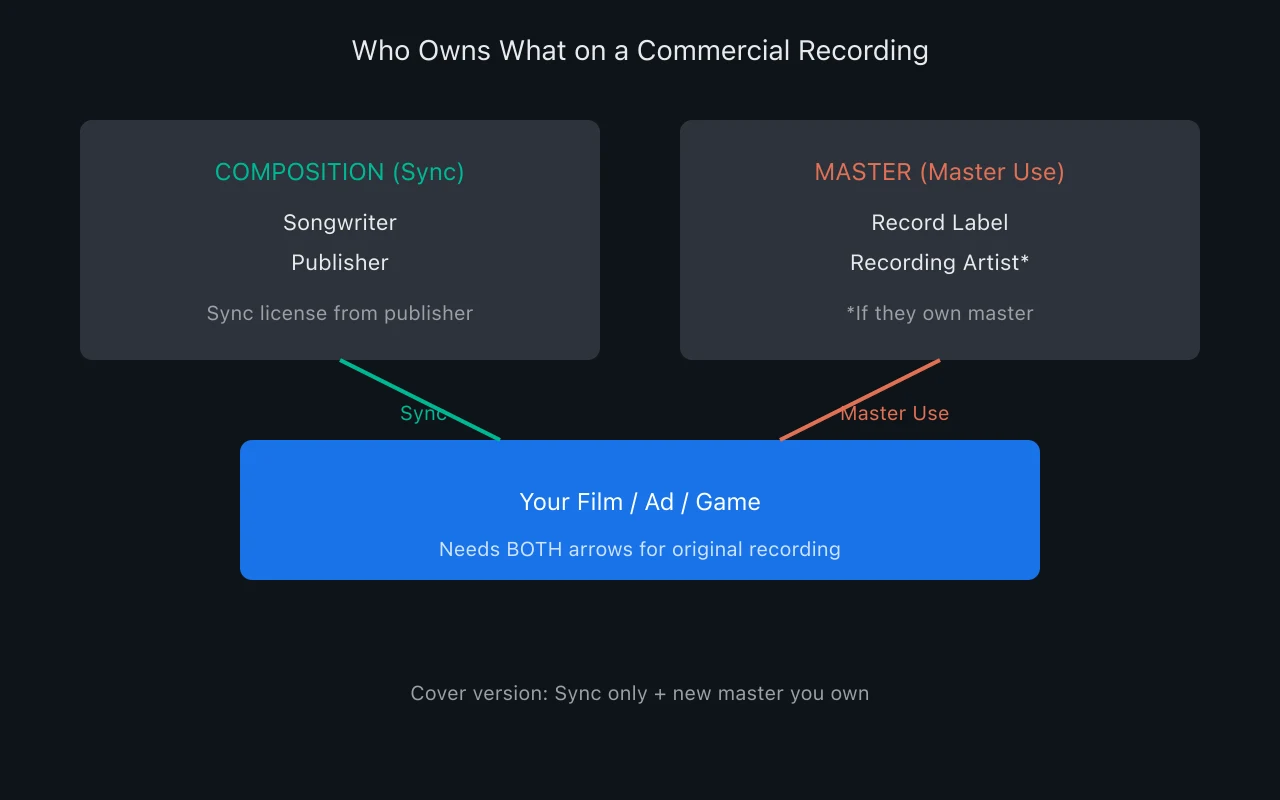
Master use vs sync ownership diagram
Independent artists who own both sides simplify clearance into one conversation—but splits and co-writers still multiply contacts.
Sync License Deep Dive
A synchronization license grants the right to fix a composition to moving images or timed media. Scope includes media type (theatrical, streaming, broadcast), territory, term, advertising window, and whether uses are in-context or in-trailer.
Publishers issue sync licenses on behalf of songwriters. Co-written songs may require 100% approval across publishers—one holdout blocks the deal.
Sync Fee Components
Fees rise with scene prominence, brand category, worldwide scope, and perpetual term. A background diner scene costs less than a trailer centerpiece. Most-favored-nations clauses link multiple songs in one deal.
Master Use License Deep Dive
Master use licenses permission to reproduce a specific sound recording in your project. Labels negotiate from rate cards influenced by artist tier, campaign size, and whether the master is a heritage catalog track.
Some independents own their masters outright; others owe label approval even when artists initiate contact. Always confirm master ownership in writing before assuming artist consent suffices.
Master Fee Components
Master fees often mirror or exceed sync fees for major-label hits. Packages may bundle both sides through label sync departments acting as one-stop shops—still two rights, one invoice.
When You Need Only Sync
Commission a new recording—a cover session—or use library music you already own. Pay composition sync to the publisher (or license a re-recording track from a production music library) and skip third-party master owners.
Documentary budgets and student films often cover because session costs beat heritage master quotes.
When You Need Both
Any use of the commercially released recording—the Spotify version, the famous album cut—requires master use plus sync. Advertisers chasing instant recognition rarely accept cover substitutes.
Trailers frequently need both even when the film later substitutes score; trailer masters are separate clearances.
Clearance Workflow Steps
Start clearance the day you shortlist songs—never the week before delivery. Professional workflow:
Step 1: Spotting Session
Music supervisor and director mark temp tracks with scene IDs, duration, lyrics on screen, and commercial context (theatrical vs streaming-only).
Step 2: Rights Research
Identify publishers via PRO databases (ASCAP, BMI, SESAC, PRS) and masters via label, distributor, or artist rights databases.
Step 3: Quote Requests
Send one-page clearance brief: project type, scene description, term, territory, media, option periods, and budget range.
Step 4: Negotiation
Negotiate sync and master fees in parallel. Label may condition master approval on sync being settled first.
Step 5: Contracts
Execute sync agreement with publisher and master use agreement with label or artist. Align definitions of media, term, and promotional uses.
Step 6: Delivery
Receive high-resolution masters and cue sheets for PRO reporting. File fully executed PDFs with production counsel.
Common Clearance Failures
Teams clear sync from a friendly songwriter while forgetting label owns master. Teams clear U.S. sync while master license excludes Canada. Teams clear in-context film use but trailer promotes streaming service—outside grant.
Each failure triggers takedowns, failed E&O insurance, or last-minute re-edits costing more than upfront quotes.
Budgeting Both Licenses
Indie films often budget $5,000–$25,000 per needle drop for recognizable catalog. Major brand ads run six to seven figures combined. Documentary and student projects pursue reduced tiers with limited media and term.
According to synchronization rights practice, sync and master fees are market-driven—not statutory—so quotes vary wildly by song.
One-Stop Shops
Labels with publishing affiliates may offer one-stop clearance—both rights in one deal. Indie artists who retained both sides can one-stop themselves. Verify each co-writer and sample clearance before relying on one-stop claims.
Re-Recording Strategy
When master use quotes exceed budget, re-record after securing sync (or public domain / original composition). You lose sonic familiarity but gain control. Some ads intentionally use sound-alike aesthetics to evoke era without heritage fees.
Samples and Interpolations
Samples require clearance of underlying composition and sampled master—often a third layer. Interpolations need sync for the melodic fragment. Master use vs sync license framing still applies; sample deals add publishing splits and producer approvals.
International Territory Gaps
U.S. sync does not cover German broadcast if territory clause excludes EU. Master owners may restrict China while publisher grants worldwide sync—legal conflict you must resolve before shipping.
Union and Re-Recording Rules
Some sound recordings involve union musicians with reuse fees separate from master use licenses. Factor AFM or equivalent reuse when budgeting re-records and samples.
Cue Sheets and PRO Reporting
After clearance, cue sheets list composition shares for performance royalties. Master use fees are typically buyouts for the licensed window—performances in theaters still generate PRO money to songwriters, not extra master payments.
Errors and Omissions Insurance
Distributors require E&O policies proving chain of title. Missing master use paperwork voids coverage. Store licenses in production data rooms with scene mapping.
Indie Film Case Study
A festival film used a cult indie song: publisher granted $8,000 sync for North America streaming and limited theatrical; label wanted $22,000 master use. Total $30,000—forty percent of music budget. They re-recorded with $6,000 session and $4,000 sync, saving $20,000 and ten days negotiation.
Brand Campaign Case Study
A sportswear brand needed original recording for global TV and social. Label packaged master and sync at $450,000 with six-week window and athlete tie-in. Cover was non-starter—brand equity required recognizable hook. Master use drove price; sync was secondary.
Video Games and Interactive
Games often need broader interactive rights than film. Publishers add game riders to sync; master owners add platform volume tiers. Treat games as separate media in both licenses.
Podcast and Short-Form Note
Most podcast beds use production music—not commercial masters—avoiding master use entirely. Short-form social may still need both if you drop recognizable recordings under branded content.
Checklist Before Picture Lock
Confirm: both licenses executed, territories match distribution plan, term covers SVOD windows, promotional uses defined, high-res masters delivered, cue sheet drafted, E&O file updated. Picture lock with temp tracks still in timeline is a liability.
Working With Music Supervisors
Experienced supervisors quote master use vs sync license scenarios early—preventing director love affairs with unaffordable tracks. Pay supervisor fees to save multiples in overrun clearance.
According to music supervisor workflows, parallel publisher and label outreach shaves weeks off sequential chasing.
Work Made for Hire Clarification
Session musicians and work-for-hire producers do not automatically grant master use to your film. The label or commissioning party owns the master unless contracts say otherwise. Master use vs sync license confusion extends inward—verify production agreements on scores commissioned for your project.
Public Domain Recordings Trap
Compositions can enter public domain while commercially released masters remain protected. Using a 1920s melody from a 1998 remaster still needs master use for that remaster. Educational guides on master use vs sync license must emphasize both sides of the copyright split.
Advertising Indemnity Clauses
Brand campaigns face higher indemnity exposure. Publishers and labels may require marketing approval rights over scene context—alcohol, politics, competitors. Sync and master agreements should list prohibited category adjacencies before shoot—not during legal review of rough cut.
Step-Off and Option Periods
Films option master and sync rights in phases: festival year, then SVOD step-up fee if distribution deal lands. Master use vs sync license negotiations both support option structures—useful when producer lacks upfront cash for perpetual worldwide grants.
Library Music Alternative Path
Production music libraries grant sync and master in one license for library recordings. You avoid separate publisher and label negotiations. Trade-off: no iconic hook recognition. Documentary and corporate producers choose libraries precisely to collapse master use vs sync license into one invoice.
Cue Sheet Timing vs Payment
PRO cue sheets report compositions for performance royalties; they do not replace sync or master upfront fees. Some producers confuse backend PRO money with clearance—songwriters earn performance share while you still pay sync and master for use.
Legal Review Budget Line
Budget entertainment counsel hours to review both agreements. Mismatched media definitions between sync and master licenses create coverage gaps E&O carriers detect. Couple hundred dollars of lawyer time prevents six-figure delivery delays.
FAQ: Master Use vs Sync License
What is the simple difference?
Sync = composition rights. Master use = specific recording rights. Original recording needs both.
Does a cover version need master use?
Not for the original label's master—you use your new master. You still need sync permission for the composition unless public domain.
Which license usually costs more?
For hit recordings, master use often matches or exceeds sync. For obscure masters, sync may dominate if publisher is difficult.
If my film streams on Netflix, is that covered?
Only if sync and master licenses list SVOD/streaming media and required territories. Broadcast-only grants fail streaming distribution.
The artist says they own the master—is that enough?
Get written confirmation and check label agreements. Distributor contracts sometimes encumber masters artists thought they owned.
Moral Rights and Integrity Considerations
Some territories recognize moral rights limiting how compositions appear—distortion, juxtaposition with violence. Sync licenses may address integrity; master owners may add approval rights over scene context. International distribution amplifies moral-rights exposure beyond U.S.-centric clearance habits.
Digital Download vs Streaming Grants
Older sync and master agreements drafted before SVOD dominance may grant DVD and download only. Modern master use vs sync license packages must enumerate streaming, clip, and social cutdown rights explicitly—legacy language fails distributor legal review.
Metadata and ISRC Hygiene
Incorrect ISRCs split streams across duplicate recordings, corrupting both sync and master royalty trails. Before any clearance conversation, verify U.S. and international ISRC on the master you intend to license. Master use vs sync license paperwork references specific recordings—wrong metadata invalidates grants.
Union New-Use Fees on Reissues
Reissued masters involving union session players may trigger new-use fees when licensed to film—even if master owner grants clearance. Factor AFM and counterpart obligations into total cost alongside sync and master publisher-label fees.
Co-Writer Approval Bottlenecks
Songs with four writers across three publishers multiply sync signatories. One holdout blocks master deals because labels refuse to grant recording use when composition clearance uncertain. Master use vs sync license timelines should track publisher responses in parallel spreadsheets—sequential chasing adds weeks.
Title Sequence vs End Credits
Title sequence uses often command premium sync and master fees—higher visibility, longer duration, promotional centrality. End-credit needle drops may price lower with narrower promotional rights. Specify placement in clearance brief when negotiating master use vs sync license bundles. Opening-title prominence is the most expensive thirty seconds in many indie film music budgets.
Delivery Legal Hold
After executing both sync and master use agreements, place files on legal hold until distributor acceptance. Post-delivery edits that change scene context may require amendment riders. Master use vs sync license maintenance does not end at signature—it tracks picture changes through final IMF or ProRes delivery.
Master Use vs Sync License Summary
Master use vs sync license is not semantic trivia—it is the clearance spine of any project using commercial music. Map owners with the comparison table, visualize the split with the rights diagram, run the six-step workflow, and budget both sides before directors fall in love with temp tracks you cannot afford. Treat clearance as production infrastructure equal to camera and insurance—not post-production paperwork.


