

Music distributor royalty fees rarely appear as a single line item on your statement. They arrive as distribution percentages, processing surcharges, conversion spreads, reserve holdbacks, and add-on service bundles that each look reasonable alone but compound into serious annual leakage. Artists celebrating gross streaming growth sometimes net less year-over-year because fee architecture—not fan engagement—ate the upside.
This article maps how distributor royalty fees stack, models the drain with real numbers, and gives you a renegotiation checklist before your next renewal auto-extends.

Your statement total is net of fees you may never have negotiated individually.
The Quiet Drain Problem
Distributors perform real work: delivery pipelines, DSP relationships, accounting, fraud filtering, and rights conflict resolution. They deserve compensation. The problem is opacity—bundled tiers hide effective rates, and artists compare headline "15%" offers without modeling FX spreads or per-transaction micro-fees.
Quiet drains do not trigger alarm because payouts still arrive. Smaller than expected becomes normalized until someone models effective take rate across all income lanes.
Fee Stacking Example Table
| Layer | Typical Rate | Applied To | Annual Impact (Illustrative) |
|---|---|---|---|
| Base distribution commission | 15% – 30% | Gross streaming royalties | $4,500 on $30,000 gross |
| Payment processing | 2% – 4% | Net after commission | $510 on $25,500 |
| Currency conversion spread | 1% – 3% hidden | Foreign DSP revenue converted to USD | $300 on $10,000 foreign |
| Reserve holdback | 10% – 20% rolling | Current period receipts | Cash-flow timing cost |
| YouTube Content ID admin | 20% – 30% | UGC match revenue | $800 on $4,000 CID |
| Physical / merch passthrough | 8% – 15% | Non-streaming lanes if bundled | Varies by catalog |
| Annual account / priority support | $20 – $80 / year | Flat account fee | Small but signals tier lock-in |
Stacked effective rates often land 5–12 points above the commission you thought you agreed to. Always build an "all-in" model.
Worked Numeric Drain Example
Consider an independent artist generating $48,000 annual gross across streaming and YouTube CID through a mid-tier distributor advertising "18% distribution."
Streaming gross: $44,000. Distribution at 18% = $7,920 retained by distributor. Remaining $36,080.
Payment processing at 3% on payout = $1,082. Remaining $34,998.
Foreign streaming ($18,000 of the $44,000) converts with an effective 2.5% spread = $450. Remaining $34,548.
YouTube CID gross: $4,000. CID admin at 25% = $1,000. Remaining $3,000 added to pool = $37,548 net before tax.
Total distributor take: $7,920 + $1,082 + $450 + $1,000 = $10,452 on $48,000 gross. Effective rate: 21.8%—not 18%.
If the artist grew gross 12% year-two to $53,760 but renegotiation failed and micro-fees crept up (processing 3.5%, spread 3%), effective take can hit 23%+, swallowing most of the growth delta.
Fee Layers Diagram
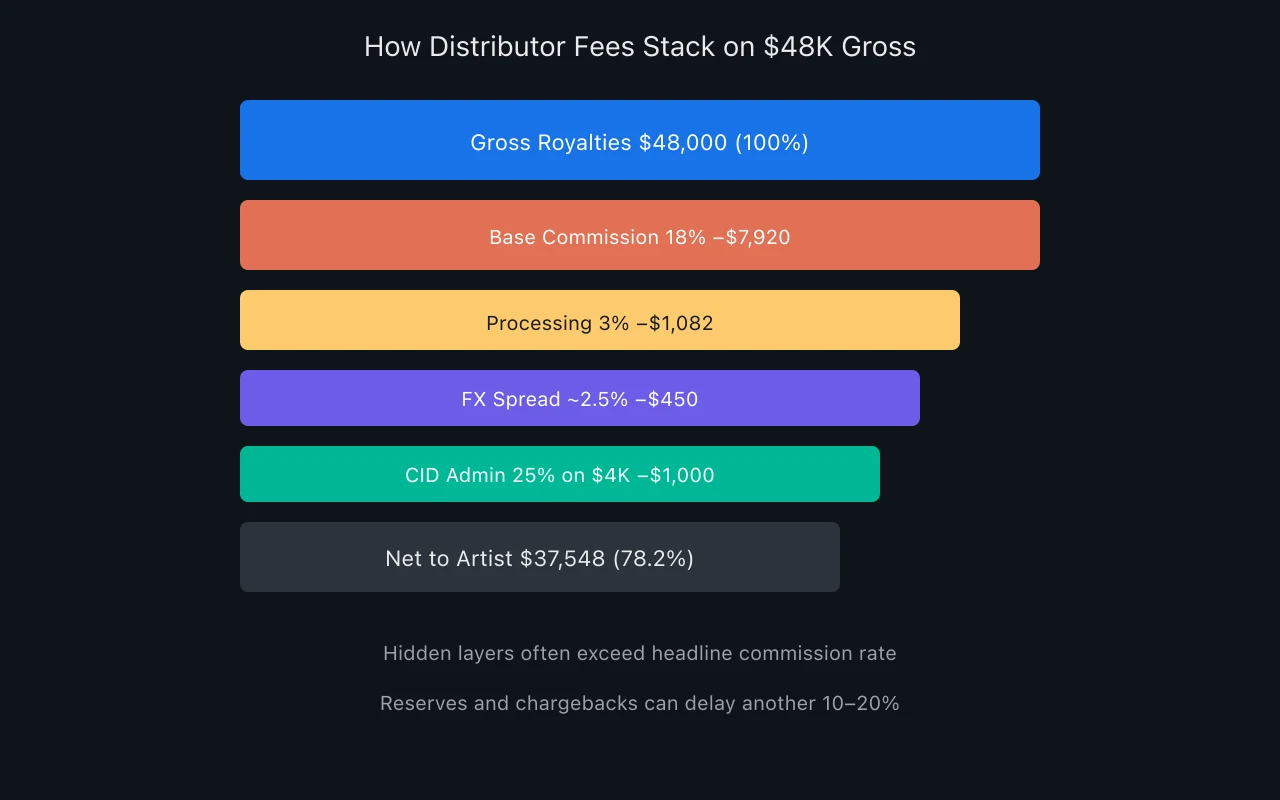
Music distributor royalty fee layers
Visualizing layers clarifies negotiation priorities. A 2-point commission cut matters less if processing and FX spreads stay untouched.
Headline Rate vs Effective Rate
Industry conversations fixate on distribution percentage. Finance-savvy artists calculate effective take: total distributor retention divided by gross royalties all sources. Include CID, lyrics, neighboring rights passthrough, and mechanical collections if bundled.
According to music distribution economics, scale artists gain leverage—micro-artists often accept worse effective rates because switching costs feel high.
Reserve Holdbacks and Cash Flow
Reserves protect distributors against chargebacks when DSPs detect fraud or rights conflicts. Typical rolling reserves hold 10–20% for 1–3 quarters. Not technically a "fee," but timing cost hits touring artists financing records from royalty cycles.
Negotiate reserve caps and sunset clauses after clean history. Long-term catalogs with stable fraud profiles should not fund reserves like day-one releases.
YouTube and UGC Revenue Splits
Content ID revenue carries its own admin percentages, sometimes higher than streaming commission. Artists assume one rate governs all—you need separate CID line items in contracts and statements.
Match CID admin against standalone YouTube partners. Occasionally dedicated CID administration beats bundled distributor rates.
Conversion Spreads and DSP Geography
Global streaming means revenue arrives in euros, yen, and reais before conversion. Distributors apply bank rates plus undisclosed spreads. Statements rarely isolate spread cost.
Ask for conversion methodology in writing. Some artists route foreign collections through specialized forex-friendly administrators.
Per-Release and Hidden Surcharges
Unlimited release plans still hide uplifts: priority delivery, editorial pitching fees, lyric sync charges, and annual ISRC maintenance. Each micro-charge is small; catalog scale multiplies them.
Audit twelve months of invoices for pass-through surprises. Marketing credits bundled into premium tiers may not offset higher commission.
Label vs Artist Distributor Deals
Labels negotiate volume discounts artists never see. If you are on a label using a distributor, your leakage may originate two layers up—understand label distribution charges in your recording agreement.
Independent artists dealing direct hold more renegotiation leverage than roster acts without audit rights.
Switching Costs Myth
Distributors emphasize migration pain—catalog transfer, metadata, timeline risk. Pain is real but finite. Staying on a bad fee stack for five years because switching takes six weeks is poor math when effective rates differ 4+ points.
Plan migrations during low-release windows. Deliver ahead with cleaned metadata to compress downtime.
Renegotiation Checklist
Before renewal auto-extends, complete this review:
- Calculate trailing twelve-month effective take rate (all income lanes)
- Compare headline commission vs processing, FX, CID, and reserves separately
- Benchmark against two alternative distributors with same catalog size
- Request fee schedule appendix listing every surcharge with dollar examples
- Negotiate commission tiers tied to annual gross thresholds
- Cap reserves and request release after four clean quarters
- Carve CID to separate rate or match streaming commission
- Require itemized conversion spread disclosure or mid-market rate commitment
- Confirm who pays chargebacks on fraudulent streams
- Verify exit terms: no punitive transfer fees, metadata export SLA
- Document editorial and marketing promises vs paid add-ons
- Set calendar reminder 90 days before renewal—not 9 days
Bring effective-rate spreadsheet to the call, not feelings. Numbers move commission desks.
Tiered Commission Strategy
Propose declining rates as gross scales: 20% under $25K, 17% to $75K, 14% above. Distributors accept tiers to retain growing catalogs. Your growth funds their absolute dollars while your marginal rate improves.
Audit Rights and Statement Hygiene
Contracts should permit annual royalty audits with reasonable notice. Store CSV exports monthly—DSP dashboards cross-check distributor statements when disputes arise.
Watch for duplicate ISRC deliveries and territory misallocations that look like fee problems but are metadata failures.
Neighboring Rights and Publishing Passthrough
Some bundles tax neighboring rights or publishing admin passthrough at distribution-like rates. These income types are not distribution—resist applying streaming commission logic.
According to record label accounting practice, passthrough lines should be cost-plus or flat annual, not percentage of gross neighboring rights.
Chargebacks and Fraud Clawbacks
Artificial streaming triggers DSP clawbacks distributors pass through. Understand contractual liability—some deals make artists absorb 100% of fraud penalties even when marketing vendors caused inflation.
Fee disputes pale next to six-figure clawbacks. Compliance is fee defense.
Merch and DTC Integrations
Distributor DTC storefronts and merch integrations add new fee layers on non-streaming revenue. If you use Shopify separately, bundled merch fees may be dead weight—drop unused modules at renewal.
Label Services vs Pure Distribution
Some distributors morph into label services—marketing, playlist pitching, video production—with bundled fees that resist line-item analysis. Ask which services you actually used last year. Paying for unused playlist campaigns is a soft fee drain masquerading as value-add.
Pure distribution should mean transparent delivery and accounting. If your rep functions as informal manager, compensate that relationship explicitly rather than through inflated commission permanence.
Growth Scenario Modeling
Model three scenarios before signing renewals: flat growth, 25% annual growth, and viral spike year. Effective rates interact with growth—tiered commissions reward spikes differently than flat percentages. A 25% flat rate on $200,000 gross costs $50,000; tiered 20% dropping to 14% above $75K might save $4,500 at same gross.
Build a simple spreadsheet: gross by lane, each fee layer, net, effective rate. Update quarterly. Artists who track trailing effective rate enter negotiations with leverage; artists who guess accept quiet escalations.
Joint Venture and Label Imprint Deals
Imprint and JV structures sometimes hide distribution fees inside profit-splits after marketing recoup. Read whether distribution commission applies pre- or post-marketing spend. Post-recoup stacking can push effective takes above 30% even when headline says 15%.
Indie labels distributing roster through white-label infrastructure should audit per-artist allocation—one artist's fraud clawback should not dilute another's net without contractual basis.
Transparency Regulation Trend
Industry pressure toward royalty transparency—EU directives, platform disclosures, artist advocacy—gradually forces clearer statements. Still assume you must request breakdowns proactively. Do not wait for perfect regulation to understand your deal.
Request sample statements from prospective distributors before migrating. Compare line-item clarity side by side. Opaque statements predict opaque fee disputes.
Accounting Calendar and Payment Timing
Payment frequency affects cash flow independent of fee percentage. Quarterly vs monthly vs threshold-based payouts matter for touring cycles. Some distributors charge faster-payout premiums—another fee layer.
Align accounting calendar with your tax and tour budgeting. A lower commission with 90-day lag can hurt more than slightly higher commission with monthly deposits when crew payroll is weekly.
Family and Catalog Estate Planning
Long-term catalog owners should model distributor fees across decades, not quarters. Auto-renewals with escalation clauses compound on estates and heirs who may not renegotiate aggressively. Build fee review into estate planning checklists alongside will updates.
Distributor Marketing Credits
Some deals offer marketing credits—playlist pitching, social ads, PR—tied to premium tiers. Credits are not cash but have value. Track utilization: unused credits signal you are over-tiered. Request credit balances in writing at renewal.
Comparing Statement Formats
When evaluating distributors, compare whether statements show gross per DSP, deductions per line, and net per territory. Granular statements catch leakage; summary statements hide it. Artists who switch for transparency often recover fees without changing headline commission.
Bundle Unbundling Strategy
Premium bundles include YouTube CID, lyric sync, publishing admin, and neighboring rights passthrough. Unbundle services you already have elsewhere—paying CID admin twice through different vendors is common when artists sign bundles without inventorying existing relationships.
Playlist and Editorial Economics
Editorial playlist placement is not a distributor royalty fee, but premium tiers blur the line—artists pay higher commission believing playlist access is guaranteed when it is only probabilistic. Separate marketing spend from distribution commission in your mental model.
Track whether premium-tier artists actually receive measurably more editorial support than standard-tier roster mates at the same distributor. If not, downgrade.
Annual Review Meeting Template
Schedule annual distributor review with: trailing gross by lane, effective take rate trend, reserve balance, upcoming release calendar, and competitive quotes. Bring data, not vibes. Distributors respond to artists who demonstrate switching competence.
Wholesale and Enterprise Paths
High-volume labels sometimes access wholesale distribution rates artists never see individually. If you are signing through a label services deal, ask for effective rate disclosure in your label agreement. Enterprise distribution can drop effective takes below 10% when volume justifies it.
Independent artists approaching enterprise thresholds—$500K+ annual gross—should initiate enterprise tier conversations proactively. Waiting for distributor outreach surrenders leverage.
Case Study: Renegotiation Win
A rapper with $62,000 annual gross discovered 24.1% effective take. Renegotiation secured 16% base (from 19%), CID aligned to 18%, processing capped at 2%, reserve reduced from 20% to 10% after two clean quarters. Projected savings: $3,900 annually plus improved cash timing.
Case Study: Switching Distributor
An electronic duo migrated after modeling five-year cost of 4-point effective-rate gap: $14,000+ at modest growth assumptions. Six-week migration delivered cleaned metadata and zero downtime on new releases. Old distributor's "too painful to leave" pitch collapsed against NPV math.
FAQ: Music Distributor Royalty Fees
What are music distributor royalty fees?
Charges distributors deduct for delivering your music to DSPs, collecting royalties, processing payouts, and administering add-ons like YouTube CID—often multiple layers beyond the headline commission.
What commission rate is fair in 2026?
Independent artists with moderate volume often target 12–18% all-in effective rates. Ultra-premium heritage catalogs pay less; brand-new micro-releases sometimes pay more for hand-holding.
Can I renegotiate an existing deal?
Yes, especially near renewal or after demonstrating material gross growth. Effective-rate data strengthens your position.
Do reserves count as fees?
Not permanently—they are timing holds—but they affect cash flow and should be negotiated like fees.
Can I switch distributors without losing my catalog?
Generally yes with proper metadata transfer and DSP redelivery. Plan ahead and avoid releasing during migration week.
What statement red flags should I watch?
Sudden CID % changes, unexplained "adjustment" lines, growing FX losses without geographic mix change, and reserve % creep without fraud notices.
Distributor Fees Bottom Line
Music distributor royalty fees drain revenue quietly because each layer seems modest. Build the stacking table for your catalog, calculate effective rate—not headline rate—and run the renegotiation checklist before auto-renewal. Growth you earn should land in your account, not disappear into spreads and surcharges you never individually approved.
Schedule your next renewal review today, even if the date is months away. Collecting twelve months of statement data takes time—and that data is the only language commission desks respect.


