

Music publishing sync administration is the back-office engine that turns your songs into licensable assets supervisors can find, quote, and pay for. Without it, brilliant catalogs sit invisible in PRO databases while competitors with weaker songs win placements because their metadata, registrations, and pitch infrastructure work. An admin deal does not replace your creative voice—it professionalizes the business side so you can keep writing instead of chasing cue sheets at midnight.
Whether you are an indie songwriter with ten co-writes or a producer building a boutique catalog, understanding what sync administration actually delivers—and what it costs—prevents signing away income you did not know you had.

Sync administration turns catalog data into placements supervisors can license quickly.
What Sync Administration Actually Means
Sync administration is a contractual arrangement where a publisher or specialized admin company handles licensing your compositions for synchronization uses—film, television, advertising, trailers, video games, and branded content—on your behalf. They pitch, negotiate, invoice, register deals, and often collect royalties, while you retain ownership of your copyrights.
This differs from a full publishing deal where a company may own or co-own shares of your compositions. Pure administration typically leaves ownership with you and charges a fee for services rendered.
Administration vs Co-Publishing
Co-publishing splits copyright ownership and long-term income. Administration keeps your ownership intact and bills for operational work. Songwriters who want catalog control but lack in-house clearance teams choose admin for flexibility.
Why Songwriters Sign Admin Deals
Supervisors work on brutal timelines. They need instant answers on splits, clearance status, instrumental availability, and fee expectations. A solo writer answering email at 2 a.m. loses to a publisher with a dedicated sync desk and searchable catalog site.
Admin deals buy relationships. Established administrators sit on speed-dial lists at music supervision firms, trailer houses, and agency producers. Warm intros convert at higher rates than cold Dropbox links.
They also buy accuracy. Misregistered works, conflicting writer shares, and missing ISWCs trigger delays that kill deals. Administrators maintain PRO registrations, fix metadata, and produce split sheets supervisors trust.
Typical Fee Structure Table
| Fee Type | Common Range | What It Covers | Watch-Out |
|---|---|---|---|
| Administration commission | 10% – 20% of gross sync income | Pitching, negotiation, invoicing, collections | Applies to upfront sync fees and sometimes backend |
| Registration setup | $0 – $500 per work (one-time) | PRO work registration, ISWC request, CWR delivery | Some charge per song; others bundle annually |
| Retainer / desk fee | $0 – $2,000 / year | Catalog hosting, instrumental prep, CRM upkeep | Rare for micro-catalogs; common at boutique admins |
| Legal pass-through | At cost | Deal memos, license drafting, amendment riders | Confirm cap or approval before counsel hours stack |
| Collection commission | 5% – 15% of foreign collections | Sub-publisher routing, currency conversion, audits | May stack atop domestic admin percentage |
| Pass-through expenses | Variable | Express instrumental mastering, translation, notary | Require pre-approval on non-standard costs |
Always model net income after commissions, not headline sync fees. A $10,000 placement at 15% admin costs you $1,500 before taxes and co-writer splits.
What Admin Deals Buy You
Think of administration as purchasing a bundle of capabilities you would otherwise hire piecemeal:
- Dedicated sync pitch team with genre-specific relationships
- Instrumental, stem, and alt-mix preparation for briefs
- One-stop clearance when you control sufficient shares
- Standardized deal memos supervisors recognize
- Collections infrastructure across domestic and foreign PROs
- Conflict resolution when co-writers disagree on terms
- Analytics on pitch volume, pass reasons, and close rates
According to music publisher practice, the economic value of administration scales with catalog depth—one song benefits less than twenty related cues supervisors can blanket across a season.
Pitch-to-Payment Workflow
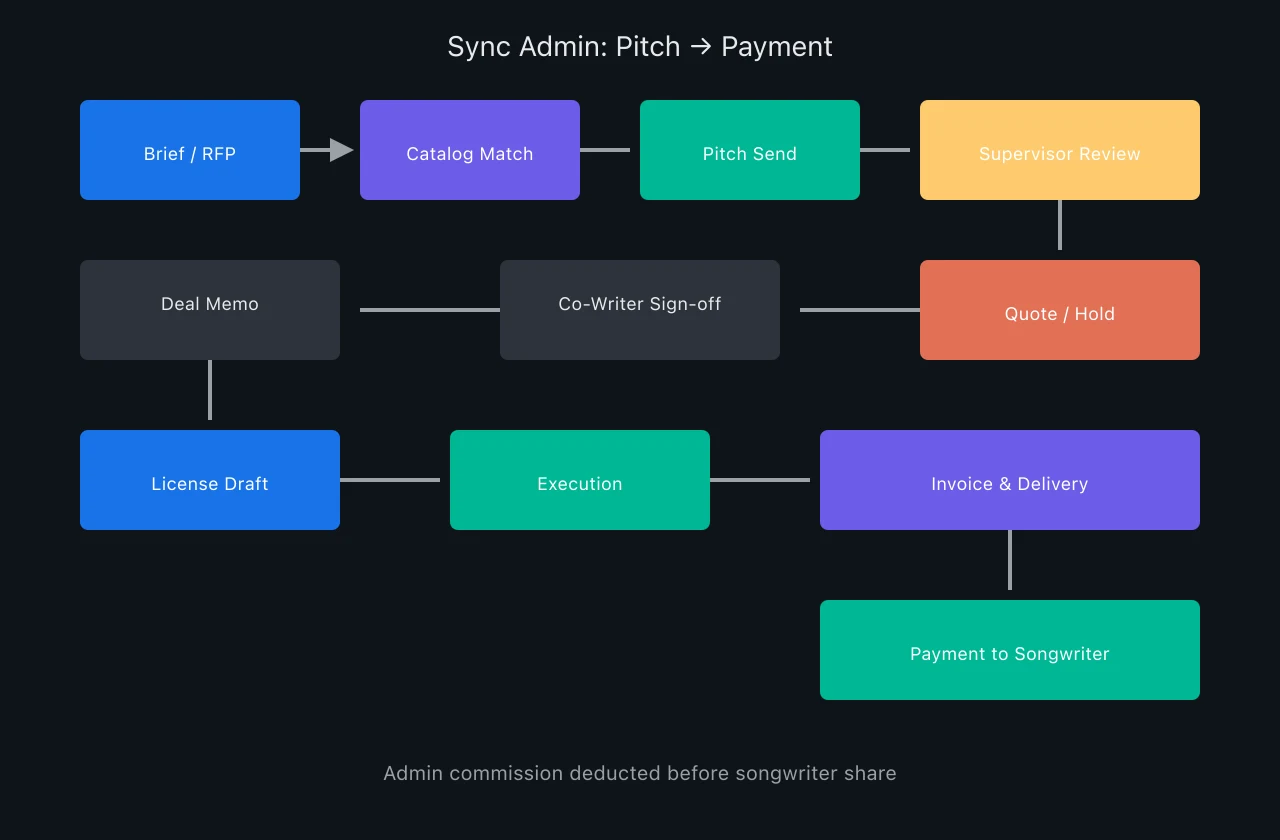
Music publishing sync administration pitch to payment workflow
Each stage has failure points. Weak metadata kills catalog match. Slow co-writer sign-off loses holds. Administrators earn their commission by compressing timeline between pitch send and executed license.
Evaluating Admin Partners
Not every administrator excels at sync. Some focus on performance royalties and treat sync as ancillary. Ask for placement lists in your genre, average time-to-quote, and how many active supervisor relationships they maintain.
Request a sample deal memo and license template. Supervisors reuse familiar paperwork; exotic formats slow legal review on the production side.
Red Flags in Admin Contracts
Avoid perpetual commissions on works you only admin for five years. Watch for broad exclusivity that blocks you from self-pitching film-school friends. Clarify whether YouTube creator deals count as sync or require separate approval.
Retaining Control While Outsourcing
Strong admin contracts specify approval thresholds. You might auto-approve deals under $2,000 with standard terms while retaining veto on exclusivity or moral-rights waivers. Carve out personal relationships you brought before signing.
Keep access to pitch logs. Transparency on who received your music prevents duplicate pitches and supervisor fatigue.
Co-Writer Dynamics in Admin
When multiple writers share a composition, one administrator often takes the lead for sync quoting. Confirm your admin has authority from sufficient shares or signed sync-only mandates. A 10% writer cannot bind 40% partners without documentation.
Pre-negotiated sync rate cards among co-writers accelerate holds. Administrators love writers who settled minimums during the session, not during the network deadline.
Instrumentals, Stems, and Alt-Mixes
Supervisors frequently need instrumental versions within hours. Admin deals should specify who pays for alt-mix creation and how stems are stored. Centralized DAM folders beat scattered Google Drive links with expired permissions.
Alt-tempo and shorter-edit versions increase placement odds for advertising. Budget one session day per EP to create sync-friendly assets proactively.
One-Stop Clearance Advantage
If you control majority shares or have sync authority from co-writers, your administrator offers one-stop clearance—single signature for composition rights. Supervisors pay premiums in time saved.
Partial one-stop still beats chaos. Knowing exactly which two publishers must sign prevents phantom quotes that collapse at legal.
Foreign Collection and Sub-Publishing
Domestic sync fees are only part of income. Performance royalties from broadcast uses flow through PRO networks internationally. Administrators route foreign collections via sub-publishers and deduct collection commissions.
Audit clauses matter. Reputable admins permit songwriter audits of sync income and pass-through expenses annually.
When DIY Sync Makes Sense
Writers with tiny catalogs, strong personal networks, and appetite for negotiation can self-administer early placements. DIY breaks down when brief volume exceeds your bandwidth or when co-writer conflicts need neutral mediation.
Hybrid models exist: self-pitch locally, admin for national campaigns. Contract must explicitly permit both lanes.
Transitioning Between Administrators
Catalog moves require notice periods and orderly handoffs. Export split sheets, registration confirmations, and pending deal memos before termination. Pending quotes die in limbo if neither party owns relationship continuity.
According to synchronization rights licensing norms, supervisors rarely care about your internal admin change—they care that clearance speed does not slip mid-season.
Sync Income vs Performance Income
Administration commissions typically attach to sync upfront fees. Performance royalties from PROs may be handled under separate publishing administration percentages. Read definitions carefully—some contracts broadly define "publishing income" to include both.
Negotiate carve-outs for performance income if you only need sync services. Mixing both under one high commission erodes backend for years.
Building Supervisor Trust
Trust compounds. Administrators who deliver accurate metadata, honor holds, and never double-book exclusive categories become first-call catalogs. Your songwriting quality matters, but reliability wins repeat briefs.
Encourage admins to decline bad fits honestly. Pitching inappropriate songs burns relationships faster than silence.
Data Room Hygiene
Maintain a living sync bible: lyrics, split percentages, PRO work IDs, contact trees, master ownership notes, and past placement history. Administrators inherit chaos or clarity—clarity converts.
Update within 48 hours of every new co-write session. Delayed split sheets are the silent killer of music publishing sync administration efficiency.
Case Study: Indie Electronic Writer
An electronic songwriter with fourteen co-writes signed a 15% sync admin deal with a boutique firm. Within nine months, the admin placed three cable documentary cues and one car commercial alt-mix. Gross sync income: $34,000. Admin commission: $5,100. Net to writer after splits: $19,400—more than prior two years of DIY pitching.
Key win: instrumental versions existed before briefs arrived. DIY years lost placements waiting on mix revisions.
Case Study: Exiting a Bad Admin
A folk catalog signed broad exclusive admin with no performance carve-out. Sync income was modest; PRO backend commission at 20% cost thousands annually. Writer served notice, moved to sync-only admin at 12%, and retained separate PRO administrator. Lesson: match contract scope to actual value received.
Negotiating Commission Down
High-volume writers with proven sync income negotiate tiered commissions—18% on first $50,000, 12% above. Bring closed-deal history when asking. Admins accept lower rates to retain catalogs that pitch themselves.
Term limits help. Five-year admin with mutual renewal beats perpetual agreements signed before your first placement.
Legal Review Before Signing
Have entertainment counsel review admin agreements before execution. Focus on exclusivity scope, commission base, expense pass-throughs, audit rights, and reversion triggers. A few hundred dollars upfront prevents five-figure disputes.
Sync Rate Cards and Minimums
Professional administrators maintain internal rate cards by media type: background TV, featured ad, trailer all-media, game interactive. Share your floor prices with co-writers during splits conversations so quotes stay consistent across pitches.
Minimum sync fees protect catalog value. Accepting $500 background uses for songs that command $5,000 in competitive briefs trains supervisors to expect discounts. Admins should consult before sub-floor deals unless strategic—new supervisor relationship, franchise pilot, or credit-building placement.
Cue Sheet and PRO Handoff
After license execution, administrators file cue sheets with accurate writer and publisher shares so performance royalties flow correctly. Sync upfront fees and PRO backend money are separate income lanes—administration quality on cue sheets affects backend for years.
Confirm your admin includes cue sheet preparation in commission or bills separately. Missing cue sheets mean broadcast performances generate no PRO income despite visible on-screen use.
Catalog Segmentation Strategy
Not every song pitches equally. Segment catalog into tiers: active sync rotation, hold for exclusivity, and archive until re-recorded. Administrators waste supervisor attention when 200 deep cuts get blasted indiscriminately.
Quarterly pitch reviews with your admin identify which genres convert and which collect pass reasons—tempo, lyrical content, master quality. Refine rotation based on data, not sentimental attachment to album tracks fans love but supervisors skip.
MFN and Package Deals
Most-favored-nations clauses link multiple songs in one production deal—if one track gets a higher fee, others in the package step up. Administrators must track MFN triggers across simultaneous negotiations to avoid accidental escalations.
Package pitches work when catalog shares mood or era. Pitching twelve unrelated songs to one supervisor reads as spam; pitching six cohesive cues for a docu-series reads as curated service.
Sync vs Mechanical Administration
Mechanical royalties from interactive streams flow through different collection pipes than sync fees. Some admin deals bundle mechanical collection; others sync-only. Clarify whether your administrator registers with the Mechanical Licensing Collective for U.S. streaming mechanicals or if a separate administrator handles that lane.
Double administration—two companies each taking percentage on overlapping income—happens when writers sign sync admin without reviewing existing publishing deals. Map income lanes on one spreadsheet before adding signatures.
Supervisor Relationship Cadence
Top administrators schedule quarterly check-ins with key music supervisors—not to pitch every song, but to refresh catalog highlights and confirm contact data. Relationship maintenance is part of what your commission funds.
Writers can support admins by attending industry panels, sync showcases, and brief feedback sessions. Face time converts cold catalogs into considered options when briefs land.
Termination and Reversion Clauses
Admin agreements should define clean termination: notice period, pending deal handling, and whether admin retains commission on licenses signed during term after termination. Some contracts claim tail commissions indefinitely—negotiate sunset on post-term collections.
Reversion of unplaced works after admin term lets you move catalogs without orphaned conflicts. Clarify which societies need updated publisher of record notices when admin ends.
FAQ: Music Publishing Sync Administration
What is music publishing sync administration in plain terms?
A company pitches and licenses your songs for film, TV, ads, and games, handles paperwork, and takes a percentage of sync fees while you usually keep copyright ownership.
What commission is typical?
Most sync admin deals charge 10% to 20% of gross sync license fees. Retainers and pass-through costs may apply on top.
Do I lose my copyright?
Pure administration generally leaves ownership with you. Co-publishing or assignment deals are different—read the grant language.
Can I still pitch songs myself?
Only if your contract allows non-exclusive admin or carve-outs for personal relationships. Exclusive admin may block self-pitching.
How long until placements appear?
Genre and relationships matter. Six to eighteen months is common for new catalog relationships; established admins with warm supervisors move faster.
How is admin different from a full publisher?
Full publishers may own shares and control creative direction. Administrators operate your copyrights for a fee without taking ownership.
Sync Administration Bottom Line
Music publishing sync administration is an infrastructure purchase, not a creative compromise. The right partner converts dormant copyrights into quoted, cleared, invoiced placements while you write the next song. Model fees with the structure table, demand transparency in the pitch-to-payment chain, and negotiate scope that matches how your catalog actually earns. Supervisors reward reliable catalogs—and reliable catalogs start with professional administration.


