Understand What Venues Are Actually Working With
Venues operate on tight margins that most artists don't see clearly from the outside. A significant portion of ticket revenue often goes toward the venue's own operating costs, staffing, and sometimes a booking agent's cut, before the artist's share is even calculated. Understanding this isn't about accepting a bad deal, it's about knowing which parts of a negotiation are genuinely flexible for a venue and which parts they have less room to move on.
Smaller and mid-size venues, in particular, often have more flexibility around non-cash terms, like merchandise splits or promotional support, than they do around the core guarantee or door split, simply because their cash flow is tighter and less predictable than a larger venue's.
Know the Difference Between a Guarantee and a Door Deal
A guarantee is a fixed payment you receive regardless of how many tickets sell, while a door deal ties your payment to a percentage of ticket sales, sometimes after the venue recoups certain costs first. Guarantees are generally safer for developing artists with an unpredictable draw, since they remove the risk of a poorly attended show resulting in minimal pay.
Some venues offer a hybrid structure: a modest guarantee plus a percentage of ticket sales above a certain threshold. This structure can work well for an independent artist with a growing but still uncertain local following, since it provides a safety net while still allowing for meaningful upside if the show sells better than expected.
Negotiate the Door Split Percentage, Not Just the Number
If you're working with a door deal, the specific percentage split matters significantly over time, even if a few percentage points sounds minor in a single negotiation. A venue offering a 70/30 split in the artist's favor versus an 80/20 split in the venue's favor represents a real, ongoing difference in income across every future show at that venue, not just the one currently being negotiated.
It's reasonable to ask what percentage other artists at a similar career stage typically receive at that venue, and to use a track record of past ticket sales, even modest ones, as leverage for a more favorable split on subsequent bookings.
Pay Close Attention to Merchandise Splits
Many venue contracts include a merchandise cut, sometimes 10-20% of your table sales at the show, which the venue takes as part of hosting the event. This term is often more negotiable than the core show payment, particularly for developing artists whose merchandise sales might otherwise not be a major consideration for the venue.
Some artists successfully negotiate this percentage down or eliminate it entirely in exchange for a slightly lower guarantee, depending on which revenue stream matters more for their specific situation. Knowing your typical merchandise sales relative to your guarantee before the negotiation helps you understand which term is actually worth pushing harder on.
Clarify Promotional Responsibilities Upfront
A significant source of disputes after a poorly attended show comes down to unclear expectations about who was responsible for promoting the event. Some venues include the show on their own marketing channels and expect the artist to drive most ticket sales independently, while others take a more active promotional role.
Getting this expectation clearly stated in the contract, including specifics like social media promotion, email list inclusion, or local advertising, protects you from a situation where a show underperforms and the venue points to the artist's promotional effort as the cause, without having contributed meaningfully to promotion themselves.
Understand Cancellation and Rescheduling Terms
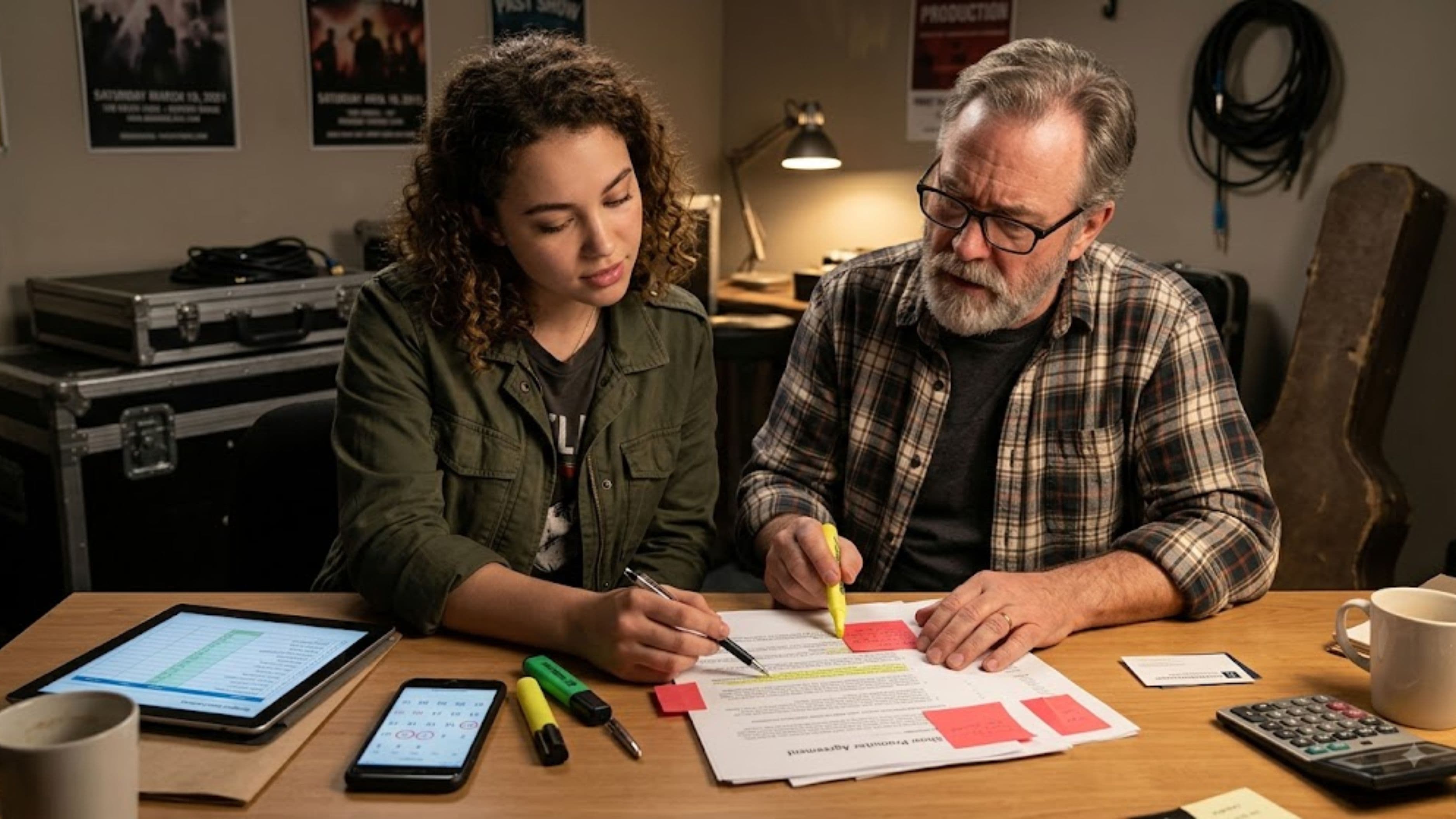
Contracts should clearly specify what happens if either party needs to cancel or reschedule, including any kill fees (a payment owed if the venue cancels without sufficient notice) and the artist's own obligations if a cancellation becomes necessary on their end. This term is frequently overlooked during negotiation but becomes critically important if unexpected circumstances arise.
Asking for a clear, specific cancellation policy, rather than accepting vague language, protects both parties and reduces the likelihood of a dispute if plans change closer to the show date.
Negotiate Load-In and Sound Check Time
While not a financial term, adequate load-in and sound check time directly affects your ability to put on a good show, which in turn affects your reputation and future booking opportunities at that venue and others. Rushed sound checks are a common source of frustration for independent artists, particularly at venues juggling multiple acts in a single night.
If a venue's standard schedule feels too tight for your specific setup, it's reasonable to negotiate for additional time, particularly if you're bringing more elaborate equipment than a typical single-artist booking at that venue.
Building Leverage for Future Negotiations
Your negotiating position improves considerably once you have a track record of reliable ticket sales, professional conduct, and positive relationships with venue staff. Keeping accurate records of your past show attendance and any positive audience or venue feedback gives you concrete leverage for future negotiations, rather than relying purely on your own sense of your draw or performance quality.
Building a direct, professional relationship with a venue's talent buyer or booking manager, rather than only communicating through a booking agent or generic email, also tends to improve negotiating outcomes over time, since venues generally prefer working with artists they know to be reliable and easy to work with.
What to Watch Out For
Be cautious of contracts with vague or missing payment timelines, since unclear language about when exactly you'll be paid after the show can lead to unnecessary delays or disputes. Watch for contracts that place all promotional responsibility on the artist while still taking a significant door split, since this combination shifts most of the financial risk onto the artist without a corresponding reduction in the venue's cut. It's also worth watching for exclusivity clauses that restrict you from performing at other venues within a certain radius or timeframe, since these can limit your ability to book other shows in your local market.
Key Takeaway
Most of the real negotiating room in a venue deal exists outside the headline payment number, in the door split percentage, merchandise cut, promotional responsibilities, and cancellation terms. Understanding these levers, and knowing which ones matter most for your specific situation, tends to produce better long-term outcomes than focusing negotiation energy purely on the guarantee amount.
FAQ
Should I always try to negotiate every venue contract? Not necessarily every term on every deal, particularly for smaller shows where the relationship and experience matter more than maximizing every dollar, but understanding what's negotiable helps you know when it's worth pushing and when it's reasonable to accept the standard terms.
Is it normal for venues to take a merchandise cut? Yes, it's a common practice, particularly at established venues, though the specific percentage and whether it's negotiable varies significantly by venue and your standing as an artist.
Do I need a lawyer to review a venue contract? For larger shows or unfamiliar venues with complex terms, having a music industry attorney review the contract is a reasonable investment. For smaller, more standard local bookings, understanding the key terms discussed here is often sufficient for most independent artists.
📚 Sources
Recording Academy – Understanding Live Performance Contracts – https://www.grammy.com/advocacy
American Federation of Musicians – Contract Resources for Musicians – https://www.afm.org/resources/