

Podcast music licensing is where enthusiastic hosts discover—often via a cease-and-desist or a stripped upload—that enthusiasm is not a license. Podcasts distribute on platforms that scan audio, rights holders fingerprint catalogs aggressively, and a recognizable intro riff can cost more than a year of hosting fees if cleared wrong.
This beginner guide walks through what you can play safely, which licenses to buy, which mistakes trigger takedowns, and how to build a sustainable sonic identity without betting the show on fair-use hope.
Your intro music is a contract problem before it is a branding problem.
Why Podcasts Are Different From Radio
Terrestrial radio pays performance licenses through PRO blanket deals with stations. Most independent podcasters lack those blankets. Uploading episodic audio to Apple, Spotify, YouTube, and RSS mirrors counts as reproduction and distribution—triggering both composition and master rights unless a specific license covers podcast media.
Platform deals evolve, but the safe default remains: license music you are authorized to use in on-demand episodic format.
Beginner Licensing Checklist
Before publishing episode one with music:
- Confirm every cue has written license or is 100% original/you commissioned
- Verify license explicitly includes podcast / on-demand episodic use
- Check monetization allowance (ads, Patreon, sponsor reads)
- Confirm territory (worldwide vs U.S.-only) matches your RSS reach
- Save PDF license, receipt, and track ISRC or library ID in show bible
- Separate stings (short) from theme (long) licenses—terms differ
- Document royalty-free vs rights-managed library rules
- Plan YouTube video version—video platforms scan stricter than audio-only
Checklist completion beats apologizing in episode 47 after three strikes on Spotify for Creators.
License Type Comparison Table
| License Type | What It Covers | Podcast Fit | Typical Cost |
|---|---|---|---|
| Production / stock music subscription | Library recordings for stated uses | Excellent if podcast listed in terms | $15 – $50 / mo |
| Per-track royalty-free | One library master + embedded sync | Good for themes and stings | $30 – $200 / track |
| Creative Commons | Varies by CC flavor (BY, NC, etc.) | Risky—NC blocks many ads | Free with conditions |
| Commercial release (sync + master) | Famous recording | Usually unaffordable for indies | $5,000 – $50,000+ |
| Composer work-for-hire | Custom theme you own | Best long-term branding | $500 – $5,000+ |
| PRO blanket (station) | Performance on licensed stations | Does not replace podcast master rights | N/A for most hosts |
Read subsection headers in stock libraries—"social media only" plans often exclude podcast RSS distribution.
Common Licensing Mistakes
- Using Spotify-downloaded files as production beds—personal streaming ≠ license
- Assuming radio PRO payments cover your independent RSS feed
- Choosing Creative Commons NC music then running Midroll ads
- Mixing uncleared guest-intro music into your mastered episode
- Believing short clips under ten seconds are automatically fair use
- Using TikTok viral sounds outside TikTok's platform license
- Renewing hosting but not annual stock subscription—license lapses
- Ignoring YouTube Content ID when publishing video simulcasts
Each mistake has produced real takedowns and demonetization—not theoretical risks.
Podcast Music Decision Flow
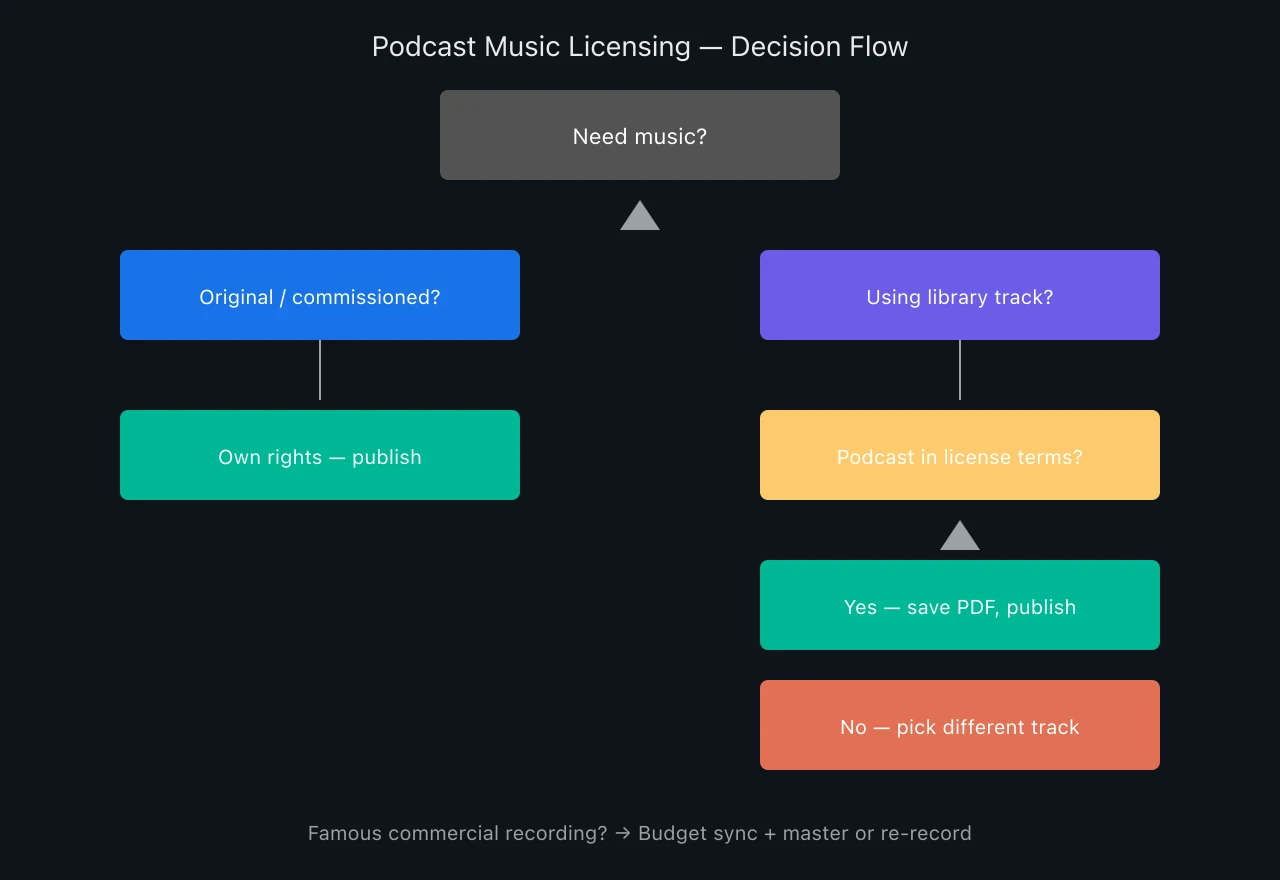
Podcast music licensing decision flow
Follow the flow before editing episode one—retroactive clearance costs more and stalls back catalog.
Production Music Libraries
Epidemic Sound, Artlist, Audio Network, Musicbed, and Pond5 offer podcast-oriented tiers. Compare: monetization caps, Content ID whitelisting, sting counts, and whether licenses transfer if you sell the show.
Enterprise podcast networks negotiate blanket deals—solo hosts should not assume network rights extend to spin-off feeds without assignment paperwork.
Commissioning a Custom Theme
Hiring a composer with work-for-hire agreement gives maximum branding freedom. Budget $800–$3,000 for indie podcasts; specify stems, loop versions, and sting cutdowns in contract.
Own the master and composition outright so mergers, network sales, and international syndication do not require re-clearance.
Interview Beds and Ducking
Low-volume ambient beds under voice still require licenses. Duck music twelve to eighteen dB under dialogue; audible recognition increases fingerprint confidence and claim risk if unlicensed.
Guest Contributions
Guests who ask to play their track must supply master and sync authorization for podcast context—or you strip it in post. Verbal on-air permission is not legal clearance from label.
YouTube Simulcast Rules
Video podcasts face Content ID and manual claims. Some library subscriptions whitelist channels; others forbid YouTube entirely. Match license to distribution stack on day one—not when video views spike.
According to podcast distribution trends, video simulcasts are now default for many shows—license accordingly.
Spotify for Creators Claims
Spotify scans uploaded podcast audio. Cleared library tracks with proper whitelisting usually pass; uncleared commercial music triggers stripped audio or episode blocks. Keep license IDs handy for disputes.
Apple Podcasts Review
Apple historically focused on metadata quality; rights violations surface via rights-holder complaints rather than pre-publish scan. Do not interpret absence of instant flags as permission.
Fair Use Myth
U.S. fair use is a defense, not a permission slip. Commentary on a song may justify brief excerpt in some cases; using a chorus as polished intro theme rarely qualifies. Beginners should avoid fair-use gambling entirely.
Public Domain Pitfalls
Composition may be public domain while a 1960s recording remains master-controlled. Use new performances of public-domain compositions or verify both sides. Classical recordings are not automatically free.
Sound Effects vs Music
Licensed SFX libraries differ from music subscriptions. Risers, whooshes, and room tone come from separate packs—do not pull SFX from unlicensed YouTube rips.
Corporate and Sponsored Shows
Brand podcasts need licenses permitting commercial use and sometimes exclusivity windows. Consumer podcast tiers may exclude branded content—upgrade license tier before signing CPM ad deals.
Network Acquisition Due Diligence
Buyers audit show bibles for music licenses. Missing paperwork reduces acquisition price or kills deals. Store licenses in cloud folders indexed by episode number and cue timecode.
International RSS Reach
Worldwide RSS defaults mean U.S.-only licenses under-protect EU listeners. Choose worldwide grants unless geo-fencing distribution—a rare podcast tactic.
Subscription Renewal Cadence
Calendar renewal thirty days before annual library lapse. Archive episodes using lapsed tracks need perpetual licenses or replacement edits—painful at episode 200.
Stinger vs Theme Strategy
Short three-second stings brand as effectively as forty-second themes with fewer repetition fatigue issues. License both variants if library permits; some tiers limit broadcast length.
Live Podcast Music
Live streamed shows with DJ interludes need licenses covering live simulcast and subsequent on-demand replay—distinct grants in some PRO frameworks. VOD replay is what gets fingerprinted.
Audiobook vs Podcast License
Do not reuse audiobook narration music subscriptions for interview podcasts—media definitions differ. Rights holders treat wrong-media use as unlicensed reproduction.
Case Study: True Crime Show
A true crime podcast used cinematic library music on a consumer plan that excluded monetized podcasts over ten thousand downloads. At twelve thousand downloads monthly, the library demanded upgrade and back payment. Total cost under four hundred dollars—cheaper than one hour of infringement counsel.
Case Study: Interview Show
An interview host played guests' commercial singles as walk-on music. Three episodes triggered Content ID on YouTube simulcast. Producer stripped walk-ons, replaced with licensed stings, re-exported back catalog—twenty hours labor. Podcast music licensing lesson: never embed guest tracks without paper.
Case Study: Custom Theme
A business podcast paid $2,200 work-for-hire for theme and stings. Two years later the network acquired the show; clean ownership avoided a twenty-thousand-dollar re-clearance estimate for library tracks with non-transferable licenses.
Building a Show Bible
Document: theme ISRC, library account email, license PDF, composer agreement, episode cue sheet template. New editors inherit compliance without Slack archaeology.
According to music licensing norms, written chains matter more than good intentions when platforms or buyers audit.
Dispute Response Playbook
When claims arrive: pause promotion, pull episode if necessary, locate license PDF, contact library whitelist team, submit counter-notification only with counsel if confident. Never argue fair use in email without lawyer review.
Budget Planning Year One
Model $200–$600 annually for stock subscriptions plus $0–$3,000 one-time custom theme. Famous commercial intros are not beginner budget items—desire does not equal clearance cost.
RSS Hosting and Music Claims
Some RSS hosts scan uploads for copyrighted material before publish. Licensed library tracks usually pass; uncleared commercial intros fail upload validators. Check host music policy alongside platform policies—double gatekeeping surprises new hosts.
Patreon and Bonus Episodes
Bonus episodes for paid Patreon tiers still need podcast music licensing covering commercial monetization. Consumer-tier library plans may exclude subscriber-only feeds—upgrade before launching paid tier with licensed theme.
Cross-Promotion Network Swaps
Network swap promos that play another show's licensed theme do not transfer license to your feed. Each show needs independent clearance. Swaps using uncleared music expose both networks to claims.
AI-Generated Music Caution
AI music tools carry evolving terms—some prohibit podcast monetization or require attribution. Read AI platform licenses like stock libraries. Podcast music licensing now includes verifying training-data claims if your brand avoids infringement controversy.
Transcription and Clip Shows
Clip shows pulling audio from past episodes re-trigger music rights on republished segments if licenses lapsed. Perpetual licenses or owned custom themes prevent clip-show relicensing labor when highlights reel goes viral.
Kids and Family Content
Family podcasts face stricter platform policies and brand safety expectations. Explicit lyrics in licensed beds—even instrumental versions with sampled vocals—fail COPPA-adjacent brand reviews. Filter library searches for clean edits explicitly.
Multi-Host Ownership Splits
Co-hosted shows should document who owns custom theme rights in operating agreement. When co-host exits, master license for theme determines whether show continues without renegotiation. Podcast music licensing intersects partnership law early—address in founding docs.
FAQ: Podcast Music Licensing
Can I use songs from my Spotify playlist?
No. Personal streaming licenses do not grant podcast reproduction rights.
Is a stock subscription enough?
Yes if terms explicitly include podcast distribution, your monetization level, and all platforms you use (including YouTube).
Are clips under ten seconds safe?
Not automatically. Short recognizable clips still trigger fingerprints and rights claims.
Can guests grant permission to play their song?
Only if they control master and publishing or supply label/publisher approval—not typical for signed artists.
Custom theme or library?
Library is faster and cheaper early; custom theme wins if you plan network sale, syndication, or multi-year brand equity.
Intro, Outro, and Segment Stingers
Podcast music licensing often treats intro theme, outro tag, and mid-roll stingers as separate cues requiring individual license coverage or library bundle confirmation. One track licensed for intro does not automatically cover outro unless terms say so.
Seasonal and Topical Shows
Holiday episodes and limited series still need perpetual or term-matched licenses for replays in back catalog. Podcast music licensing for six-episode season must cover reruns and best-of compilations listeners access years later.
Dynamic Ad Insertion Impact
DAI re-serves older episodes with new ads—monetization tier may change years after publish. Podcast music licensing must cover commercial use indefinitely for back catalog if DAI monetizes episodes you released under ad-supported library tiers. Upgrade licenses before enabling DAI on archive.
Live Event Recording Beds
Recording live shows with background music between segments needs licenses covering both live performance context and on-demand replay upload. Library terms vary—confirm live-plus-VOD bundle before touring live podcast.
Trademark and Show Title Music
Show title trademarks and theme music rights are separate legal layers. Owning podcast name trademark does not grant music rights. Podcast music licensing checklist should sit beside trademark filing—not replace it.
Affiliate and Sponsorship Reads
Sponsored episodes with affiliate links count as commercial use under many stock licenses. Podcast music licensing review must happen before signing host-read deals—consumer podcast tiers may exclude affiliate monetization even when music bed is instrumental.
Language Localization Re-Edits
Translating episode intros for localized feeds creates derivative use. Confirm library license covers localized versions and AI dubbing workflows if you expand internationally. Some composers retain localization rights separately from base theme grant.
Editor Onboarding Music Policy
Freelance editors habitually drop temp commercial tracks into rough cuts. Send podcast music licensing policy before first project file handoff: approved library login, banned sources, export naming for cue sheets. Prevention beats strip-and-re-export after host approval. Include policy link in every freelancer contract appendix alongside loudness and file-format specs.
Annual License Audit
Once yearly, audit show bible licenses against current monetization and distribution stack. Shows evolve from audio-only to video simulcast to live tours—podcast music licensing that fit year one may fail year three without upgrades or custom ownership.
Network Bundle Negotiation
Podcast networks buying multiple shows should negotiate blanket library deals or shared composer retainers. Per-show subscriptions multiply cost; network-level podcast music licensing reduces effective price per feed and standardizes whitelist handling across YouTube channels. Centralize license PDF storage so network ops can answer platform disputes within hours, not days.
Podcast Music Licensing Summary
Podcast music licensing begins with a honest checklist, a license-type table matched to your monetization plan, and avoidance of beginner mistakes that platforms fingerprint daily. Use the decision flow before publishing, archive PDFs like financial records, and upgrade from library to custom ownership when the show's enterprise value outgrows subscription terms. Compliance is cheaper than takedowns, re-edits, and lost ad deals combined. Treat music licensing as core operations—not optional creative flair.


