Pricing merch well isn't complicated, but it requires understanding a few things most artists skip: what it actually costs to produce an item, what the market expects to pay, and how much your merch needs to earn to be worth the effort of carrying it. Here's a practical walkthrough.
Start With Your True Cost Per Item
The number you need to know before you price anything is your landed cost – the actual all-in cost of having one item ready to sell, not just the printing quote. Artists who skip this calculation routinely underprice because they're not counting everything.
For a printed t-shirt, your landed cost includes the blank garment, the print cost, any setup or screen fees if you're doing screen printing, shipping from the printer to you, and any packaging materials if you're selling online. If you're selling at shows, add a proportional share of the table fee or merch space rental. If you're using a fulfillment service for online orders, add their per-item fee and the outbound shipping cost. If you're paying a merch manager at shows, their time has a cost too, even if it's your bandmate doing it as a favor.
Print-on-demand services like Printful, Printify, or Bandcamp's integration simplify this – your cost per item is displayed upfront before you set a price. But print-on-demand typically has higher per-unit costs than bulk printing, which affects your margin and therefore your pricing floor. Know which model you're using and cost accordingly.
A t-shirt printed in a run of 50 through a local screen printer might cost you $10 to $14 per unit all-in. The same shirt through a print-on-demand service might cost $18 to $22. Those are different floors, and they require different prices to generate the same margin.
Understand the Difference Between Cost-Plus Pricing and Market Pricing
There are two ways to approach pricing: from the cost up, or from the market down. Both matter, and using only one leads to mistakes in opposite directions.
Cost-plus pricing starts with your landed cost and applies a multiplier to reach your sale price. The standard retail markup is roughly 2x to 2.5x cost, meaning a shirt that costs you $12 to produce should sell for $24 to $30. This ensures you're covering your costs and generating meaningful margin. If your cost-plus price is much higher than what the market bears, you need to reduce your production costs, not your price.
Market pricing starts with what fans actually pay for merch in your genre and at your level. Spend an hour looking at what artists at a similar career stage are selling their t-shirts, hoodies, and hats for. Look at Bandcamp merch stores, Big Cartel shops, and what you see at shows in your scene. For most independent artists today, t-shirts typically sell in the $25 to $35 range, hoodies in the $45 to $65 range, and hats in the $25 to $35 range. These aren't minimums – they're what the market has established as normal, and pricing significantly below these levels signals lower quality or desperation rather than generosity.
The goal is for your cost-plus price and your market price to align. If your production costs are so high that a 2x markup pushes you significantly above market rate, you need cheaper production. If your production costs are so low that 2x markup leaves you significantly below market rate, you can either raise prices to market rate (capturing more margin) or maintain the lower price as a conscious choice with awareness of what you're leaving behind.
Factor in the Sales Channel
Where you sell changes what price is sustainable. At a live show, you have zero shipping cost, zero platform fee, and the highest conversion rate you'll find anywhere – people are already there, already in the mood, and making an emotional purchase in the moment. This is where merch margins are highest and where the economics of physical products make the most sense.
Online sales through your own store or Bandcamp involve platform fees and shipping logistics. Bandcamp takes 10% to 15% on physical merchandise sales. Shopify charges a monthly platform fee plus transaction fees. If you're handling fulfillment yourself, your time has value. If you're using print-on-demand, the higher per-unit cost compresses your margin. All of this means your online pricing often needs to be slightly higher than your show pricing to generate comparable margin – or your online products need to be clearly communicated as including shipping.
Shipping cost handling is a real decision. "Free shipping" is never actually free – it's bundled into the product price, covered by your margin, or both. If you offer free shipping, price the product to absorb a realistic average shipping cost. If you charge shipping separately, make sure the total price (product plus shipping) remains competitive with what buyers can find elsewhere.
Wholesale and consignment deals with merch sellers or other venues typically require you to sell at 50% of retail, which means your production costs need to be low enough to make 50% of your retail price still meaningful. For most independent artists, wholesale and consignment only work with efficient production costs or higher-priced items like premium hoodies where the margin at 50% is still worthwhile.
The Psychology of Merch Pricing
Price communicates value. This is not a soft concept – it's observable in how merch performs at shows and online. An artist selling t-shirts for $15 signals something different than an artist selling t-shirts for $30, even if the actual shirts are identical. The $30 shirt reads as something worth owning. The $15 shirt reads as something the artist is trying to get rid of.
This doesn't mean you should inflate prices beyond reason. It means you should price to what your product is actually worth and what the market expects, and stop thinking of lower prices as a fan-friendly gesture. Fans who value your music are not looking for a discount on your merch – they're looking for a reason to buy. That reason is emotional connection, quality, and feeling like the item is worth displaying or wearing. Price signals quality. A $15 t-shirt from an artist you love feels like a cheap souvenir. A $30 t-shirt from the same artist feels like a piece of something meaningful.
Bundling plays into this too. A vinyl record at $25 and a t-shirt at $30, sold separately, generate $55. A bundle of both at $50 creates a perceived savings, moves more units simultaneously, and often results in a higher per-transaction total than either item sold alone. Limited bundles at shows – "first 20 people get the record and shirt for $50" – create urgency and drive sales in the first hour, which is when merch tables are busiest.
Pricing Different Product Types
Not all merch performs the same, and different items have different pricing dynamics.
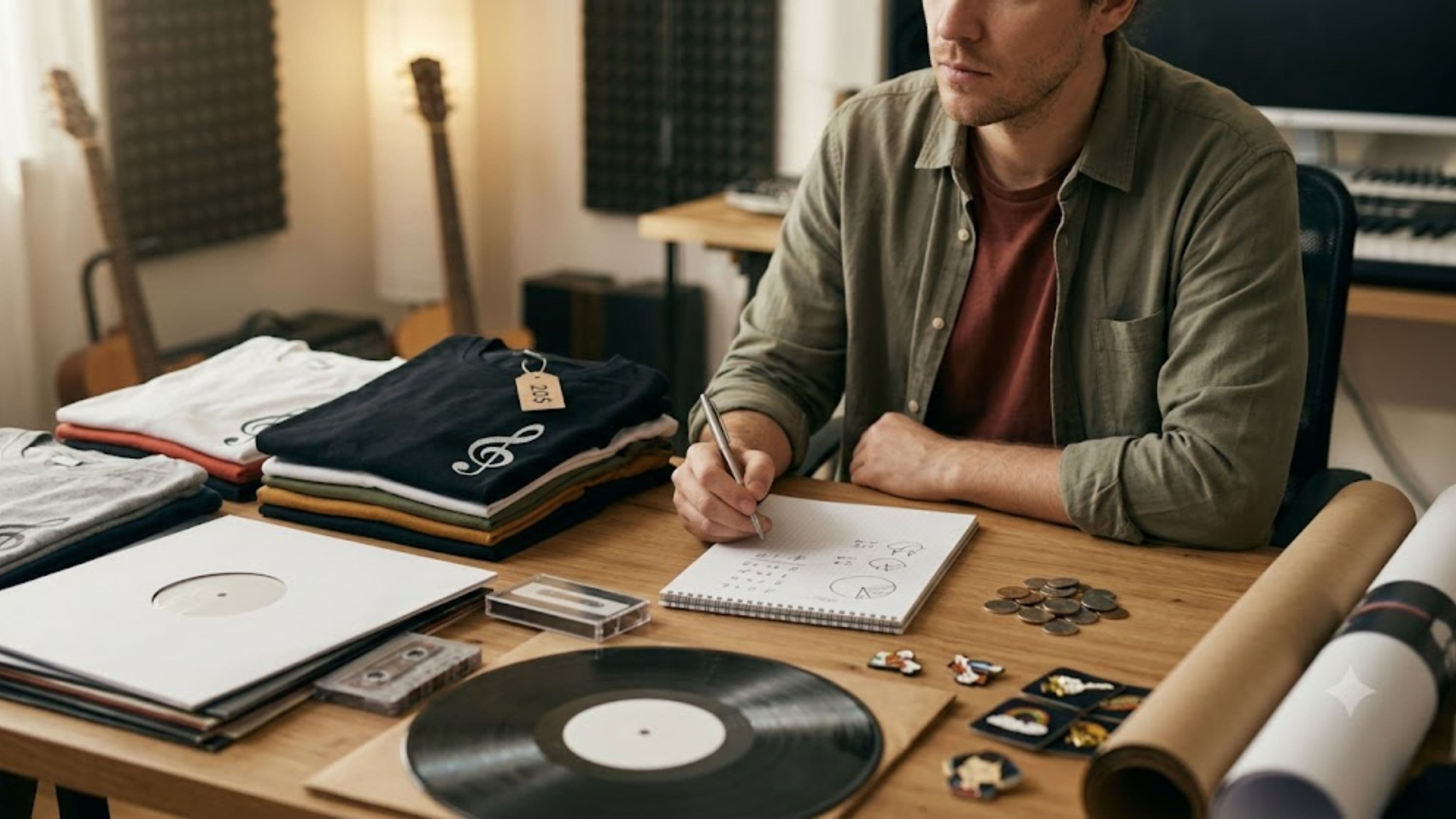
T-shirts are your core item. They're the most bought, most worn, and most visible. Invest in quality blanks – the difference between a $2 blank and a $5 blank is significant in how the shirt feels and holds up, and fans notice. Pricing range: $25 to $35 for standard, $30 to $40 for premium or oversized fits.
Hoodies have the highest unit cost and the highest sale price. They're slower sellers at shows because of the price point, but they generate more margin per item and are reliable online sellers in colder months. Don't underprice hoodies to move them – a $35 hoodie that cost you $28 to make is a poor use of capital. Pricing range: $50 to $70.
Hats (embroidered caps, beanies) have good margins when produced correctly. Embroidered caps through a quality supplier can cost $8 to $15 each in reasonable runs and sell comfortably at $25 to $35. Pricing range: $25 to $35.
Vinyl and CDs have complicated economics depending on pressing costs and quantities. Vinyl pressed in a run of 300 typically costs $5 to $10 per unit including mastering amortized across the run, and sells at $20 to $30. CDs are less in demand in most genres but have very low production costs – $1 to $3 per unit in runs of 100+, selling at $10 to $15.
Posters and art prints are high-margin items when produced locally or in short digital print runs. A high-quality 18x24 print might cost $3 to $6 to produce and sells at $15 to $25. They're light, easy to transport to shows, and appeal to a fan who wants something for their wall without the commitment of a hoodie purchase.
Limited or signed items command a premium. A signed record at $40 when the unsigned version is $25 is a reasonable uplift. A limited-edition color variant of a shirt or a numbered art print can price 20% to 40% above the standard version without resistance from fans who understand and value scarcity.
The Minimum Earning Test
Before you order a merch run, ask yourself: how many units do I need to sell to break even, and is that realistic? This is a basic inventory risk calculation that too many artists skip.
If you print 100 shirts at $12 each, you've committed $1,200 of capital. To break even at a $30 sale price, you need to sell 40 shirts. Is that realistic based on your show attendance and online following? If you play shows to 50 to 100 people and convert 5% to 10% of the room to a merch purchase, you might sell 5 to 10 shirts per show. At that rate, selling 40 shirts takes 4 to 8 shows. That's manageable. If you're playing to 15 people a show and have 200 followers online, ordering 100 shirts puts you at real inventory risk.
Right-sizing your orders to your actual audience reduces financial risk significantly. Print-on-demand is more expensive per unit but eliminates inventory risk entirely – it's the right choice when you're earlier in your career or testing a new design. Moving to bulk printing makes sense when you're confident in the design and the volume, because the per-unit savings directly translate to higher margin.
What to Watch Out For
Pricing inconsistency between your online store and show pricing confuses fans and erodes trust. If your shirt is $25 at a show and $30 online (plus shipping), that's explainable and reasonable. If it's $20 at a show and $30 online with no explanation, fans who bought at the show feel overcharged and fans who bought online feel taken advantage of. Keep your pricing logical and consistent, with any differences explainable by shipping costs or channel fees.
Discounting too aggressively signals desperation and devalues your brand. End-of-night "take what you want" pricing at a merch table, or constantly running 40% off sales online, trains your audience to wait for a deal rather than buy at full price. If you have excess inventory, sell it in a bundled deal or a clear "end of run" sale with context, rather than a quiet permanent discount.
Finally, don't forget about sales tax obligations. If you're selling merch online across state lines in the US, sales tax compliance is a real legal requirement in most states above certain revenue thresholds. It's not glamorous, but getting it wrong is more expensive than dealing with it upfront.
FAQ
How do I handle merch pricing at my first few shows when I don't know what will sell? Start small and start with high-margin items. A single t-shirt design in the most popular sizes, a hat, and a CD or vinyl if you have one. Price them at market rate, not at a discount to "move them." Watch what fans ask about and what they buy. That data is more valuable than guessing ahead of time.
Should I offer a discount for buying multiple items? Bundle deals are more effective than straight discounts. "Shirt plus record for $50" (when each is $30 and $25 separately) feels like value without training fans to expect percentage discounts on individual items. Bundling also increases your average transaction value, which matters when show traffic is high but brief.
Is print-on-demand worth it compared to bulk printing? It depends on your volume. Print-on-demand is worth it when you're releasing a new design and aren't sure of demand, when you're earlier in your career with a smaller audience, or when you're selling exclusively online and don't want to hold inventory. Bulk printing is worth it when you know a design will sell, you're playing regular shows, and the per-unit savings are meaningful to your margin.
What's the most common merch pricing mistake? Pricing based on what you'd personally pay as a consumer rather than on what your actual production cost and market rate dictate. Artists routinely price their shirts at $20 because "I wouldn't pay more than that for a t-shirt," without accounting for the fact that their cost structure doesn't support that price and the market doesn't expect it.
Good merch pricing is one of the most direct ways an independent artist can improve their financial position without needing more fans. You already have the audience – pricing correctly means the revenue they're willing to spend actually lands in your hands rather than being lost to thin margins or undervalued products. Run the numbers, price to market, and treat your merch operation like the real revenue stream it is.
📚 Sources
Bandcamp. Selling Merch on Bandcamp. https://bandcamp.com/guide
Ari's Take. How to Price Your Merch. https://aristake.com/how-to-price-music-merch/
Music Business Worldwide. The State of Merch in the Music Industry. https://www.musicbusinessworldwide.com/the-state-of-merch-in-music/
Printful. How to Price Custom Products. https://www.printful.com/blog/how-to-price-products
Shopify. How to Price Products. https://www.shopify.com/blog/how-to-price-products