

Pro rata music streaming royalties distribute a platform's subscriber revenue pool in proportion to each rights holder's share of total streams—not per play at a fixed penny rate. When Spotify or Apple Music pays out a territory's subscription money, your payment equals your streams divided by all streams, multiplied by the pool. Understanding that math separates realistic royalty forecasts from mythic "per-stream rate" arguments on social media.
This explainer walks through pool mechanics, worked examples, how user-centric alternatives differ, and scenario tables labels use for planning.

Pro rata is a pool division problem—your numerator is streams; the denominator is everyone else's too.
How Pro Rata Allocation Works
Each month, a service totals net distributable revenue in a country—subscriptions, ads, minus refunds and certain costs. That total is the royalty pool. Every track's share of streams in that country becomes its share of the pool. Labels, distributors, and collecting societies then apply splits to songwriters, publishers, master owners, and artists per contract.
There is no single guaranteed per-stream rate. If total streams double while revenue stays flat, everyone's per-stream average halves—even if your stream count rises.
Territory Matters
Pools are calculated per territory. One million streams in Norway and one million in India do not draw from the same subscriber revenue. Forecasting requires geo-weighted stream mixes, not global averages.
The Core Formula
Your Payout = (Your Streams ÷ Total Platform Streams) × Royalty Pool × Your Master Share
Songwriter and publisher royalties run through separate mechanical and performance pipelines, often still pro rata at the collection society layer. Master-side recordings follow distributor statements artists see monthly.
According to streaming media economics, scale effects dominate: platforms with more subscribers grow pools, but more uploaded music dilutes per-stream averages.
Scenario Table: Same Streams, Different Pool Conditions
| Scenario | Your Streams | Pool Size | Total Platform Streams | Est. Master Payout |
|---|---|---|---|---|
| Baseline | 500,000 | $10M | 5B | $1,000 |
| Pool grows | 500,000 | $12M | 5B | $1,200 |
| Stream inflation | 500,000 | $10M | 6B | $833 |
| You grow share | 750,000 | $10M | 5B | $1,500 |
| Holiday dip | 500,000 | $9M | 5.2B | $865 |
| Viral month | 2,000,000 | $10M | 5.1B | $3,922 |
Figures assume one hundred percent master share for illustration. Real statements apply label splits, distributor fees, and withholding.
Pro Rata Money Flow Diagram
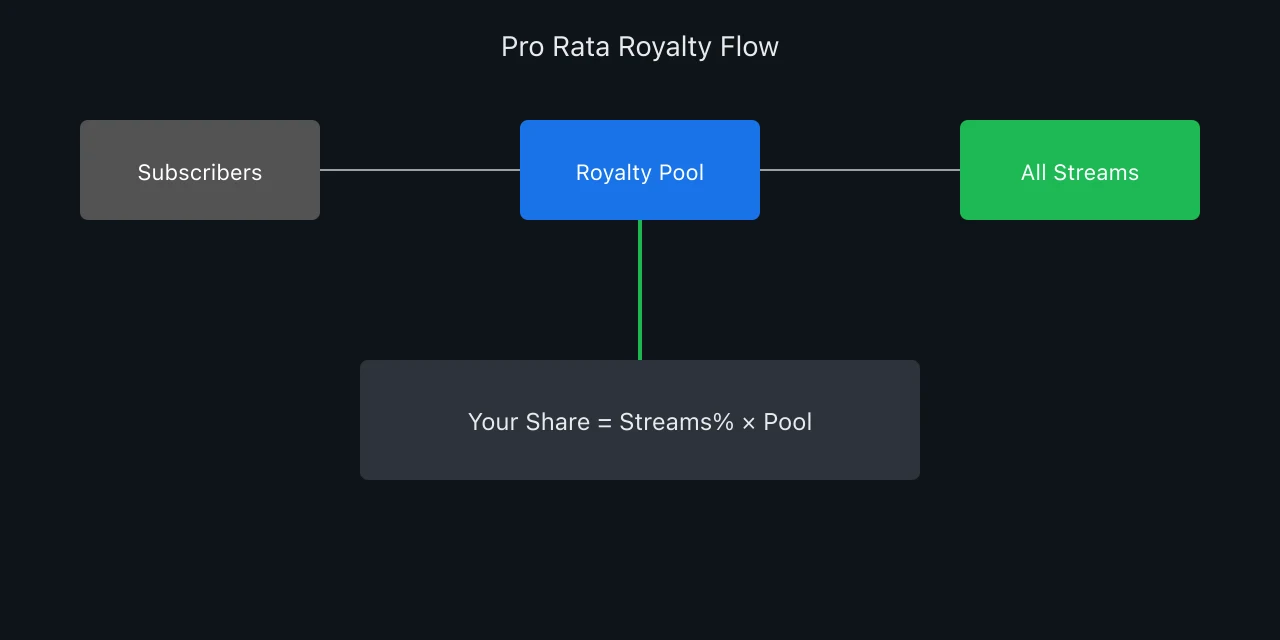
Pro rata royalty flow
Money flows into the pool; streams determine slice size. No stream share, no payout—regardless of catalog size.
Why "Per-Stream Rate" Is a Derived Average
Artists quote three-tenths of a cent or four-tenths of a cent as if platforms publish fixed tariffs. Those numbers are payouts divided by streams after the fact. A track with strong premium-subscriber listenership in high-ARPU countries shows higher averages than a track dominated by ad-supported tiers in emerging markets.
Report geo and tier mix to artists when discussing averages—it prevents false disappointment when a viral emerging-market spike pays "less per stream" while still growing absolute dollars.
User-Centric Alternative (Contrast)
Some propose user-centric models: each subscriber's fee funds only artists that subscriber played. Pro rata instead pools everyone and divides by global share. User-centric would advantage niche artists with dedicated fans; pro rata advantages mass-appeal catalogs that capture huge stream share.
No major DSP has fully switched; pro rata remains the industry default you must model.
Label Recoupment and Pro Rata Timing
Labels recoup advances from master royalties. A pro rata dollar that arrives in month three still may not reach the artist wallet until advance recoupment completes. Forecast pool share separately from cash flow to artists—contracts matter as much as math.
Distributor Fees and Net Receipts
Independent distributors take percentages or per-release fees before artists see net.pro rata pool math sits upstream; your statement applies commissions last. When comparing distributors, model net not gross pool share.
Planning a New Release with Pro Rata Logic
Estimate territory mix from prior releases. Apply expected pool growth or shrink from industry guidance. Project total platform stream inflation conservatively—historically upward. Multiply share by master split by recoupment status. Present a range, not a point estimate.
Case Study: Catalog Dilution
A label saw per-stream averages fall twelve percent year-over-year while total label revenue rose eight percent. Streams grew faster than subscriber pools—classic dilution. Artists with flat stream counts saw smaller checks despite stable popularity. Communication focused on market-wide inflation, not distributor error.
Songwriter and Publisher Layer
Mechanical and performance royalties for compositions follow separate societies with their own pro rata or weighted formulas. A hit can pay master owners well while writers wait on society processing delays. Full-track economics require both pipelines.
Transparency Initiatives
Some distributors now show pool estimates and geographic breakdowns. Use them in artist meetings to demystify statements. Transparency reduces conspiracy theories about per-stream manipulation.
Common Forecasting Errors
Using one global RPM. Split territories.
Ignoring ad-supported tier mix. Ad tiers pay differently.
Assuming viral streams pay like core fans. Geo skew matters.
Forgetting distributor fees. Net vs gross confuses everyone.
Pro Rata Summary
Pro rata music streaming royalties are proportional claims on a finite monthly pool—your streams divided by everyone's streams, times the money available. Master that mental model, run scenario tables, and teach artists that average per-stream rate is an outcome, not a promise.
Premium vs Ad-Supported Pools
Spotify separates subscription and advertising revenue pools in many territories before pro rata allocation. A stream on ad-supported tier draws from a different—and typically smaller—per-stream effective pool than premium. High ad-tier share in your geo mix depresses averages even when premium RPM looks healthy.
Family Plan and Bundle Dilution
Family and student plans increase stream counts per subscription dollar. Pro rata still pays your share, but average per-stream rates fall as household members stream more hours. This is market structure, not fraud.
Label Deals and Breakage
Major labels historically negotiated advances, marketing commitments, and in some cases equity participation that change net economics versus pure pro rata math. Indies see closer-to-textbook pro rata on distributor statements.
Mechanical Royalties Separate Pipeline
Songwriters receive mechanicals through societies and publishing admins—often months delayed. A track can show master pro rata revenue in March while writer mechanicals arrive in July. Cash flow planning must separate pipelines.
Tax Withholding and Territories
Cross-border royalty flows may incur withholding. US streams paying through US entities differ from Brazilian streams paying through local societies. Finance teams model net after tax per territory for touring and visa budgeting—not just stream bragging rights.
Educating Artists on Pro Rata
Use a pizza metaphor in artist meetings: the pool is one pie; your slice size is your stream share. Bigger pie with more people at the table can still mean smaller slices if your share shrinks. Artists who understand pool logic argue less about "unfair per-stream rates."
Historical Pool Trends
Track industry subscriber growth versus total stream growth annually. When streams outpace subscribers three to one, expect dilution unless subscription prices rise or ad revenue accelerates. Build dilution into multi-year forecasts instead of assuming flat RPM.
Pro Rata in Contract Negotiations
When negotiating producer deals or featured artist points, specify whether calculations use gross distributor receipts or net after fees. Pro rata pool share is upstream; contract splits determine who eats dilution risk.
Mini Pool Worked Example
Imagine a territory pool of one million dollars and one billion total streams. Your track has two hundred thousand streams—0.02% share. Gross master allocation before splits: two hundred dollars. Apply distributor fee ten percent: one hundred eighty dollars. Apply label net artist rate fifty percent: ninety dollars to artist. Walk artists through this chain to demystify statements.
Annual Dilution Sensitivity
If streams grow twelve percent annually but subscriber revenue grows eight percent, expect roughly four points of effective RPM pressure absent price increases. Model that sensitivity in multi-year artist advance recoupment schedules.
Joint Venture and Distribution Deals
Some distribution deals guarantee minimum per-stream floors regardless of pro rata—read contract fine print. Indies on standard deals face pure pro rata. Comparing your statement to a friend's different deal type causes confusion in artist group chats—educate on contract variance.
Black Box Royalties Overview
Unmatched publishing and orphaned master shares accumulate in society black boxes redistributed later by market share. Pro rata at DSP layer is only one piece; songwriters should register works correctly to capture composition share flowing through separate pools.
Currency Fluctuation Effects
Global distributors convert foreign pools to your currency monthly. EUR weakness versus USD changes statement totals without stream count changing—finance should note FX in variance explanations to artists.
Stream Share vs Revenue Share Reporting
Internal dashboards can show stream market share rising while revenue share falls—dilution plus geo mix shift. Teach teams both metrics to avoid false victory laps on stream count alone.
Recoupable Costs From Royalties
Labels recoup recording costs, video costs, and sometimes marketing from artist royalty share after pro rata calculation. Artist sees pool math abstractly; statements show recoupment line items—connect both in onboarding.
Statement Reconciliation Monthly
Match distributor total to sum of track lines within rounding tolerance. Flag tracks with streams but zero revenue—possible metadata conflicts. Pro rata pays only when rights and territories match registration.
Interactive Pool Calculator for Artists
Build simple spreadsheet where artists slide stream share and pool size inputs to see payout range. Transparency reduces support tickets asking why per-stream rate changed month to month.
Neighboring Rights Separate
Neighboring rights and master streaming royalties differ—performers collect neighboring rights through societies for broadcast, not identical to Spotify master pro rata. Educate roster to avoid conflating line items.
Audit Rights Before Campaign
Pro rata pays masters only when metadata, ISRC, and territory rights are clean. Pre-release audits prevent streams that do not pay because conflicting claims held money in escrow. Finance and legal are part of royalty math, not afterthoughts.
Artist Advance Modeling With Pro Rata
Model advance recoupment using conservative stream share growth and dilution scenarios—not best-case RPM tweets. Pro rata uncertainty should widen error bands in advance offers; narrow bands mislead artists about recoup timing.
Transparency With Producers
Producer points on net master royalties should reference same pro rata pool definitions label uses. Misaligned definitions cause disputes when statements arrive—define pool basis in producer agreements explicitly.
Streaming vs Physical Margin Context
Artists comparing pro rata streaming to CD era unit economics need margin context: no manufacturing, but infinite competition for pool share. Pro rata is volume game at scale—explain why mid-tier stream counts still produce modest dollars until share grows.
Label Services and Net Payout
Label services deals may charge back marketing, distribution, and radio costs before artist sees net share of pro rata pool. Contract schedule attachment should list recoupable categories—artists sign deals faster when pool math connects to wallet math.
Quarterly Pool Education Email
Send artists short quarterly note: subscriber growth headline, stream inflation headline, what that meant for their RPM this quarter. Proactive education prevents reactive frustration when September statements dip versus June.
Streaming Advances and Recoup
Distributors offering streaming advances use projected pro rata share as collateral—understand projections assume stream share holds. Declining share makes advance deals expensive quickly; model downside before accepting.
Collective Management Comparison
Performance rights organizations distribute performance royalties via their own allocation rules—separate from master pro rata. Songwriters need both literacies; managers who conflate them lose trust in financial updates.
Pro Rata Glossary for Roster
Publish one-page glossary: pool, share, RPM, recoupment, net, premium tier, ad tier. Onboarding artists with glossary reduces repetitive finance DMs and aligns everyone on vocabulary before first statement arrives.
Finance Team Pro Rata Model
Finance should maintain rolling twelve-month model: pool growth assumption, stream inflation assumption, catalog stream share trend. Update quarterly from distributor actuals—artists appreciate finance that explains RPM moves with spreadsheet transparency.
Legal Review of Statements
Annual legal review of sample statements catches territory withholding errors before they compound—pro rata math is useless if wrong territories credit wrong pools.
Joint Administration Clarity
Jointly administered works split pro rata receipts through multiple administrators—statements arrive in pieces. Artists need timeline of which administrator pays when to avoid panic about missing money that is simply in another pipeline.
Pro Rata Closing Statement
Pro rata music streaming royalties reward share of attention at scale—teach artists the pool, run scenarios, reconcile monthly, and platform averages become less mysterious every quarter.
Artist Office Hours Pool Math
Monthly office hours demo pool spreadsheet live—artists who see math once stop repeating per-stream myths in group chats and trust finance team more during statement season.
Modeling Subscriber Growth Scenarios
When you forecast royalties for a catalog or a new signing, build three pool scenarios: conservative subscriber growth at two percent annually, base case at five percent, and aggressive at eight percent with rising ad-tier conversion. Hold your estimated stream share constant in each scenario first, then layer in realistic share erosion or gain based on marketing plans. A debut artist might grow share from zero to three basis points over eighteen months; a legacy catalog might slowly lose share as listening fragments. Present all three scenarios in signing meetings so everyone understands that pro rata dollars move with both pool size and competitive attention—not with any fixed per-stream price. Finance teams that document assumptions this way avoid surprise when a strong streaming quarter still pays less per stream because the global pool grew faster than the artist's slice.


