

Professional audio mastering software VST purchases fail quietly. The cart confirms, the installer finishes, and three months later the same mix still translates thin on earbuds, pumps on Spotify normalization, and clips on a cheap DAC you swore you would never reference. The problem is rarely "bad plugins." It is mismatched tooling: a bedroom producer buying broadcast-grade suites without true-peak metering, or a working mastering engineer stacking five character limiters when the release path demands transparent loudness compliance first.
Written from an analytical, music-tech practical lens — decision tree, specs matrix, translation checklist, false-economy traps, and studio versus bedroom criteria — with a trial protocol built around LUFS targets, intersample peaks, and real playback environments, not demo presets.
Mastering VST selection should follow release-path loudness rules and monitoring constraints — not sale-season bundle size.
Mastering VST Decision Tree: Where to Start
Before comparing brands, answer four routing questions. Each branch eliminates entire product categories and saves trial hours.
Branch 1: Release Destination
Streaming-first masters (Spotify, Apple Music, YouTube Music, Tidal) require integrated loudness targets and true-peak headroom. If 90% of your output lands on DSP playlists, prioritize metering-accurate limiters and transparent EQ over vintage color boxes. Physical-only releases (vinyl cutting, CD duplication) shift weight toward linear-phase correction and conservative peak control — not maximum LUFS density.
Branch 2: Chain Philosophy
Modular chains assemble separate VST instances: corrective EQ, gentle bus compression, stereo imaging, clipping stage, final limiter. Suite-style mastering platforms bundle spectral tools, dynamic EQ, and loudness modules in one UI. Modular wins when you already own best-in-class mix bus tools and need only a final-stage upgrade. Suites win when workflow speed and preset recall matter more than swapping individual manufacturers.
Branch 3: Stem vs Stereo Master
Two-bus mastering processes a single stereo mix file. Stem mastering (drums, bass, music, vocals as separate stems) demands multiband dynamics and M/S-capable EQ that can target one element without smearing the full image. If your clients deliver stems regularly, budget for multiband compression and mid-side EQ — not another stereo-only saturator.
Branch 4: Monitoring Class
Untreated rooms and headphones without crossfeed correction cannot validate subtle EQ moves above 8 kHz or sub-40 Hz mono summation. Bedroom selectors should overweight plugins with visual spectral feedback, correlation meters, and delta monitoring. Treated rooms can invest in minimum-phase character tools where ear trust replaces screen dependence.
Decision output: map your four answers to one primary chain type — streaming-compliant transparent, character-forward boutique, stem-flexible multiband, or hybrid — before opening any vendor comparison page.
Processor Matrix by Genre and Release Path
Not every genre needs the same mastering VST emphasis. The matrix below scores processor priority — Primary, Secondary, Optional — across five common release paths. "Primary" means buy here first; "Optional" means defer until revenue justifies it.
| Processor Role | Pop / Hip-Hop (Streaming) | Rock / Indie (Streaming + Vinyl) | EDM / Club | Jazz / Acoustic | Podcast / Spoken Word |
|---|---|---|---|---|---|
| Corrective linear-phase EQ | Secondary | Primary | Secondary | Primary | Primary |
| Minimum-phase character EQ | Primary | Secondary | Primary | Optional | Optional |
| Bus glue compressor (low GR) | Primary | Primary | Secondary | Optional | Primary |
| Multiband dynamics | Secondary | Optional | Primary | Optional | Secondary |
| M/S width and center focus | Primary | Secondary | Primary | Optional | Secondary |
| Clipper / soft-clip stage | Primary | Secondary | Primary | Optional | Optional |
| True-peak-aware limiter | Primary | Primary | Primary | Primary | Primary |
| Maximizer / loudness maximizer | Secondary | Optional | Primary | Optional | Optional |
| BS.1770 loudness meter | Primary | Primary | Primary | Primary | Primary |
| Correlation / mono-compatibility meter | Secondary | Primary | Primary | Primary | Primary |
Pop and hip-hop streaming masters often stack gentle clipper plus transparent limiter to hit competitive loudness without brickwall distortion. Jazz and acoustic paths overweight linear-phase corrective EQ because phase smear audibly collapses room ambience. Podcast chains treat dynamics and corrective EQ as Primary because sibilance and noise floor dominate listener fatigue more than LUFS density.
LUFS Targets, True Peak, and Intersample Peaks
Integrated loudness — measured in LUFS per ITU-R BS.1770 conventions — is the currency streaming platforms normalize against. Spotify commonly applies loudness normalization around −14 LUFS integrated; Apple Music targets approximately −16 LUFS; YouTube lands near −14 LUFS. Masters slammed to −8 LUFS integrated get turned down; masters at −18 LUFS may get turned up — but turning up exposes peak headroom problems if you clipped the file.
True peak measures the reconstructed analog peak after D/A conversion, not merely sample peaks inside the digital file. A master showing −0.1 dBFS sample peak can still exceed 0 dBTP during playback, triggering distortion on consumer converters. Professional mastering limiters must display true-peak metering (dBTP) and support oversampling on the limiter stage.
Intersample peaks occur between digital samples when reconstruction filters overshoot. Aggressive limiting without oversampling creates invisible peaks that survive export but fail QC on aggregators. When evaluating mastering VST candidates, export at 44.1 kHz and 96 kHz, then compare true-peak readouts. A limiter that looks clean at base rate but fails at 4× oversampling is not a mastering-grade tool.
Short-Term vs Momentary Loudness
Integrated LUFS averages the full program. Short-term (3-second window) and momentary (400 ms) readings expose pumping verses and chorus jumps that integrated numbers hide. EDM selectors should watch short-term crest factor; acoustic selectors should verify choruses do not spike momentary loudness more than 4 LU above verses unless intentional.
Linear-Phase vs Minimum-Phase EQ
Minimum-phase EQ — the default in most analog-modeled plugins — introduces phase shift around boosted or cut frequencies. That shift can sound "musical" on drums and bass, adding apparent punch. It can also smear stereo piano and room microphones when broad Q boosts stack across a mastering chain.
Linear-phase EQ preserves phase relationships across the spectrum at the cost of pre-ringing and higher latency. Use it for surgical corrective work: notch resonances, tame 2–4 kHz harshness, tighten sub rumble below 35 Hz. Avoid stacking three linear-phase instances — latency and pre-ringing accumulate.
Practical rule: corrective moves below ±3 dB and above 300 Hz in linear-phase; broad tonal shaping and air boosts in minimum-phase. Hybrid mastering suites that offer both modes per band reduce guesswork. Trial candidates by A/Bing the same 1 dB shelf at 10 kHz — if stereo width collapses in minimum-phase but holds in linear-phase, your source mix is phase-sensitive.
Metering Plugins as Infrastructure
Mastering without a dedicated loudness meter is guessing with skin in the game. At minimum, your metering VST should report integrated LUFS, short-term LUFS, true peak (dBTP), loudness range (LRA), and stereo correlation. Optional but valuable: spectrum comparison against a reference track, phase scope, and dynamic range histogram.
According to LKFS / LUFS measurement standards, meter ballistics differ between implementations — pick one BS.1770-compliant plugin and standardize all deliverables through it. Metering VSTs are audit infrastructure, not optional accessories.
Mid-Side Tools in Mastering Chains
Mid-side (M/S) processing splits the stereo signal into center (mid) and difference (side) components. Mastering applications include widening reverbs without vocal drift, tightening kick and bass in the center, and taming sibilance on the sides while preserving vocal presence.
M/S EQ demands discipline: side-channel air boosts above 10 kHz, center-focused low cuts below 250 Hz. Trial by mono fold-down — wide sides that vanish on phones mean excessive side boosting.
Stem Mastering Chains vs Two-Bus
Two-bus mastering applies one sequential chain to the stereo mix. Workflow is fast; recall is simple; phase interactions are predictable. The limitation: fixing bass masking requires EQ that also affects vocals in the same frequency band.
Stem mastering routes separate drums, bass, instruments, and vocal stems through shared bus processing plus per-stem inserts. Multiband compressors tame drum transients without ducking vocal air — at the cost of session complexity and doubled CPU. Buy multiband tools with solo-able bands before another stereo saturator if stem revenue is on your roadmap.
Limiter Chain Signal Path Diagram
Competitive streaming loudness without distortion follows a deliberate peak-management sequence. The diagram below maps a professional mastering limiter chain from mix bus input to export — each stage has a measurable job.
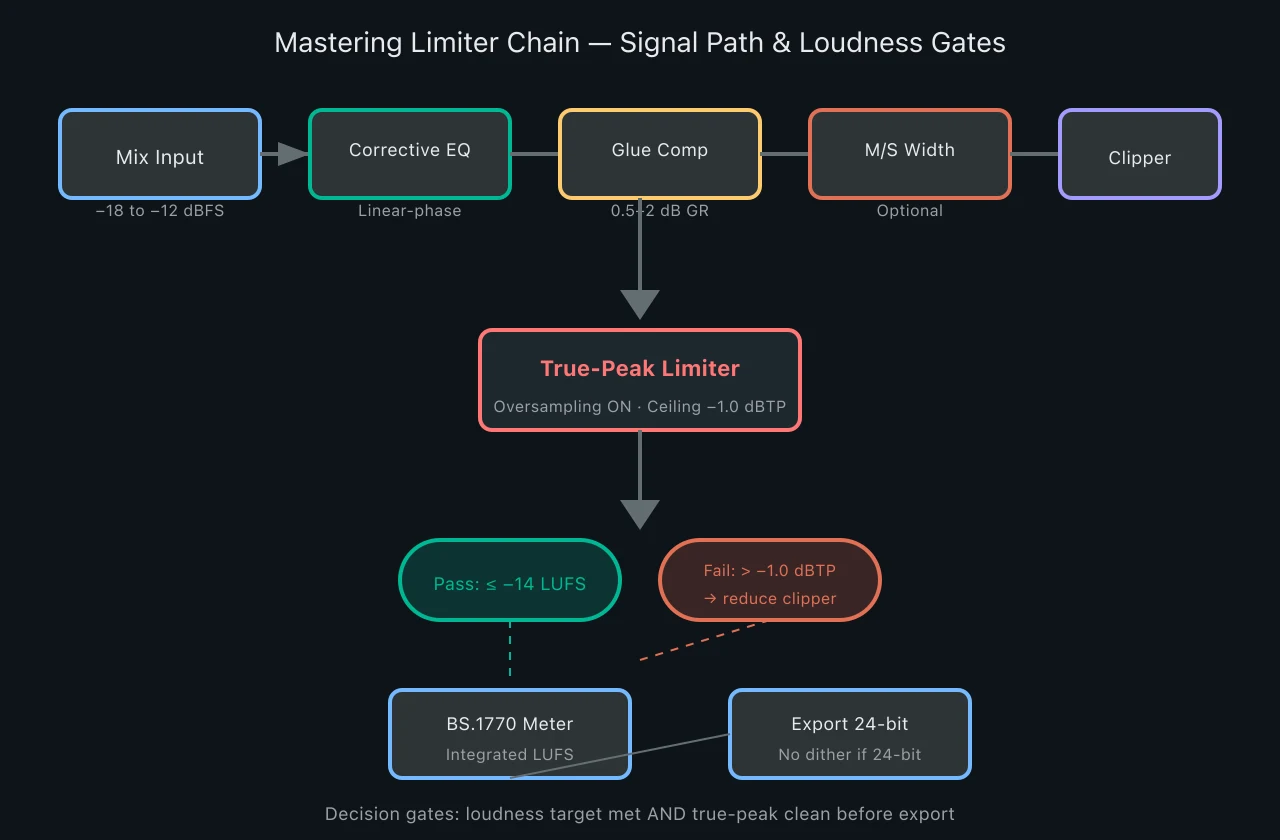
Mastering limiter chain signal path with LUFS decision points
Clipper-before-limiter ordering reduces limiter workload — the limiter sees a softer crest factor and produces fewer intersample artifacts. If true-peak fails after limiter adjustment, walk backward one stage rather than slamming ceiling lower.
Translation Checklist Before Purchase
A mastering VST earns its license only if masters survive playback environments you do not control. Run every trial candidate through this checklist on the same reference mix — not the vendor's demo session.
Consumer Devices
Export at −14 LUFS integrated with −1.0 dBTP ceiling. Listen on Apple earbuds, a car stereo via aux, a TV soundbar, and one Bluetooth speaker with mono fold-down. Note harshness above 6 kHz, vocal swallowing around 300–500 Hz, and bass bloom below 60 Hz.
Normalization Simulation
Load the export into a DAW and apply −3 dB and +3 dB gain to simulate platform normalization. Masters that crumble when turned up reveal limiter pumping or phase issues. Masters that sound unchanged when turned down were over-limited for no competitive gain.
Mono and Phase
Summed mono should retain vocal intelligibility and kick definition. Correlation readings below 0.3 on extended passages suggest side-phase problems introduced by M/S widening or linear-phase stacking.
Low-Volume Intelligibility
Play at conversation-level volume. Professional masters remain balanced when quiet — if the chorus disappears, dynamics processing is masking not mastering. This test separates transparent limiters from maximizers that trade density for punch.
False-Economy Traps in Plugin Shopping
Mastering VST shopping has predictable capital leaks. Avoid these before they become sunk cost.
Trap 1: Bundle Bloat
Sale bundles pack 40 mixing plugins and call two of them "mastering." You pay for convolution reverbs you will never insert on a master bus. Buy the limiter and meter first; add character EQ when a specific harmonic profile justifies it.
Trap 2: Analog Modeling Latency
Heavy analog-modeled suites can add 2,000+ samples latency per instance. That breaks low-latency headphone monitoring and confuses A/B bypass timing. Verify reported latency in your DAW before committing — mastering chains stack multiple instances.
Trap 3: Maximizer as Limiter Substitute
Loudness maximizers optimize perceived density. They are not true-peak safe limiters. Relying on a maximizer alone exports intersample violations that aggregators flag. Use maximizers as optional color before a true-peak limiter, never as the final ceiling.
Trap 4: Preset Dependency
"Spotify Ready" presets assume generic spectral balance. Your mix may already carry 3 dB excess at 3 kHz — the preset adds more. Presets accelerate workflow only after you calibrate offsets per genre. Blind preset export is how masters sound the same and wrong.
Trap 5: Duplicate Metering
Three loudness meters on one bus with different ballistics produce three "correct" readings. Standardize one BS.1770-compliant meter. Duplicate metering is not redundancy — it is conflicting audit trails.
Studio-Grade vs Bedroom Selection Criteria
Professional mastering rooms and bedroom setups need different VST emphasis. Neither is inferior — but buying studio tools without studio monitoring wastes money.
Studio-Grade Criteria
Treated rooms favor minimum-phase character EQ, analog-modeled compression, and limiters with subtle harmonic color — with 8× oversampling on the final stage when CPU allows. Budget: 40% limiter/meter, 30% EQ, 20% dynamics, 10% utility.
Bedroom Criteria
Untreated rooms benefit from linear-phase corrective EQ, correlation meters, and spectrum overlay. Prefer transparent, low-latency processors over color boxes ears cannot verify. Budget: 35% metering, 35% true-peak limiter, 20% corrective EQ, 10% dynamics.
Hybrid Upgrade Path
Start with meter, limiter, and linear-phase EQ. Add glue compression after room treatment; add M/S and character tools when monitoring upgrades justify them.
Fourteen-Day Trial Evaluation Protocol
Vendor trials are marketing funnels unless you impose structure. Run this protocol on every mastering VST candidate during the trial window.
Days 1–3: Meter and Limiter Baseline
Install only the limiter and loudness meter. Process three owned mixes: dense EDM, dynamic acoustic, vocal-forward pop. Document integrated LUFS, true peak, and A/B delta at matched loudness. Reject candidates that cannot hit −14 LUFS integrated at −1.0 dBTP without audible pumping on acoustic material.
Days 4–7: EQ and Dynamics Layer
Add corrective EQ and bus compression to the trial chain. Re-run the same three mixes. Measure whether EQ introduces pre-ringing (linear-phase) or width collapse (minimum-phase). Compression should show under 2 dB gain reduction on pop material unless stem mastering demands more.
Days 8–10: Translation Battery
Execute the full translation checklist on one finalized master per genre. Score each plugin chain 1–5 on earbuds, car, mono, and low-volume tests. Discard chains scoring below 3 on any consumer device.
Days 11–14: CPU, Latency, and Recall
Stress-test CPU at 96 kHz session rate with full chain engaged. Save and reopen sessions to verify preset recall and automation integrity. Note licensing terms: ilok, machine limits, and offline grace periods matter for touring laptops and multi-machine studios.
According to audio plug-in licensing practice, perpetual licenses with paid maintenance differ from subscriptions — model three-year total cost, not first-year promo pricing.
FAQ: Mastering VST Loudness and Tooling
What integrated LUFS should I master to for Spotify?
Target −14 LUFS integrated with −1.0 dBTP true peak as a starting point. Heavier genres may push toward −11 to −12 LUFS integrated if artistic intent demands density — but expect normalization to turn down hot masters. Preserve dynamic range; do not chase pre-normalization loudness wars platforms already settled.
Is oversampling necessary on mastering limiters?
Yes for streaming deliverables. Oversampling reveals intersample peaks the base sample rate hides. Minimum 4× on the final limiter; 8× if CPU allows. Compare true-peak readouts with oversampling on and off — if peaks jump more than 0.3 dBTP, keep oversampling enabled for export.
Should I buy one mastering suite or build a modular chain?
Suites accelerate workflow and suit engineers mastering fewer than five releases monthly. Modular chains suit engineers with existing mix-bus favorites who need only a limiter-meter upgrade. Use the decision tree branches above — not brand loyalty — to choose.
Which VST types matter most for stem mastering?
Multiband compression with adjustable crossovers, dynamic EQ, phase-linear corrective tools, and a summing limiter with true-peak metering. M/S capability per stem bus helps but is secondary to multiband control.
Why must trials use my own mixes?
Vendor demo sessions are spectrally balanced and dynamically controlled — they flatter plugins that fail on real client material with harsh vocals, uneven bass, or mix-bus distortion. Your mixes expose corrective EQ needs and limiter pumping honestly.
Can bedroom producers master professionally with VSTs alone?
Plugins can meet loudness and true-peak specs from any room. Translation quality depends on monitoring. Pair bedroom VST chains with headphones you know, a BS.1770 meter you trust, and the translation checklist — not untreated nearfields alone.
Professional Mastering VST Summary
Choosing professional audio mastering software VST is not a leaderboard exercise. The right chain matches release-path loudness rules, monitoring class, and stem versus two-bus workflow — then proves itself on your mixes through true-peak-safe limiting, BS.1770 metering, and consumer-device translation.
Buy infrastructure first: meter, true-peak limiter, corrective EQ. Layer character and M/S tools when revenue and room treatment justify them. Run the fourteen-day trial protocol without presets or demo sessions. Reject plugins that pass the meter but fail earbuds — because listeners never open your DAW to admire the waveform.


