

Reduce YouTube CPV on your next music campaign starts at the media buyer desk—not on the tour bus. At 9:47 a.m. on a Tuesday, three tabs are open: a Google Ads account with a learning-phase warning, a spreadsheet where gross CPV looks acceptable until you subtract kids-app placements, and a Slack thread where the artist manager wants "more views for the same money" without defining whether those views should convert to pre-saves or simply signal momentum. That desk is where cost-per-view either becomes a controlled input or a vanity number that flatters a bad buy.
This article is an operations playbook for label marketers, indie growth leads, and agency buyers running video ads against music assets. You will not find SEO keyword ledgers or video-suite software reviews here—those are different lanes. Instead: the CPV formula, a waste taxonomy, creative levers, bidding and audience discipline, measurement hygiene, and a test calendar you can paste into a campaign brief. Julian Cole's media-ops lens treats CPV as a waterfall metric: gross platform CPV is rarely the number that should drive budget decisions.

CPV optimization is spreadsheet discipline before it is creative genius—exclusions and measurement define the real number.
CPV Formula for Music Campaigns
YouTube bills most music promotion through YouTube Ads on a cost-per-view basis when you run video view campaigns or certain video reach objectives. A view typically counts after thirty seconds of playback—or the full duration if the creative is shorter—or when a user engages with the ad. CPV equals total spend divided by counted views. Simple division; messy inputs.
For a music campaign, segment CPV into layers buyers actually control:
Gross CPV — platform-reported average across all placements and audiences. Useful for pacing, dangerous for optimization.
Eligible CPV — views after removing known junk inventory (kids content, parked placements, MFA-style channels) via placement exclusions.
Intent CPV — views from audiences that match your conversion definition: similar-artist affinity, custom intent, or remarketing pools with demonstrated engagement.
Outcome-adjusted CPV — spend divided by views that also produced a downstream signal you trust: pre-save click, profile visit, thirty-second view with sound-on, or email capture.
Julian Cole's rule on music video buys: never compare gross CPV across artists without matching objective, geography, and creative length. Pair CPV with view rate and average watch percentage—cheap CPV with collapsing watch time usually means subsidized skip behavior on junk inventory.
CPV Cousins: Skip Rate and Hook Length
Skip rate is CPV's impatient cousin on skippable inventory. High skip rates inflate effective cost per retained second—track both in the same placement report. Hook length governs both: front-load chorus, riff, or vocal timbre before the skip button wins. Test hook-led cuts against full-video ads; the official music video is not always the best ad asset.
Waste Taxonomy: Where CPV Inflates
Before bidding tricks, map where spend leaks. Most music campaigns bleed in predictable buckets.
Placement Waste
Autopilot distribution sends ads into mobile game walkthroughs, kids nursery rhyme compilations, and low-CPM parked domains that juice view volume. Views are cheap; humans are not listening. Build and maintain placement exclusion lists at account level. Refresh weekly during learning phase, then biweekly at scale. Export placement reports where average view duration falls below eight seconds and exclude aggressively.
Audience Waste
Broad affinity expansions ("Music Lovers," enormous custom segments scraped from unrelated site traffic) compress CPV while destroying listener quality. Cheap views from audiences who cannot name a single similar artist will not convert to saves—and they poison lookalike seeds if you feed them back into modeling.
Frequency Waste
Uncapped frequency buys repeat impressions to the same viewer until CPV looks efficient but attention is exhausted. Set frequency caps on prospecting—typically three to five impressions per seven days for cold music audiences. Performance retargeting pools tolerate higher caps; that nuance belongs in funnel architecture, not this CPV primer. For launch prospecting, repetition without creative rotation raises CPV on marginal impressions and trains viewers to skip.
Creative Waste
Static or slow-open video ads trigger skips before the view counter matters. Mismatch between ad promise and landing experience—clicking through to a dead profile or unrelated playlist—does not raise CPV but raises effective cost per meaningful outcome.
Measurement Waste
Counting views without sound-on segmentation, device context, or placement cohorts flatters campaigns that win on muted mobile feeds. Measurement waste is operational: wrong columns in the export drive wrong exclusions next week.
According to broader online advertising economics, platforms optimize toward the event you pay for—views—not toward the outcome your release needs. The waste taxonomy is how you reintroduce business intent into an algorithm optimizing CPV alone.
CPV Waterfall: Gross to Net Quality
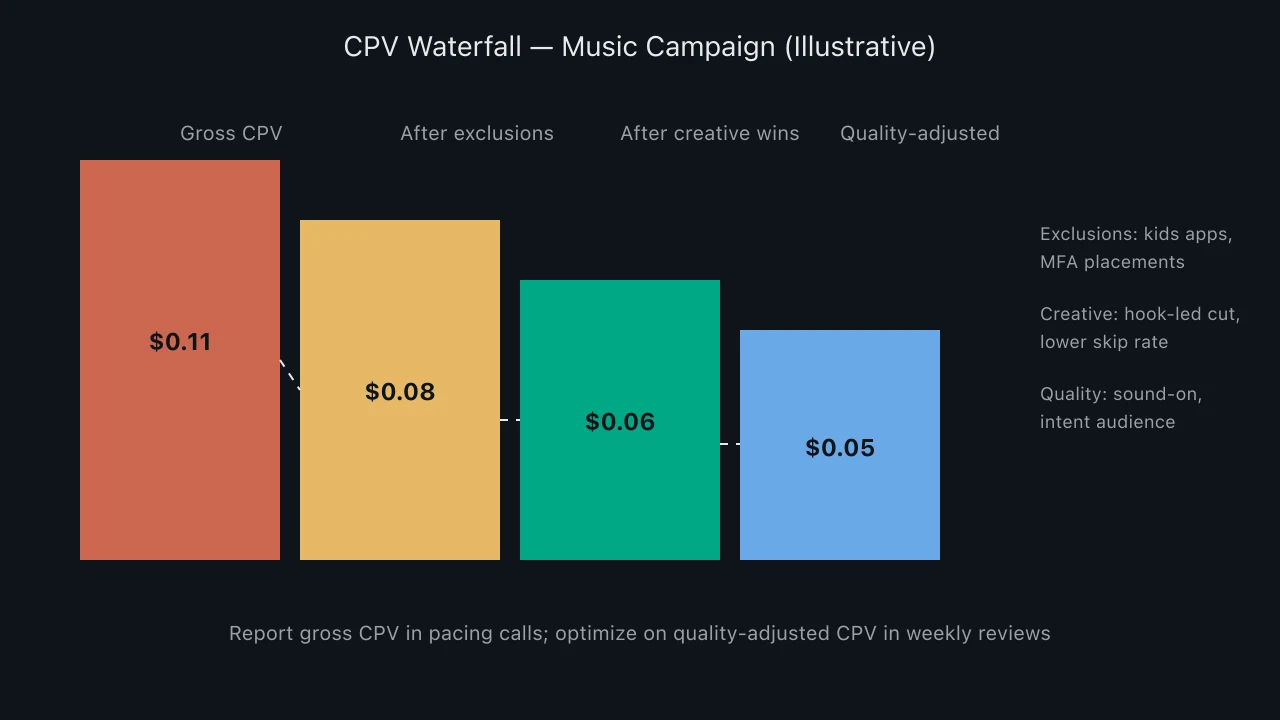
Music campaign CPV waterfall
The waterfall is illustrative—your absolute dollars differ by genre, territory, and creative—but the sequence is stable. Teams that bid down gross CPV without running the exclusion layer first often re-import the same junk inventory at a slightly lower auction price. Exclusions change the game board; bids only change seat assignment.
Music Campaign CPV Levers and Expected Impact
| Lever | Implementation | Expected CPV Impact (Illustrative) | Quality Tradeoff |
|---|---|---|---|
| Placement exclusion lists | Weekly export; exclude sub-8s avg view duration | −12% to −28% gross CPV | Low risk if monitored |
| Frequency caps (prospecting) | 3–5 impressions / 7 days cold pools | −5% to −15% effective CPV | May slow reach initially |
| Hook-led 15s creative cut | Chorus-first edit vs full MV ad | −8% to −22% skip-adjusted cost | Brand story truncated |
| Similar-artist custom intent | Seed from 5–10 peer channels + keywords | +5% to +18% CPV vs broad | Much higher save intent |
| Device bid modifiers | Reduce mobile TV or raise desktop | −3% to −12% on target device | Reach shifts by device |
| Geo bid modifiers (high level) | Trim low-stream territories in week one | −6% to −20% in kept geos | Requires stream data overlay |
| Sound-on creative overlay | Text cue: "Turn sound on" | −4% to −10% wasted views | Minor aesthetic compromise |
| Learning phase patience | No bid edits for 72h / 50 conversions | Stabilizes ±20% CPV volatility | Short-term inefficiency |
| Audience tightening | Remove broad "Music" expansions | +10% CPV, −35% junk views | Smaller top-of-funnel |
| Daypart restriction | Evening-heavy for youth genres | −5% to −14% CPV in window | Off-hours reach loss |
Ranges assume a mid-budget indie release in English-language markets with skippable in-feed inventory. Treat cells as hypothesis bands for your test calendar, not guarantees. The lever that raises nominal CPV—similar-artist intent—often lowers cost per pre-save when measured honestly.
Creative Levers That Move CPV
Creative is the highest-leverage layer because it affects skip rate, view duration, and audience quality simultaneously. Media buyers cannot bid their way out of a weak first three seconds.
Hook Architecture
Lead with the chorus or drop—not the cinematic intro your director loved. Fifteen-second and thirty-second cuts should be separate exports, not afterthought trims. Label the variants clearly in Ads so reporting stays clean. Rotate two hooks minimum during week one to avoid creative fatigue masking as CPV inflation.
Thumbnail and First Frame
The first frame is your silent hook on muted autoPlay feeds. High contrast, readable artist name, emotional face or kinetic motion—avoid black frames and credit rolls. Muted viewers who unmute after a visual pattern interrupt often sustain watch time.
Brand vs Performance Goals
Brand campaigns prize recognition; performance campaigns prize retained seconds and click-through. Running a brand film under pure CPV optimization creates internal conflict—split objectives into separate ad groups with separate creatives. One asset cannot serve every KPI on one bid strategy.
Format Selection (Light Touch)
Skippable in-stream inventory dominates many music prospecting stacks; discovery-style surfaces behave differently on intent. Choose formats that match funnel stage, but for CPV reduction today, prioritize hook strength and placement hygiene over format shopping.
Landing Alignment
Send viewers to one focused destination—smart link with a single CTA, or official video with end-screen save prompt. Multi-link gardens dilute conversion.
Bidding and Audience Discipline
After exclusions and creative baselines exist, bidding and audience structure fine-tune CPV without reintroducing waste.
Audience Quality vs Cheap Views
The algorithm will find cheap views if you let it. Start tighter: custom intent from similar artists, festival lineups, and genre search terms, plus a small customer match list from email subscribers. Expand only after eligible CPV and watch percentage stabilize—not as a day-three panic button.
Bidding Strategy and Learning Phase Patience
Target CPV or maximize views with a CPV cap are common indie starting points. No structural edits until fifty view conversions or seventy-two hours—unless placement reports show catastrophic waste. When cutting spend, reduce daily budget before deleting audiences or rewriting creative.
Geo and Device Modifiers (High Level)
Overweight geos where streaming saves cluster; trim territories with zero historical engagement via negative modifiers. Device-wise, connected TV may deliver cheap views with weak save follow-through; mobile often wins for discovery clicks. Adjust bid modifiers modestly—±10% to ±20%—until sample sizes justify bolder moves.
Frequency Caps in Practice
Prospecting ad groups carry three-to-five-per-seven-days caps. Separate remarketing ad groups—when you run them—can breathe higher caps because the viewer already knows the artist. Document cap policy in the campaign brief so account managers do not "temporarily lift caps for reach" and silently inflate effective CPV.
Measurement Hygiene
CPV optimization without measurement discipline is guesswork with a currency symbol.
Core Columns to Export Weekly
Pull placement, device, audience segment, creative variant, average view duration, view rate, CPV, impressions, and frequency. Store dated exports so exclusion rationale survives buyer turnover.
Sound-On and Engaged View Proxies
Use average view percentage above fifty percent on fifteen-second creatives as a proxy for attentive viewing. Flag high-CPV creatives with sub-thirty percent duration for pause or rework.
Brand vs Performance Reporting
Report gross CPV and quality-adjusted CPV in the same deck. Tie performance flights to pre-save clicks and subscriber lift so CPV sits inside outcome context.
Placement Exclusion Governance
Maintain a living exclusion sheet: placement URL, date, reason, average view duration, owner. Review quarterly for false positives on legitimate music channels.
Test Calendar for CPV Reduction
Run tests in sequence, not parallel chaos. Parallel structural tests invalidate learning phase signals.
Week Zero — Pre-Flight
Finalize two hook-led cuts and one full-video variant. Load account-level placement exclusions from prior campaigns or industry starter lists. Define quality-adjusted CPV formula in writing. Set frequency caps on prospecting. Confirm conversion tracking to landing page primary CTA.
Week One — Baseline
Launch with tight similar-artist audiences and target CPV bidding. No bid edits days one through three. Daily: scan placement report for catastrophic waste only. Day four: first exclusion batch from sub-eight-second placements. Day seven: creative winner by eligible CPV and average view percentage, not gross alone.
Week Two — Optimization
Pause losing creative. Shift ten to twenty percent budget toward winning hook. Apply modest device and geo modifiers informed by streaming heat—not national guesswork. Introduce second audience seed only if week-one eligible CPV is stable within ± fifteen percent.
Week Three — Scale or Stop
If quality-adjusted CPV trends down and downstream clicks hold, increase daily budget fifteen percent every forty-eight hours until marginal CPV rises more than twenty percent—then hold. If CPV flatlines high, swap hook before touching bids. If skips dominate, shorten open before expanding reach.
Week Four — Retrospective
Document waterfall movement: gross to post-exclusion to post-creative CPV. Archive exclusion additions. Feed winning audiences and creatives into the next release flight—continuity beats rebuilding from zero each single.
Julian Cole's test calendar discipline: one major lever change per three-day window. Buyers who change audiences, creatives, and bids simultaneously cannot attribute movement—and usually blame the algorithm instead of the brief.
When Low CPV Signals Trouble
Suspiciously low CPV with exploding view volume and flat pre-saves often traces to junk inventory or incentivized traffic—audit before scaling. Sudden CPV drops after audience expansion without creative change frequently precede a placement quality cliff visible in average view duration forty-eight hours later. Inexpensive attentive views toward a defined outcome beat vanity $0.02 views every time.
FAQ: Reduce YouTube CPV on Music Campaigns
What is a good CPV for a music campaign?
Genre and geography move benchmarks too much for one universal number. Indie prospecting in U.S. English markets often lands $0.04–$0.12 gross CPV on skippable inventory; prioritize eligible CPV and cost per pre-save over chasing $0.02 vanity views.
How long should I wait during the learning phase?
Hold structural changes for at least seventy-two hours or fifty view conversions. Minor placement exclusions for extreme waste are fine; wholesale bid strategy swaps are not.
What frequency cap should I use?
Three to five impressions per seven days on cold prospecting is a sane default. Raise caps only in engaged remarketing pools with distinct creative.
Should I advertise the full music video or a short cut?
Test both. Hook-led fifteen-to-thirty-second cuts usually win on skip rate and eligible CPV; full MV may win on brand recall. Separate ad groups keep data honest.
When does CPM matter more than CPV?
Reach-and-frequency brand flights bought on CPM prioritize impressions over thirty-second views. If your KPI is attentive views toward saves, CPV campaigns with strong hooks are the cleaner fit.
Where do I start with placement exclusions?
Export week-one placement report, sort by impressions, exclude channels with sub-eight-second average view duration and obvious kids-app or unrelated gaming content. Iterate weekly.
Should I ever accept higher CPV?
Yes—when tighter audiences raise CPV but lower cost per save or cost per ticket click. CPV is an input metric, not the campaign scoreboard.
Reduce YouTube CPV Summary
Reduce YouTube CPV on your next music campaign by treating cost-per-view as a waterfall: strip placement waste, tighten audiences even when nominal CPV rises, front-load hooks to tame skip rate, respect learning phase patience, and report quality-adjusted CPV beside gross. Before scaling, confirm account-level exclusions, frequency caps on cold pools, and stakeholder alignment on whether this flight optimizes views alone or views toward saves. The media buyer desk wins when exclusions and measurement run before bid aggression.


