

Fourteen days before release, the whiteboard in the label war room has one empty column labeled "warm." Prospecting budgets are allocated. Teaser clips are scheduled. Nobody has written down who gets a second impression—or what that impression should say. By launch morning, the same team will panic-buy broad reach because pre-save velocity stalled, while three thousand people who watched the full teaser twice receive zero follow-up. That gap is not a creative problem. It is missing retargeting ad funnels architecture for a single launch.
This article is a build spec for growth leads, indie marketers, and agency buyers running one song, one EP, or one album cycle—not evergreen catalog remarketing. You will map audience windows (video viewers at seven and thirty days, site visitors, pre-save abandoners), sequence creatives so each pool hears the right message, set frequency caps that protect attention instead of burning it, and wire exclusion logic so converters never see "pre-save now" after they already saved. Julian Cole's media-ops lens treats a single launch as a closed-loop flight: every pool has an entry rule, a message, a CTA, an exit rule, and a hard end date tied to release week—not an always-on remarketing account collecting dust until the next era.

Retargeting ad funnels for a single launch are drawn before spend goes live—audience windows and exclusions are the blueprint, not a week-two patch.
Single-Launch Funnel vs Evergreen Remarketing
Evergreen remarketing chases anyone who ever visited your store. Single-launch retargeting chases people who engaged with this asset inside a defined pre-release and release window. The distinction matters because platform pixels and custom audiences decay, creative relevance expires, and frequency tolerance collapses once the song is no longer "new."
A proper single-launch funnel has four properties:
Time-bounded pools. Video viewer audiences use rolling seven-day and thirty-day windows during the campaign, then get archived—not left running into tour season with stale creative.
Stage-specific CTAs. A thirty-day viewer who never clicked pre-save needs a different message than a seven-day viewer who watched ninety percent of the teaser but bounced at the landing page.
Exclusion cascades. Pre-save converters exit all upper-funnel ads immediately. Release-day streamers exit pre-save messaging. Purchasers of merch or tickets exit performance CTAs meant for cold engagers.
Frequency governance. Caps differ by pool heat. Hot seven-day viewers tolerate more repetition than lukewarm thirty-day viewers—provided creative rotates.
According to broader retargeting practice, platforms optimize toward the audience you feed them. If you merge all engagers into one blob, the algorithm will over-index on the cheapest impression within that blob—usually your least intent viewers. Segmentation is not bureaucracy; it is how you reintroduce launch intent into auction dynamics.
Audience Windows for Music Launches
Build pools before you spend a dollar on prospecting. Prospecting fills the top; retargeting converts the middle. Without pre-built windows, you lose seven to fourteen days of platform learning while custom audiences populate.
Video Viewers: 7-Day and 30-Day
Split video engagers into at least two tiers on Meta and YouTube:
7-day viewers (hot). Anyone who watched twenty-five percent or more of teaser, snippet, or official video in the last seven days. Optional tighter slice: seventy-five percent completion for "hook convinced, CTA pending" messaging.
30-day viewers (warm). Same watch thresholds, longer window. These people showed interest but cooled. Message should re-establish novelty—release date, feature credit, behind-the-scenes proof—not repeat the identical teaser hook.
Do not stack 7-day inside 30-day without exclusions. Run parallel ad sets: 7-day hot pool gets priority budget; 30-day pool excludes 7-day members so messaging stays distinct.
Site Visitors and Smart-Link Traffic
Pixel or tag every pre-save landing page, link-in-bio destination, and official site release hub. Minimum segments:
All site visitors (14-day). Broad warm pool for reminder creative.
High-intent page visitors (7-day). People who hit pre-save page, store page, or ticket page but did not complete the action. Requires event-level tracking or thank-you page exclusion.
Multi-session visitors (7-day). Two or more sessions in seven days signals deliberation—strong candidate for social proof ("10K pre-saves") or urgency ("48 hours left").
Pre-Save Abandoners
Pre-save abandoners are the highest-yield retargeting pool most indie teams skip because tracking is messy. Define abandonment as: clicked through to DSP pre-save flow or smart-link intermediate page, spent more than eight seconds, did not reach confirmation/thank-you event. On platforms that cannot see in-app save completion, proxy with return visits to the same pre-save URL without referral from paid creative within twenty-four hours.
Cap this pool aggressively on message repetition—they almost converted. One reminder plus one urgency variant usually suffices. If they still do not save after three impressions in five days, move them to passive 30-day viewer messaging instead of hammering pre-save.
Retargeting Funnel Stages: Single Launch
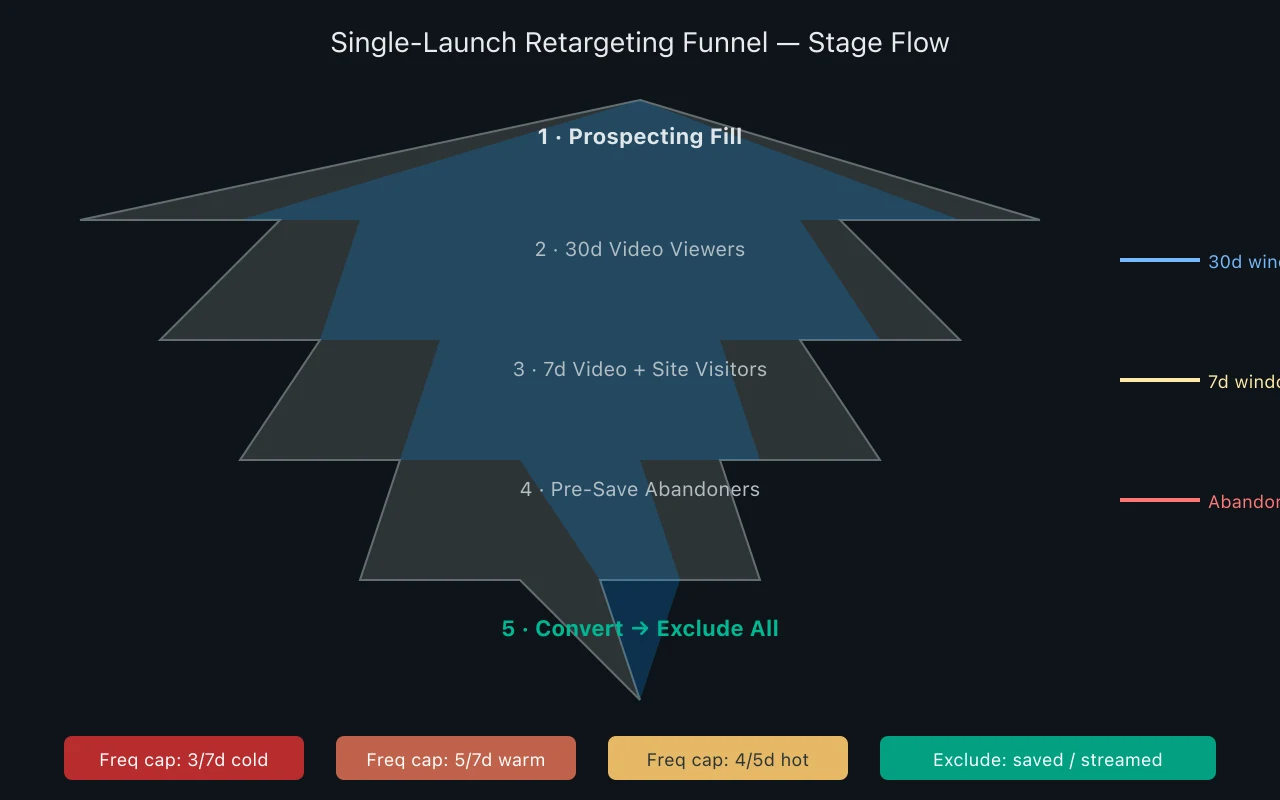
Single-launch retargeting funnel stages
The funnel narrows by intent, not by arbitrary budget percentage. Prospecting feeds volume; each lower stage receives tighter creative and stricter caps until conversion triggers a hard exclusion from all pre-release messaging. Teams that invert the pyramid—heavy spend on abandoners before 7-day pools exist—pay for urgency ads shown to people who never saw the artist name.
Creative Sequence by Funnel Stage
Retargeting creative is sequential storytelling under time pressure. You are not remixing the same fifteen-second hook six times; you are advancing the launch narrative.
Stage One — Awareness Bridge (30-Day Viewers)
Assume they forgot the title. Lead with artist name, release date, and one new visual—studio clip, cover art motion, feature artist tag. CTA: pre-save or "remind me." Avoid deep lore; this pool needs re-introduction.
Stage Two — Intent Amplify (7-Day Viewers + Site Visitors)
They remember something. Show the strongest hook again, but swap the frame: countdown sticker, fan comment overlay, or playlist placement screenshot if available. CTA: single-action pre-save button language. One variant with feature artist callout if split testing shows lift.
Stage Three — Abandon Recovery
Short, direct, almost transactional. "Finish your pre-save—30 seconds." Show the exact button path on mobile. Social proof acceptable ("Join 12K early listeners"). No new storyline—reduce friction only.
Stage Four — Release Flip (Launch Day Through Day Seven)
At midnight local or global release moment, swap all pre-save creative to stream/share/ticket variants via rules or scheduled ad set swaps. Pre-save pools that did not convert become "out now" pools—still excluded if they converted on release day via pixel events.
Minimum two active variants per pool; rotate every four to six days pre-release, every forty-eight hours during release week. Julian Cole's sequence discipline: never run abandon-recovery creative to 30-day viewers who never reached the landing page.
Audience → Message → CTA → Window
| Audience Pool | Core Message | Primary CTA | Active Window |
|---|---|---|---|
| 30-day video viewers (25%+ watched) | Re-introduce single + release date; new visual angle | Pre-save / add reminder | T−21 to T−1 (rolling 30d) |
| 7-day video viewers (25%+ watched) | Hook replay + urgency countdown | Pre-save now | T−14 to T−1 (rolling 7d) |
| 7-day video viewers (75%+ watched) | "You heard the best part—save before drop" | One-tap pre-save | T−10 to T−1 (rolling 7d) |
| Site visitors — all pages | Social proof + release date reinforcement | Return to pre-save page | T−14 to T+3 (rolling 14d) |
| High-intent page visitors (no conversion) | Friction removal; show mobile save steps | Complete pre-save | T−10 to T−1 (rolling 7d) |
| Pre-save abandoners | Transactional reminder; minimal story | Finish pre-save | T−7 to T−1 (5d max exposure) |
| Pre-save converters | Thank-you / share-with-friend (optional) | Share link / follow profile | T−7 to T+7 — exclude from pre-save ads |
| Release-day streamers (pixel/event) | Deep cut tease, tour dates, merch | Stream album / buy ticket | T+0 to T+14 (rolling 7d post-stream) |
| Email list — prior release savers | Early access tone; exclusivity frame | Pre-save / listen first | T−21 to T−1 (upload refresh per launch) |
T = release day. Adjust windows to your campaign length—a surprise drop compresses 30-day pools into seven-day equivalents. Document the table in the campaign brief so media buyers and creative producers share one source of truth.
Frequency Caps That Protect Attention
Frequency caps are the difference between retargeting and stalking. Single launches spike caps during release week; the defaults below assume a standard three-week pre-release plus one-week post-release tail.
Recommended Cap Bands
30-day viewers: three impressions per seven days per ad set. These viewers are warm but distant; repetition without novelty raises hide-and-report rates on Meta and hurts YouTube quality scores.
7-day viewers and general site visitors: five impressions per seven days across all retargeting ad sets combined—enforce with campaign-level frequency rules or audience overlap monitoring.
Pre-save abandoners: four impressions per five days, hard stop. If no conversion, suppress for seven days then downgrade to 30-day messaging.
Release week "out now": six impressions per seven days for converters excluded from pre-save—stream/share creative only. Pair with creative rotation every forty-eight hours.
Caps on Meta do not govern YouTube—assign a notional cross-platform maximum of ten retargeting touches per user per launch week. Lift caps only when creative refreshes and conversion rate holds for forty-eight hours; slow pre-save pace usually signals prospecting or landing page failure, not insufficient retargeting spend.
Exclusion Logic and Cascades
Exclusions are the hygiene layer retargeting funnels live or die on. One misconfigured include rule wastes budget and annoys fans who already saved.
Master Exclusion List (Apply at Campaign Level)
Always exclude: current pre-save converters (updated daily via pixel or API list upload), current release-week streamers from pre-save ad sets, internal label staff IP or test user lists, territories where the single is not available yet if you geo-gate pre-saves, and purchasers where merch/ticket pixels fire.
Pool-to-Pool Exclusions
7-day pools exclude 30-day members receiving parallel messaging—actually invert: 30-day ad sets exclude 7-day members so hot messaging wins. Abandon ad sets exclude confirmed savers and include only abandon event minus converter event. High-intent site visitors exclude people who only bounced from blog posts—URL rules matter.
Temporal Exclusions
After release midnight, pause all pre-save ad sets globally. Do not rely on creative text swaps alone; stale ad sets continue serving in auction caches. Schedule automated rules: T−0 00:01 local, disable pre-save objectives, enable stream objectives, push converter exclusions from overnight batch upload.
Fourteen days after release, archive the entire funnel. Upload saver lists as warm seeds for the follow-up single or suppress engagers briefly if creative fatigue is a concern—document the choice either way.
Platform Setup: Meta, Google, and TikTok
Run one campaign per launch phase—Pre-Release Retargeting, Release Week Retargeting—with ad sets mapped to table rows and exclusions at ad set level. On Meta, use Custom Audiences from video engagement, website events, and customer lists. On Google, build separate YouTube channel and video ad viewer lists; pair with Google Ads remarketing site tags for smart-link traffic. Dedupe across campaigns via shared negative audience lists. Where TikTok retargeting is available, mirror 7-day and 30-day splits with tighter caps—treat it as supplementary unless prospecting already dominates there.
Launch Timeline: Flight Calendar
T−21 to T−14: Install pixels, verify events, publish teaser to seed 30-day pools. Prospecting only until pools hit minimum size (typically one thousand per ad set on Meta).
T−14 to T−7: Enable 30-day, 7-day, and site visitor ad sets. Audit exclusions at T−10.
T−7 to T−1: Activate abandon pool; rotate countdown creative every forty-eight hours. Freeze structural changes at T−48 unless tracking breaks.
Release week: Hard swap to stream/share/ticket messaging; retarget converters with share CTAs, not pre-save repeats.
T+14: Pause all ad sets; export pool performance for the next brief. Julian Cole's rule: if an ad set still says "Single X Pre-Save" after T+14, next launch starts muddy.
Measurement and Diagnostic Metrics
Measure pool-by-pool, not blended ROAS alone. Track impressions, frequency, CTR, cost per pre-save (or cost per stream post-release), and conversion rate from pool entry to CTA completion. Abandon pool CPR should beat 7-day viewer CPR if tracking is honest.
Weekly, sample converted users and verify they are not still receiving pre-save ads—leaks usually trace to delayed event firing or missing thank-you page pixels. Report one slide per pool: window, cap, spend, conversions, CPR, and creative winner so executives see which warm segments moved the single.
Case Study: Indie R&B Single
An indie R&B artist ran a three-week pre-save window with six thousand dollars total prospecting across Meta and YouTube. Retargeting activated at T−14: 30-day viewers got re-intro creative, 7-day viewers got hook-led vertical cuts, abandon pool opened at T−5 after two hundred qualifying sessions.
Abandon pool delivered pre-saves at half the CPR of 7-day viewers; 7-day beat 30-day by thirty-five percent. Retargeting was twenty-eight percent of budget but drove forty-one percent of verified pre-saves. All ad sets archived at T+14; saver list uploaded as warm seed for the follow-up single.
Common Retargeting Funnel Mistakes
Merging all warm audiences. One ad set named "Retargeting All" destroys message fit and obscures diagnostics.
No converter exclusions. Fans who saved see five more pre-save ads and screenshot them for Twitter—not the brand moment you want.
Identical creative across windows. 30-day viewers need re-introduction; abandoners need checkout recovery. Same asset fails both.
Uncapped release week. Enthusiasm spikes frequency to twelve-plus; unsubscribe and hide rates follow.
Evergreen left running. Six months later, ads still say "pre-save" for a catalog track. Calendar end dates are non-negotiable.
FAQ: Retargeting Ad Funnels for a Single Launch
What minimum audience size should I wait for before launching retargeting?
Meta often recommends one thousand people per ad set; YouTube lists can perform below that but with volatile delivery. Start prospecting early enough that pools hit threshold by T−14. If abandon pool stays under five hundred, consolidate with high-intent site visitors rather than forcing a standalone ad set.
How should I split budget between 7-day and 30-day viewer pools?
Start sixty percent toward 7-day and high-intent pools, forty percent toward 30-day during pre-release. Shift toward abandon and 7-day in the final five days. Adjust if CPR data shows 30-day outperforming—rare but possible on story-heavy campaigns.
Do frequency caps work the same on Meta and YouTube?
No. Configure caps per platform and track cross-platform totals manually. YouTube campaign frequency caps apply differently than Meta ad set rules—read current platform docs each launch because UI moves quarterly.
How do I retarget pre-save abandoners if DSP completion is invisible?
Use smart-link intermediate pages, thank-you page fires, click-out events with short window return tracking, and email capture fallbacks. Combine behavioral signals: video 75% plus landing page visit plus no thank-you page equals abandon proxy.
What share of total launch budget should retargeting receive?
Twenty-five to thirty-five percent during pre-release is a common band for teams with healthy prospecting fill. If retargeting exceeds fifty percent, you likely under-built top-of-funnel or over-narrowed prospecting audiences.
When exactly should I swap pre-save creative to stream creative?
At release availability in your primary market timezone—or stagger by region if you geo-stagger DSP availability. Automate via scheduled rules; manual swaps miss overnight impressions in other zones.
Should I exclude fans who pre-saved my last single?
Exclude them from identical messaging if no new hook exists; include them as warm seeds if the narrative continues. Never show them pre-save ads for the old single—archive old flights first.
Retargeting Ad Funnels for a Single Launch — Summary
Build retargeting ad funnels for a single launch by drawing audience windows before spend goes live: 7-day and 30-day video viewers, site visitors, and pre-save abandoners each get distinct messages, CTAs, frequency caps, and exclusion cascades that remove converters immediately. Sequence creative from re-introduction through abandon recovery to release-week stream pushes; archive the entire flight fourteen days after drop so the next single starts clean. Measure pool-by-pool CPR, audit exclusion leaks weekly, and coordinate caps across Meta, YouTube, and any supplementary platforms. The whiteboard "warm" column should never be empty on launch morning—every engager from prospecting deserves a planned second act.


