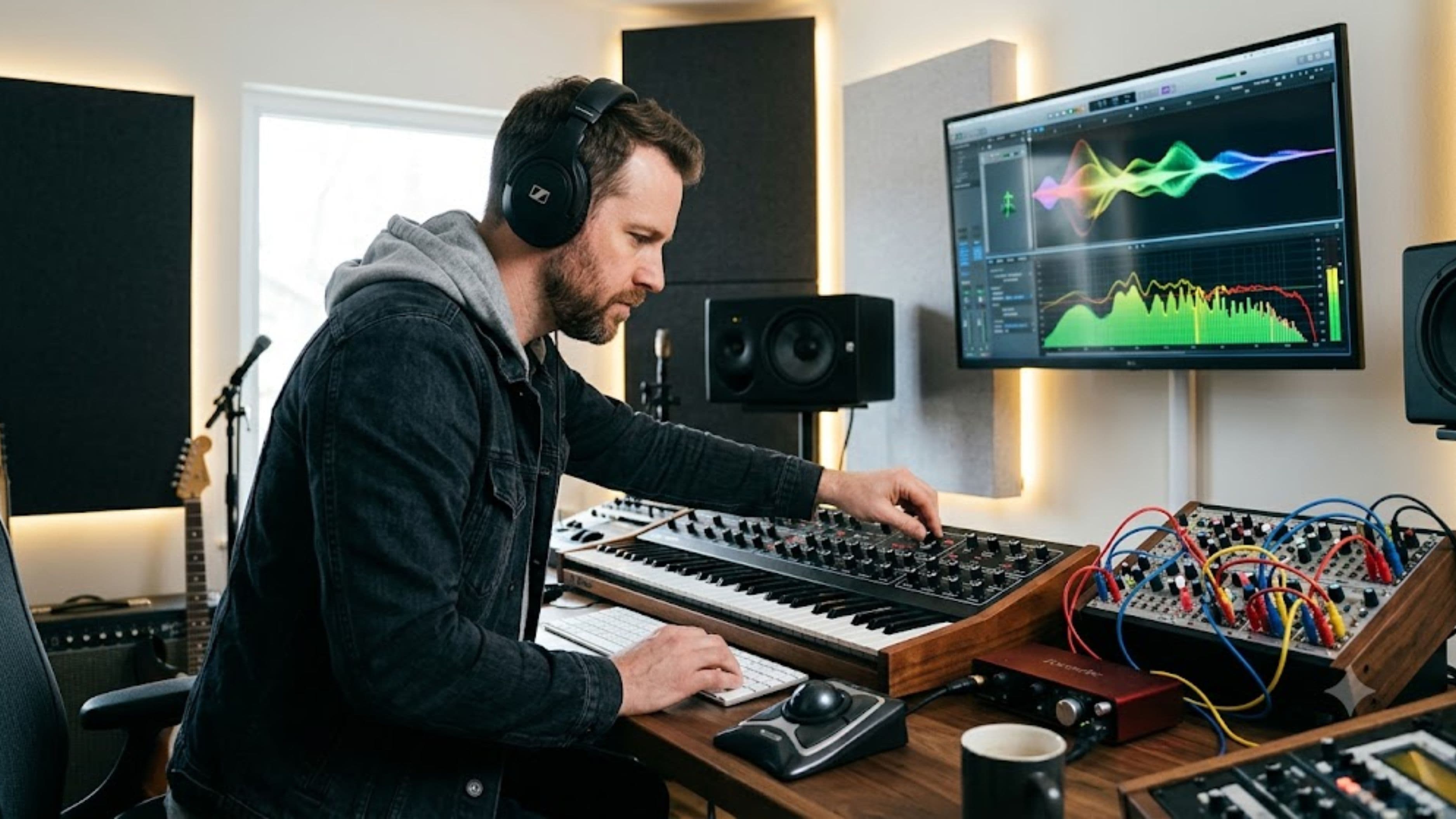
Understanding Waveforms as a Starting Point
Every sound design decision ultimately comes back to waveform shape, since the basic waveform types – sine, square, sawtooth, triangle – each carry distinct harmonic content that determines their character. A sine wave is pure and simple, containing only a single frequency, which makes it useful for sub-bass or clean, focused tones. Sawtooth waves contain a full spectrum of harmonics, giving them a bright, buzzy character that works well for leads and aggressive bass sounds. Square waves sit somewhere in between, with a hollow, woody character from their specific harmonic content.
Understanding this isn't about memorizing waveform math – it's about developing an ear for why a patch built from a sawtooth wave sounds fundamentally different from one built on a sine wave, even before you apply any additional processing.
Filters: Shaping Sound After It's Generated
Once a sound exists, filters determine which frequencies pass through and which get reduced. A low-pass filter, the most commonly used type, allows lower frequencies through while reducing higher ones, which is why sweeping a low-pass filter closed is one of the most recognizable sound design moves in electronic music – it progressively removes brightness, creating a sense of movement or transition.
High-pass filters do the opposite, removing low frequencies while preserving highs, and are commonly used to clean up muddiness in a mix by removing unnecessary low-end rumble from instruments that don't need it, like hi-hats or certain vocal takes. Band-pass filters isolate a specific frequency range, useful for creating telephone-style vocal effects or focusing a sound into a narrow, distinct frequency pocket.
Learning to use filter cutoff and resonance together – resonance boosting the frequencies right at the cutoff point – gives you significantly more control over shaping a sound's character than adjusting cutoff alone.
Envelopes: Controlling How Sound Changes Over Time
A sound's character isn't just about its frequency content – it's also about how that sound develops from the moment it starts to the moment it ends. Envelopes, typically structured as Attack, Decay, Sustain, and Release, control exactly this. A fast attack with a short decay produces a percussive, immediate sound, useful for plucky basses or percussive synth stabs. A slow attack creates a swelling, pad-like quality, useful for atmospheric or ambient elements that need to fade in gradually rather than hit immediately.
Understanding envelope shaping is often what separates a flat, static-sounding patch from one that feels alive and responsive to how it's played. Two identical waveforms with dramatically different envelope settings can sound almost unrecognizable from each other.
Layering: Building Complexity From Simple Elements
Professional-sounding sound design rarely relies on a single oscillator or sample doing all the work. Layering multiple sound sources – a sub-bass sine wave layered under a mid-range sawtooth for harmonic detail, or a clean sample layered with a distorted version of the same sound – builds richness and complexity that a single source alone typically can't achieve.
The key to effective layering is giving each layer a distinct role rather than stacking similar sounds that just compete for the same frequency space. If two layered elements are both fighting for the same low-mid frequency range, layering adds mud rather than depth. Effective layering usually means each layer occupies a slightly different frequency range or serves a different textural purpose within the combined sound.
Modulation: Adding Movement and Interest
Static sounds, no matter how well-designed, can become fatiguing over the length of a full track. Modulation – using an LFO (low-frequency oscillator) to continuously vary a parameter like filter cutoff, pitch, or volume over time – adds a sense of motion and life to a sound that would otherwise stay flat and unchanging throughout a section.
Subtle modulation, like a slow LFO gently moving a filter cutoff back and forth, can add just enough interest to keep a sustained pad or bass sound from feeling static, without being obvious enough to distract from the rest of the arrangement. More extreme modulation, like a fast LFO on pitch, can create the wobble effects common in certain electronic subgenres.
Applying These Concepts Beyond Synthesis
These sound design fundamentals aren't limited to building synth patches from scratch. Understanding filters and envelopes helps you make better decisions when processing recorded audio, choosing samples, or even deciding how to EQ a live instrument recording. A guitarist's tone, a vocalist's recorded take, and a fully synthesized bass patch all respond to the same underlying principles of frequency content, filtering, and time-based shaping.
What to Watch Out For
Don't rely on presets without understanding what they're actually doing under the hood – a preset is a useful starting point, but modifying it effectively requires understanding which parameter controls which aspect of the sound. Avoid over-layering every element in your track out of habit; more layers isn't automatically better if they're competing for the same sonic space rather than serving distinct roles. And resist the temptation to apply heavy modulation to everything at once, since a track where every element is constantly moving can become fatiguing and lose the sense of contrast that makes movement meaningful in the first place.
Frequently Asked Questions
Do I need expensive synths to learn sound design fundamentals? No – most modern DAWs include a capable built-in synth that covers waveforms, filters, envelopes, and modulation, which is more than enough to learn and apply these core concepts.
Is sound design only relevant for electronic music? No – understanding filters, envelopes, and frequency content improves decision-making across genres, including how you approach mixing recorded instruments and vocals.
What's the best way to practice sound design fundamentals? Start by recreating simple, familiar sounds from scratch using a basic synth, focusing on one concept at a time – waveform choice, then filtering, then envelope shaping – before combining them.
📚 Sources
Sound on Sound – "Synthesis Basics" resources – https://www.soundonsound.com/techniques
Ableton – "Learning Synths" – https://learningsynths.ableton.com/