

Soundcharts platform review evaluates one of the most complete airplay-plus-streaming intelligence suites available to labels, publishers, and artist teams who need radio, playlist, and social signals in one subscription. Unlike scouting-first competitors, Soundcharts built depth around broadcast monitoring, chart trajectories, and competitive benchmarking—making it a favorite for sync teams and campaign analysts who care about traditional media as much as DSPs.
This review covers strengths, weaknesses, pricing considerations, and a practical scorecard for deciding whether Soundcharts earns a line item in your analytics budget.

Soundcharts shines when your strategy still runs through radio, playlists, and charts—not streams alone.
What Soundcharts Is
Soundcharts aggregates streaming playlist placements, radio airplay detections, social metrics, and chart positions into artist and track profiles. It targets music professionals who need multi-channel visibility without building scrapers in-house. Data refreshes frequently enough for weekly campaign reviews; API tiers support larger organizations embedding metrics internally.
Platform Scorecard
| Category | Score (1-10) | Notes |
|---|---|---|
| Playlist intelligence | 9 | Historical adds, reach estimates |
| Radio / airplay | 9 | Core differentiator |
| Social tracking | 7 | Solid; not TikTok-native only |
| UI / learning curve | 7 | Dense but logical |
| Indie affordability | 6 | Premium pricing tier |
| API & exports | 8 | Strong on upper plans |
| Scouting discovery | 7 | Good filters; not only focus |
| Roster management | 8 | Watchlists and comparisons |
Scores reflect editorial assessment for typical indie label use—your weights may differ if radio is irrelevant to your genre.
Pros and Cons
Pros
Unified radio and streaming view reduces tool sprawl. Playlist historical depth supports pitch retrospectives. Chart trajectories help sync and promo teams time announcements. Comparison mode speeds competitive reviews. Customer support responsiveness generally scores well in user forums.
Cons
Entry price can sting for solo artists. Interface density overwhelms casual users first week. Some social metrics lag native platforms during viral spikes. Overlap with Chartmetric or Viberate means careful role definition required.
Campaign Feedback Loop Visual
Soundcharts feedback loop
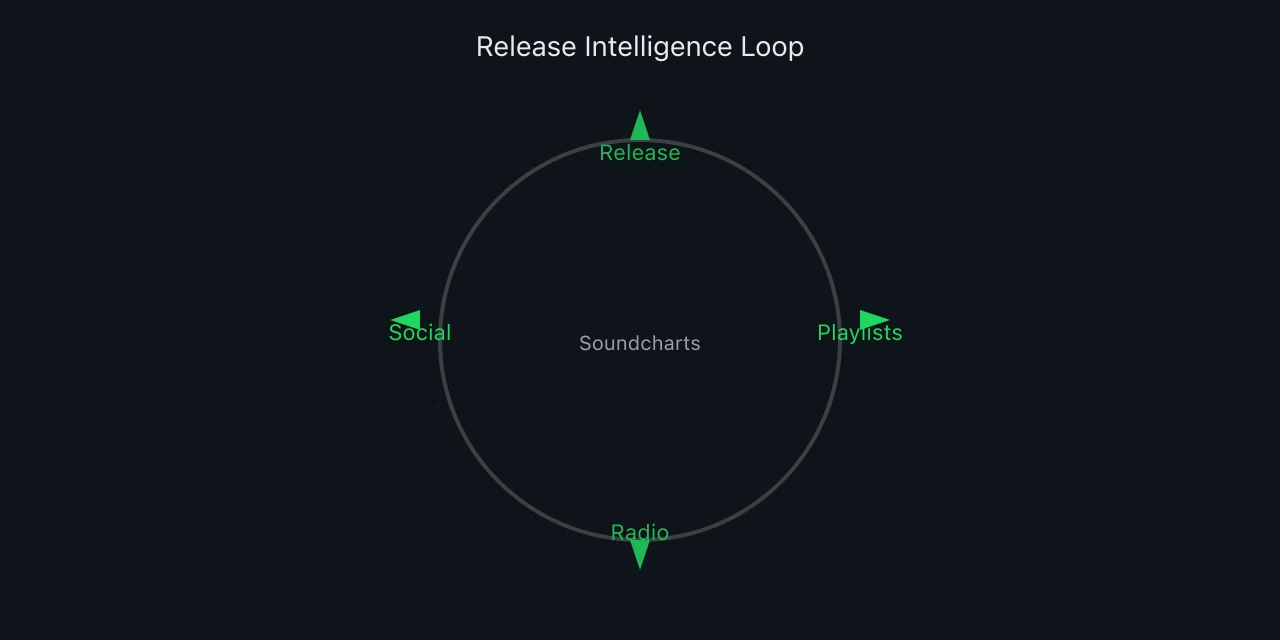
Teams run weekly loops: measure placements, adjust pitches, re-measure—Soundcharts is the hub if you configure watchlists seriously.
Ideal Customer Profiles
Genre-agnostic labels with radio-promo spend. Publishers tracking writer airplay across stations. Sync teams proving momentum to supervisors. Managers defending booking fees with third-party charts. Less ideal: bedroom producers with zero promo budget—Spotify for Artists may suffice.
Radio Depth as Differentiator
Many analytics tools treat radio as an afterthought. Soundcharts inverted that heritage as streaming rose—valuable when AAA, country, or urban formats still drive career breaks. Cross-reference airplay with streaming spikes to see multi-channel stories.
According to music chart and certification systems, multi-channel validation still matters for industry credibility beyond raw stream counts.
Playlist Workflows
Track editorial and algorithmic playlist entries, estimate reach, and review historical adds for pitching narratives. Export adds for Monday label meetings. Pair with internal save-rate data from Spotify for Artists to separate passive from intent-driven placements.
Pricing and Tiers
Tiers scale by seats, API access, and export volume. Annual contracts often discount monthly equivalents. Negotiate at renewal if roster size grew—some teams report flexibility when consolidating duplicate tools.
Onboarding Recommendations
Week one: import roster, configure alerts for top ten priorities. Week two: build competitive comparison templates. Week three: integrate exports into Monday deck. Do not enable every alert—tune to prevent noise.
Soundcharts vs Chartmetric vs Viberate
Chartmetric offers broader API culture; Viberate offers scouting-friendly discovery; Soundcharts wins integrated radio-playlist chart loops for promo-heavy workflows. Some enterprises run Chartmetric plus Soundcharts; indies usually pick one.
Case Study: Sync Pitch Acceleration
A sync coordinator cited Soundcharts radio and playlist trajectory slides in a supervisor meeting—showing six-week growth across formats. The track landed in a trailer placement. Correlation not guaranteed, but third-party charts beat screenshotting Spotify counts alone.
API and Data Exports
Larger labels pipe Soundcharts into Looker or Tableau. Verify rate limits and field definitions before promising executives real-time custom dashboards.
Limitations to Accept
No vendor captures every user playlist perfectly. Airplay detections vary by market monitoring density. Social stats may mismatch native analytics during API changes. Treat Soundcharts as directional truth, reconciled monthly with first-party data.
Who Should Skip Soundcharts
Artists spending under five hundred dollars annually on promotion, genres with no radio pathway, or teams already saturated with Chartmetric enterprise contracts without radio needs.
Verdict
Soundcharts platform review conclusion: recommended for promo-forward labels, publishers, and managers who need radio plus streaming intelligence in one disciplined loop. Less critical for stream-only bedroom genres. Trial against two weekly workflows before committing annual budget.
Soundcharts Review Summary
Soundcharts earns its premium when airplay and playlist history inform real decisions—not when dashboards become vanity wallpaper. Use the scorecard, run the feedback loop weekly, and reconcile with Spotify for Artists to turn subscription cost into campaign clarity.
Airplay Monitoring Workflow
Configure station filters by format and market. Daily email digest of new spins for priority tracks. Weekly summary for roster meeting. Monthly trend for board deck. Soundcharts value compounds when monitoring is ritualized, not ad hoc.
Chart Entry Alerts
Chart entries lag social buzz—alerts still matter for sync and press. Set alerts for territory chart thresholds relevant to your genre: alternative album charts may matter more than global Spotify weekly for legacy acts.
Competitive Benchmarking Routine
Pick three peer artists per priority release. Compare playlist adds, radio spins, and social velocity weekly in Soundcharts comparison view. Relative performance explains narrative when absolute streams disappoint.
Soundcharts for Publishers
Publishers track writer airplay across roster splits. Radio detections support performance royalty forecasts and writer PRO discussions. Streaming alone undercounts writers with radio-forward catalogs.
Integration With PR Campaigns
PR teams cite Soundcharts trajectories in pitch emails to press—third-party charts lend credibility versus artist self-reported "we're blowing up." Keep screenshots updated; stale charts harm trust.
Annual Cancel-or-Keep Review
List decisions made because of Soundcharts data last year. If fewer than five material decisions, downgrade tier or cancel. If sync, radio promo, and playlist strategy all cited it weekly, renew and negotiate.
Soundcharts Mobile Experience
Managers traveling to showcases check mobile web for recent playlist adds before meetings. Test mobile during trial week—dense desktop UI does not always translate.
Embedding in Monday Meetings
Standard slide five: Soundcharts snapshot for top three priorities. Consistency beats depth sporadically. Teams that embed vendor data in meeting cadence extract ROI; teams that login once a month do not.
Radio Promo Team Handoff
Radio promo logs adds in Soundcharts; streaming promo logs playlist adds same Monday sheet. Unified Monday narrative prevents siloed teams contradicting each other in artist calls.
Trial Scorecard Template
Rate one to five: playlist depth, radio accuracy, UI speed, alert quality, export ease, support response. Weight categories by your workflow. Total score above thirty-five on forty-point scale suggests keep; below twenty-eight suggests pass.
Playlist Reach Estimation Accuracy
Soundcharts reach estimates help prioritize which playlist add mattered. Cross-check top three estimates against Spotify follower counts manually quarterly—calibrate trust in estimates per your genre.
Friday Release Monitoring
Global Friday drops mean Monday Soundcharts reviews are mandatory—weekend adds and radio spins accumulate. Teams that wait until Wednesday miss pitching windows for week two follow-ups.
Soundcharts and Music Reports
Combine Soundcharts airplay with Music Reports sync metadata for supervisor pitches—multi-source packages outperform single-vendor PDFs in competitive sync situations.
Indie Label Budget Tier
If annual promo budget under ten thousand dollars, Soundcharts may consume disproportionate share—evaluate whether Spotify for Artists plus free tiers suffice until budget scales.
Training Videos and Onboarding
Soundcharts offers tutorial content—invest two hours in vendor onboarding videos before declaring UI too dense. Undertrained teams undervalue subscriptions they never learned to use.
Supervisor Pitch Deck Integration
Embed Soundcharts six-week trajectory GIFs in sync pitch decks—motion shows momentum better than static Spotify counts. Keep GIFs under ten seconds for email attachment size.
Artist Weekly Email Digest
Managers email artists concise Soundcharts highlights: new playlist adds, radio spins, chart entries. Artists feel informed without learning full UI—ROI through communication not login frequency.
Comparing Soundcharts Alternatives
Radio monitoring competitors exist—trial two if airplay is core. Soundcharts wins unified dashboard for many users, but specialist radio tools may beat on specific US market depth.
Soundcharts for Managers
Managers negotiating festival fees show airplay and playlist trajectory to justify higher guarantees—Soundcharts exports become negotiation PDFs. Tool ROI appears in one better fee negotiation.
Daypart Radio Analysis
Radio spins at drive time versus overnight matter for different genres—Soundcharts daypart breakdowns inform radio promo spend timing. Generic spin count hides quality of placement.
Long-Term Contract Value
Multi-year Soundcharts contracts may include training sessions—use them. Unused training is wasted contract value common in mid-size labels.
Expanded Final Verdict
Soundcharts earns recommendation when radio and playlists jointly drive your genre economics. It is less essential for genres with zero radio pathway and pure algorithmic discovery. Score your genre radio coefficient honestly before purchase—sync, country, alternative, and urban often score high; pure hyperpop bedroom may score low.
Soundcharts ROI Calculation
ROI = (sync fees influenced + radio promo efficiency + playlist wins attributed) minus subscription and training hours. Track attributions honestly in shared doc—one supervisor sync yes pays for year.
Team Permissioning Best Practices
Grant interns read-only; promo leads editor; finance view-only exports. Permission hygiene prevents accidental alert deletion or watchlist chaos when roster turnover hits.
Soundcharts vs Spotify for Artists
S4A shows your data; Soundcharts shows competitive and radio context. Never confuse them—artists asking why Soundcharts monthly listeners differ from S4A need education on estimation versus first-party counting.
Quarterly Feature Request to Vendor
Submit feature requests quarterly as paying customer—vendors prioritize paying cohort requests. Passive users get passive roadmap.
Soundcharts Review Closing
Soundcharts platform review bottom line: buy when airplay and playlist proof change decisions weekly; skip when login frequency would be monthly or less. Honest usage forecast beats feature admiration.
Radio Promo Soundcharts Handshake
Radio promo lead confirms Monday spins in Soundcharts; streaming lead confirms playlist adds same sheet—one source of truth slide for artist update calls. Handshake prevents contradictory optimism.
Soundcharts for Sync Rosters
Sync rosters benefit most—airplay trajectory convinces supervisors faster than Spotify alone. If sync income matters, Soundcharts tier including radio monitoring is often first analytics upgrade after S4A.
New Hire Soundcharts Onboarding
New promo hires complete Soundcharts certification in week one before touching artist calls—competence standardizes external messaging about momentum.
Soundcharts Renewal Deck
Before renewal, build deck: five decisions influenced, three artist quotes, hours saved estimate. Finance approves renewals with evidence decks—not nostalgia for login habit.
Soundcharts Platform Final Word
Soundcharts platform review final word: strong buy for promo-forward, radio-relevant workflows; cautious buy for stream-only micro-genres; always trial against real weekly tasks before annual lock-in. Data only matters when it changes Monday behavior.
Soundcharts Alert Hygiene
Prune alerts monthly—alert fatigue causes missed important spins. Cap at ten high-priority alert rules per active campaign; archive rules when track enters catalog maintenance mode.
Soundcharts Data in Artist Contracts
Management contracts sometimes grant managers access to analytics dashboards—Soundcharts seat licensing should cover roster size legally, not just logins practically.
Soundcharts Winter Review
January review compares Soundcharts-influenced decisions list against outcomes—sync placements landed, radio adds secured, playlist wins attributed. Evidence-based renewal beats inertia.
Soundcharts Review End
Soundcharts platform review end state: subscribed teams run tighter Monday loops; unsubscribed teams should not pretend airplay monitoring happens via Spotify counts alone—pick intentional stack and execute.
Soundcharts Executive Summary Slide
One slide for executives: subscription cost, decisions influenced count, hours saved, renewal recommendation—Soundcharts review consumable in sixty seconds for busy label owners.
Soundcharts Peer Reviews
Read recent user forum threads before buying—recurring complaints about specific markets matter if your roster is heavy in those markets.
Soundcharts Final Summary Line
Soundcharts platform review summary: premium tool for promo-heavy workflows; justify with Monday behavior change, not login curiosity—airplay plus playlist intelligence earns its keep when loops close.
Soundcharts Monday Deck Template
Slide three template: Soundcharts adds this week, radio spins, action items—standard deck enforces usage rhythm that justifies subscription cost through visible outcomes.
Soundcharts Platform Review Complete
Soundcharts platform review complete: scorecard, pros, cons, loop visual, renewal criteria—subscribe when promo workflow depends on radio and playlist proof together.
Soundcharts Success Metrics
Success metrics: Monday deck usage, sync pitches citing Soundcharts, radio disputes resolved with spin logs—if metrics zero after six months, downgrade or cancel without guilt.
Soundcharts Review Done
Soundcharts platform review done—scorecard delivered, pros and cons weighed, feedback loop visualized—buy when radio and playlists jointly drive your weekly promo decisions.
Soundcharts Renewal Decision Framework
Before renewal, score Soundcharts on four yes-or-no questions. Did radio or playlist alerts change a promo decision in the last ninety days? Did at least two team members log in weekly without being reminded? Did exports appear in external decks, sync pitches, or artist reports? Did the tool replace a manual process you were paying for elsewhere? Three yes answers usually justify renewal; zero yes answers mean downgrade or cancel even if the dashboard is pretty. Capture those answers in a one-page memo with screenshots of decisions influenced. Labels that treat analytics subscriptions like software instead of headcount make cleaner budget calls—and Soundcharts earns its line item when the Monday loop visibly tightens.


