

SpotOnTrack pricing sits in a crowded field of music intelligence platforms where annual contracts can quietly exceed the cost of a part-time hire. Labels, managers, and indie artists compare SpotOnTrack against Chartmetric, Soundcharts, and Viberate because each vendor packages discovery, playlist tracking, and roster dashboards differently—and sticker prices rarely tell the full story once seats, API access, and export limits enter the spreadsheet.
This guide maps published and commonly quoted tier structures, compares what you actually get per dollar, and names the workflows where SpotOnTrack wins or loses against its best-known rivals.

Subscription math should follow weekly tasks—not feature lists you browse once at signup.
Why Pricing Comparisons Mislead
Music analytics vendors change tiers, bundle API access, and gate historical depth behind enterprise quotes. A $99 plan on one platform may include three seats while another charges per artist profile. SpotOnTrack pricing is often positioned as accessible for independents, but roster scale and export habits determine whether that entry tier survives your first quarter.
Compare total cost of ownership: seats, overage fees, onboarding hours, and whether you still need Spotify for Artists or a distributor dashboard alongside the vendor stack.
Hidden Cost Drivers
API calls, white-label reports, extra territories, and premium support lines appear only in sales calls. Budget fifteen to twenty percent above quoted annual price for realistic planning unless you confirm hard caps in writing.
SpotOnTrack Tier Overview
SpotOnTrack typically markets artist-level and label-level plans with streaming analytics, playlist monitoring, and chart snapshots. Entry tiers suit solo managers tracking a handful of releases; mid tiers add deeper playlist history and competitor benchmarking; upper tiers target rosters that need batch exports and multi-user collaboration.
Exact numbers shift—verify on SpotOnTrack's current pricing page before purchase. The strategic question is whether your weekly workflow is playlist-led, chart-led, or roster-led, because that determines which tier features you will actually touch.
Four-Vendor Pricing Matrix
| Vendor | Entry Tier (approx.) | Mid Tier (approx.) | Enterprise | Best Price Fit |
|---|---|---|---|---|
| SpotOnTrack | $30 – $60 / mo | $80 – $150 / mo | Custom quote | Small rosters, playlist-first workflows |
| Chartmetric | $140+ / mo | $300+ / mo | $1,000+ / mo | Labels needing API and deep history |
| Soundcharts | $50 – $100 / mo | $150 – $300 / mo | Custom | Radio + streaming hybrid teams |
| Viberate | $40 – $80 / mo | $120 – $200 / mo | Custom | Scouts and live/geo discovery |
Figures are illustrative ranges gathered from public pages and industry quotes in 2024–2026 cycles—always run your own quote before budgeting.
Relative Annual Cost Bar Chart
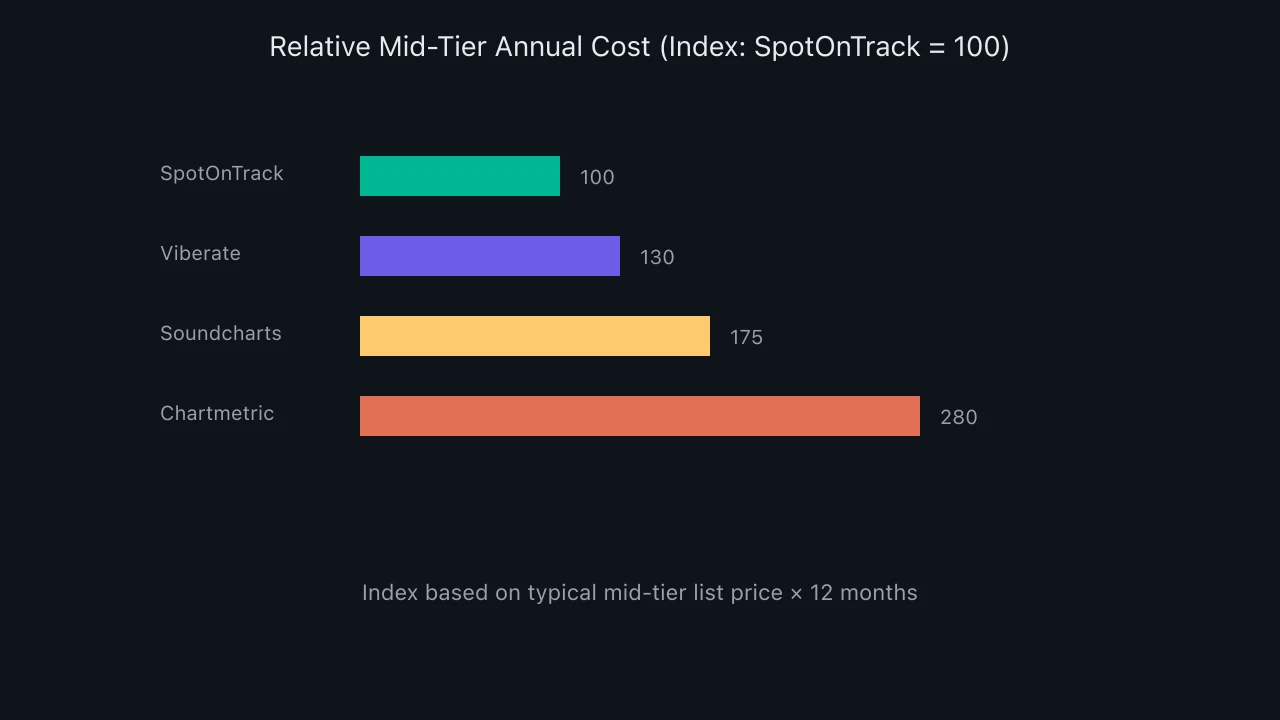
Relative mid-tier annual cost comparison
Chartmetric commands premium pricing because API culture and historical playlist archives target enterprise operations—not because every indie needs that depth on day one.
Feature-Per-Dollar Comparison
SpotOnTrack pricing often wins when your team mainly monitors playlist adds, chart positions, and release-week velocity for under twenty acts. You are paying for clarity, not for a data engineering stack.
Chartmetric wins feature-per-dollar only when you consume API feeds, custom reports, and multi-year playlist trajectories that replace manual analyst hours. Soundcharts wins when radio airplay and streaming must sit in one view. Viberate wins when live events, festival maps, and scouting cards are daily tools.
Playlist Tracking Depth
All four track Spotify playlists; differences show up in historical granularity, editorial contact metadata, and alert latency. If playlist pitching is your growth engine, trial alert speed during a real release week—not a demo dashboard.
When SpotOnTrack Wins on Price
SpotOnTrack pricing beats Chartmetric when you manage a compact roster, do not need API pipelines, and want readable dashboards without a month of onboarding. It often beats Soundcharts if radio is irrelevant to your genre. It can beat Viberate when you care more about release tracking than geographic scouting maps.
Solo managers and micro-labels under ten artists frequently report that SpotOnTrack covers eighty percent of weekly questions at thirty to forty percent of Chartmetric's mid-tier cost.
When SpotOnTrack Loses on Value
SpotOnTrack pricing loses against Chartmetric when you need enterprise roster mode, investor-grade exports, or TikTok and YouTube depth wired into the same API your internal BI tool consumes. You are not overpaying for Chartmetric—you are buying analyst time back.
SpotOnTrack loses against Viberate when A&R lives in discovery and live-market visualization rather than catalog maintenance. It loses against Soundcharts when European radio campaigns need airplay verification alongside streaming.
Seat and Roster Math
Multiply monthly price by seats before comparing vendors. A $120 Chartmetric seat shared by three managers costs $40 effective per user; a $60 SpotOnTrack plan limited to one login may cost more per seat if sharing is blocked.
Count artist profiles included in each tier. Tracking thirty acts on a ten-profile plan forces upgrades that erase entry-level savings.
Annual vs Monthly Billing
Most vendors discount ten to twenty percent for annual prepay. SpotOnTrack pricing at monthly terms helps short campaigns; annual terms help stable rosters. Model cash flow—not just annualized savings—if you might pivot distribution or downsize roster mid-year.
Trial Design for Price Test
Run identical tasks across vendors during a real release: set playlist alerts, export one competitor comparison, pull four-week chart history, and share a report with a collaborator. Log minutes spent. Divide monthly cost by hours saved to get cost-per-insight.
If SpotOnTrack finishes tasks within ten percent of Chartmetric time, keep the cheaper tool and reallocate budget to ads or studio time.
Stacking Vendors Cost Trap
Teams sometimes add SpotOnTrack for playlists plus Viberate for scouting plus Soundcharts for radio. Triple subscriptions often exceed one Chartmetric seat without eliminating blind spots. Audit overlap before stacking.
According to music industry economics, independent labels run leaner analytics stacks than majors—but underpowered data still produces expensive wrong bets.
When Chartmetric Price Is Justified
Catalog owners preparing M&A data rooms, labels with fifty-plus acts, and teams piping metrics into Looker or Tableau need Chartmetric's API and depth. SpotOnTrack pricing is irrelevant in that scenario because replacement cost is internal engineering salary.
When Soundcharts Price Is Justified
Pop and urban formats with active radio promotion benefit from Soundcharts airplay layers. If your campaign reports must show FM and streaming side by side, Soundcharts mid-tier may beat SpotOnTrack plus a separate radio monitor.
When Viberate Price Is Justified
Booking agencies, festival buyers, and discovery-heavy A&R pods use Viberate's geo and live charts daily. Paying for Viberate while fighting SpotOnTrack's UI for scouting is false economy—match tool to job.
Indie Label Case Study
A fifteen-act electronic label spent $1,800 annually on SpotOnTrack mid-tier and covered playlist and chart needs. When they signed three artists with TikTok breakouts, they lacked short-form analytics depth and spent analyst hours scraping manually. Upgrading one Chartmetric seat at $3,600 eliminated roughly ten hours monthly—paying for itself at modest internal billing rates.
They kept SpotOnTrack for junior A&R playlist alerts and Chartmetric for leadership dashboards—a hybrid under $6,000 total, still below two full Chartmetric seats.
Solo Manager Case Study
A manager with four clients tried Chartmetric for prestige, used it twice monthly, and downgraded to SpotOnTrack within four months. Savings funded sync pitching tools. Lesson: unused depth is wasted money regardless of brand reputation.
Negotiation and Renewals
Bring competing quotes to renewal. Vendors expect shopping. SpotOnTrack, Viberate, and Soundcharts often flex on multi-year deals; Chartmetric negotiates at enterprise tiers. Document usage metrics before calling—empty seats weaken leverage.
Student and Indie Discounts
Ask about nonprofit, student, and accelerator discounts across all four vendors. SpotOnTrack and Viberate sometimes offer startup pricing; Chartmetric occasionally partners with music business schools. A twenty percent discount changes the bar chart ordering for cash-constrained teams.
Data Export Limit Surprises
Entry tiers may cap CSV exports or block API access. SpotOnTrack pricing looks unbeatable until your marketing lead needs weekly automated exports—then mid-tier upgrades apply. Read export policies before signing.
Accuracy vs Price Tradeoff
Cheaper tools sometimes lag playlist updates by hours. For release-week war rooms, latency matters. Measure alert delay during trial; savings evaporate if you learn about a major editorial add a day late.
According to big data practice, reconcile vendor metrics against platform-native dashboards monthly—regardless of price tier.
Building Internal ROI Sheet
Columns: vendor, annual cost, seats, roster cap, hours saved per month, cost per insight, renewal date. Score SpotOnTrack pricing against alternatives quarterly. Finance approves renewals faster when ROI sheet exists.
Migration Cost From SpotOnTrack
Switching vendors means rebuilding watchlists, retraining staff, and losing historical alert baselines. Budget migration hours when comparing SpotOnTrack pricing to a cheaper-looking competitor—switching tax can exceed first-year savings.
Genre-Specific Recommendations
Electronic and hip-hop teams often prioritize playlist velocity—SpotOnTrack pricing aligns well. Country and adult-contemporary teams may need Soundcharts radio layers. Global touring pop acts may need Viberate geo maps. Catalog-heavy pop labels may need Chartmetric history.
Five-Year Stack Planning
If you plan to grow from five to fifty acts, model pricing at both roster sizes today. SpotOnTrack may win year one while Chartmetric wins year three. Choosing solely on today's count causes painful migrations later.
Free Tier and Freemium Limits
Some analytics platforms offer limited free dashboards. SpotOnTrack may expose basic chart positions or artist snapshots without subscription. Free tiers help hobbyists but rarely support roster monitoring, exports, or collaborator seats production teams need.
Model whether free access covers weekly decisions or merely satisfies curiosity. Curiosity-tier tools become shelfware when releases demand alerts and historical context.
The Chartmetric API Tax
Chartmetric's premium is partly an API tax: piping playlist adds into Slack, Notion, or internal A&R databases requires engineering setup once, then saves hours weekly. SpotOnTrack pricing looks cheaper until you manually export CSVs and merge them in spreadsheets—hidden labor cost.
Calculate analyst hourly rate times manual export hours. If manual work exceeds price delta, Chartmetric wins on true economics even at double list price.
Soundcharts Radio Bundle Value
Soundcharts bundles streaming and radio airplay in mid-tier packages. Teams promoting to terrestrial and satellite formats avoid buying a separate radio monitor. SpotOnTrack plus standalone radio tracking can exceed Soundcharts combined pricing while fragmenting workflow.
Genre matters: electronic and bedroom pop may ignore radio entirely; adult contemporary and country should price radio depth into vendor selection.
Viberate Live Market Premium
Viberate charges for geo maps, festival lineups, and artist comparison cards tuned for live music professionals. If your team never books tours or festivals, that premium funds features you will not open. SpotOnTrack pricing wins when live intelligence is irrelevant to your calendar.
Conversely, booking agencies comparing SpotOnTrack against Viberate often find geo scouting irreplaceable—saving one wrong routing decision pays for a year of subscription.
Renewal Shopping Calendar
Set renewal reminders ninety days before contract end. Run a lightweight re-trial: can a competitor finish your top five weekly tasks faster? Vendors improve UI yearly; last year's loser may be this year's fit. SpotOnTrack pricing advantage erodes if competitors add features you requested in writing.
Team Adoption as Price Factor
A cheaper tool nobody logs into costs infinity per insight. Price per active seat beats list price. Survey team monthly: who opened analytics this week? Zero adoption means cancel regardless of competitive matrix scores.
FAQ: SpotOnTrack Pricing
Is SpotOnTrack the cheapest option?
Often among mainstream analytics platforms for small rosters, but not universally. Compare your required seats, exports, and API needs—entry tiers look similar across SpotOnTrack and Viberate until you scale.
Is Chartmetric worth triple the price?
Worth it when API access, deep playlist history, and large-roster workflows replace paid analyst hours. Not worth it for hobbyists checking charts monthly.
Can I use SpotOnTrack and another vendor together?
Yes, if roles are split—e.g., SpotOnTrack for playlist alerts, Viberate for scouting. Avoid paying twice for identical playlist tracking.
Does SpotOnTrack include API access on entry tiers?
Typically limited or absent on lowest tiers. Confirm with sales if your stack depends on automated feeds.
How often do these prices change?
Major vendors adjust annually. Re-verify list prices each renewal cycle and keep trial accounts warm before cancellation deadlines.
SpotOnTrack for Distributors and Aggregators
Distributors sometimes negotiate volume analytics for rosters they service. Ask whether SpotOnTrack pricing drops at ten-plus artist profiles before buying individual subscriptions per act. Chartmetric and Viberate offer roster modes at scale—compare effective per-artist cost when managing distributed catalogs.
Educational and Accelerator Discounts in Practice
Music business accelerators and university programs partner with analytics vendors for cohort pricing. SpotOnTrack pricing through an accelerator may beat direct signup for six-month sprints. Document eligibility—some deals expire when cohort ends, forcing full-price renewal.
SpotOnTrack Pricing Summary
SpotOnTrack pricing competes well for playlist-forward independents who do not need enterprise API depth. Chartmetric, Soundcharts, and Viberate each justify premium lines when your workflow demands history, radio, geo scouting, or data engineering integration. Run parallel trials on real releases, model seats and roster caps honestly, and buy the tool your team opens every Monday—not the one with the longest feature PDF.


