

Viberate vs Chartmetric is the vendor choice independent labels face when upgrading from spreadsheet analytics to a paid intelligence stack. Both map the streaming economy; they emphasize different workflows, price tiers, and data freshness. Choosing wrong means either overpaying for unused enterprise depth or underpowering A&R with thin discovery tools.
This comparison matrix covers features, ideal users, integration habits, and a side-by-side visual of where each platform wins.
Most teams need one primary hub—not two subscriptions fighting for attention.
Philosophy Difference
Chartmetric built reputation as a broad music analytics operating system—playlists, charts, social stats, API access, and label-scale reporting. Viberate leaned into artist discovery, live-market maps, and scouting-friendly cards accessible to smaller teams. Overlap grew as both expanded, but default UX still reflects those roots.
Feature Comparison Matrix
| Dimension | Viberate | Chartmetric |
|---|---|---|
| Primary sweet spot | Scouting & live/geo | Full-stack label analytics |
| Playlist depth | Strong | Very strong + historical |
| Social / TikTok | Good cross-platform | Deep integrations |
| API / exports | Varies by plan | Robust API culture |
| Learning curve | Moderate | Steeper |
| Price entry | Accessible indie | Higher; scales to enterprise |
| Catalog tracking | Good | Excellent roster mode |
| Festival bookers | Strong geo/live | Strong with custom reports |
Pricing changes—run trials against your actual weekly tasks before annual commits.
Side-by-Side Strength Bars
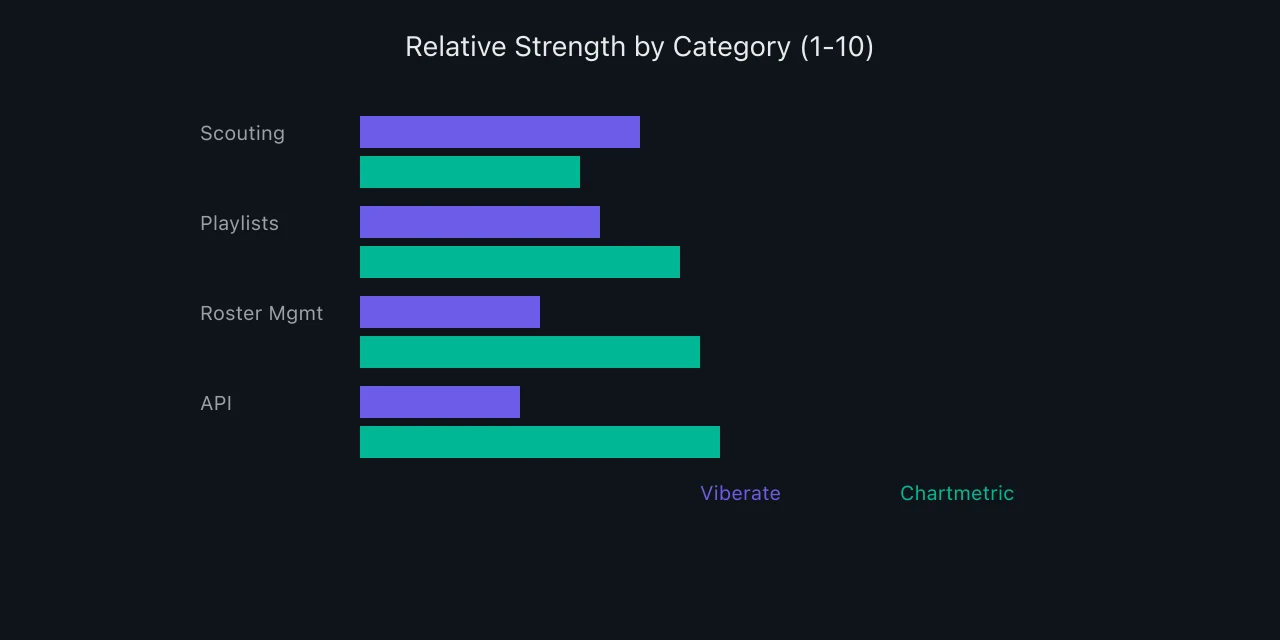
Viberate vs Chartmetric category scores
Illustrative scores for workflow planning—not a formal product review score.
Choose Viberate When
Your weekly job is finding artists to sign or book, you need approachable geo and live visuals, and your roster is under fifty acts without a data engineer. Viberate gets scouts productive fast.
Choose Chartmetric When
You manage large rosters, need API-fed internal dashboards, obsess over historical playlist trajectories, and run multi-territory campaign reporting for majors or large indies. Chartmetric's depth pays off at scale.
Overlap and Redundancy Risk
Both offer playlist tracking, artist profiles, and alerts. Running both without role split wastes budget. If you buy both, assign scouting to Viberate and catalog reporting to Chartmetric—or vice versa based on trial preference.
Data Freshness and Accuracy
Discrepancies between vendors on monthly listeners or playlist counts are normal—different scrape times and estimation models. Pick one vendor as source of truth for internal KPIs to avoid arguments.
According to big data validation practices, reconcile vendor metrics against platform-native dashboards monthly.
Onboarding Time
Viberate teams often report usable workflows within a week. Chartmetric power features reward a month of deliberate training. Budget onboarding hours in year-one ROI math.
Integration With Spotify for Artists
Neither replaces first-party artist data. Use S4A for source-of-stream truth; use vendors for competitive context and discovery outside your catalog.
Case Study: Label That Switched Primary Vendor
A thirty-act indie label used Chartmetric for three years, then trialed Viberate for A&R only while keeping Chartmetric for roster dashboards. Net cost rose slightly but deal flow improved—scouts preferred Viberate cards. They later dropped Chartmetric for a smaller roster after API needs shrank. The lesson: match vendor to headcount and workflow, not brand prestige.
Trial Methodology
Give three users the same five tasks: find rising artist in subgenre, track playlist adds for one single, compare two peers, export watchlist, set alert. Score time-to-completion and confidence. Winner is workflow fit, not feature count.
Where Soundcharts Fits
Some teams add Soundcharts for radio and airplay depth while using Viberate or Chartmetric for streaming. Audit three-way overlap before triple subscribing.
Decision Checklist
Define primary job-to-be-done. Run parallel trials two weeks. Reconcile one KPI against S4A. Map annual cost to hours saved. Assign one source of truth. Viberate vs Chartmetric is not a moral choice—it is an operations fit choice.
Viberate vs Chartmetric Summary
Viberate wins approachable scouting and live/geo storytelling; Chartmetric wins roster scale, playlist history, and API-heavy reporting. Buy for the workflow you execute weekly, not the feature list you admire once.
Seat-Based Cost Modeling
Model annual cost per scout, per marketing manager, and per artist seat. Chartmetric enterprise pricing scales with roster size; Viberate may cost less for three-seat A&R pod. Divide subscription by deals closed for effective cost per signing metric.
Customer Support Comparison
Trial users should stress-test support with one complex data question. Response time and clarity matter when release week playlist data looks wrong. Document support experience in trial scorecard.
Mobile Access Needs
Managers on tour may need mobile-friendly artist cards. Compare mobile web experiences during trial—desktop-only workflows fail on the road.
Historical Data Depth
Chartmetric's historical playlist trajectories help postmortems eighteen months later. Viberate historical depth varies—confirm how far back you need for catalog analysis before choosing.
Privacy and Data Governance
Enterprise labels ask about data processing agreements. Chartmetric has mature enterprise sales for DPA discussions; smaller vendors may require legal review for GDPR compliance in EU operations.
Hybrid Workflow Pattern
Some agencies use Viberate for festival clients and Chartmetric for label clients—specialize by client vertical rather than forcing one tool. Agency economics differ from single-label economics.
Migration Checklist Between Vendors
Export watchlists, document alert thresholds, rebuild comparison templates, train team on new navigation, run four-week parallel period, pick source of truth date, cancel redundant subscription. Migration friction is real—budget time.
Future-Proofing Analytics Stack
Favor vendors with API if you plan internal dashboards in two years. If you will never hire data staff, prioritize UX over API. Viberate vs Chartmetric decision should include your three-year headcount plan.
Executive Reporting Needs
Chartmetric's export culture suits C-suite PDF decks. Viberate suits working scout sessions. If your CEO wants weekly roster PDFs, bias Chartmetric. If your A&R room wants discovery screens, bias Viberate.
Vendor Lock-In Risks
Watchlists and alert history trapped in one vendor make switching costly. Export quarterly to CSV archives regardless of primary vendor—future you will switch tools.
Playlist Historical Depth Use Cases
Chartmetric historical playlist adds help answer "when did this artist first hit editorial?" in due diligence. Viberate may suffice for forward-looking discovery but Chartmetric wins retrospective timeline questions—weight due diligence depth in vendor choice.
Team Size Decision Matrix
Solo manager: probably one affordable tool. Five-person label: one primary plus S4A. Thirty-person with data analyst: Chartmetric API likely justified. Match headcount to vendor complexity.
Artist-Facing Reports
Some managers export Chartmetric PDFs for artist meetings; Viberate cards screenshot cleaner on mobile for quick texts. Consider artist communication habits when choosing primary UI.
Data Accuracy Reconciliation Routine
Monthly: pick five roster artists, compare Viberate and Chartmetric monthly listeners to Spotify public profile rounding. Document average variance. Pick primary vendor based on lowest median error for your genre.
Contract Renewal Leverage
At renewal, cite competing trial results to negotiate seat discounts. Vendors expect shopping—twelve-month locks are negotiable with documented alternative quotes.
Benchmarking Trial Tasks Document
Write five standard trial tasks before testing either vendor. Score completion time and confidence 1–5. Document beats memory when renewing annual contracts—attach PDF to finance approval.
Single Source of Truth Policy
Publish internal policy: Chartmetric numbers go in board deck, Viberate numbers go in scout Slack— or pick one everywhere. Mixed citations create artist distrust when figures disagree.
International Team Access
EU and US teams in same label need timezone-friendly UI and GDPR-compliant data handling—confirm vendor data residency in enterprise security questionnaire during trial.
Feature Roadmap Monitoring
Subscribe to both vendors' product update emails during trial year. Chartmetric may ship API features; Viberate may ship improved maps. Vendor choice is twelve-month bet on roadmap alignment with your growth.
Cost Per Insight Metric
Divide annual subscription by number of actionable insights logged—playlist pitches changed, deals pursued, campaigns adjusted. If cost per insight exceeds internal hourly rate value, downgrade tier or cancel.
Artist Self-Service Analytics
Some labels buy Chartmetric for office and expect artists to self-serve—artists may prefer simpler Viberate cards. Match UX to least technical roster member who must use tool weekly.
Due Diligence Data Rooms
M&A due diligence for catalog sales uses Chartmetric historical depth more often than Viberate scouting cards—if your label buys catalogs, weight historical analytics in vendor selection.
Final Vendor Recommendation Framework
Score workflow fit sixty percent, historical depth twenty percent, cost twenty percent. Viberate wins workflow fit for discovery-heavy pods; Chartmetric wins historical depth for roster-heavy enterprises. Neither wins every category—buy honestly.
Playlist Pitching Workflow Comparison
Chartmetric playlist search historical depth helps craft pitch narratives with timeline proof. Viberate playlist cards help scouts discover which lists to pitch newcomers. Pitching-heavy teams may keep Chartmetric; discovery-heavy pods may prefer Viberate—some need both temporarily during trial.
Data Export for Investors
Investors in label startups ask for market analytics stack in due diligence. Naming credible vendor with exportable history signals operational maturity—Chartmetric often recognized in investor conversations; Viberate credible for A&R-first story.
Team Feedback Survey After Trial
Survey five users: which tool would you fight to keep? Unanimous Chartmetric means buy Chartmetric even if Viberate felt prettier. Split vote means role-based licenses.
Hybrid Month Experiment
Run one month with both tools on three projects only—measure duplicate insight rate. If eighty percent insights duplicate, pick one. If complementary, negotiate bundle budget.
Long-Term Partnership Considerations
Ask vendors about multi-year roadmap for TikTok, Shorts, and regional DSP growth—vendor survival matters when watchlists hold five years of history.
Catalog Analytics Needs
Deep catalog analytics—five-year playlist history, spinoff tracks, slow-burn growth—favors Chartmetric. Frontline discovery favors Viberate. Catalog-heavy labels weight Chartmetric; frontline-heavy indie labels weight Viberate.
Vendor Trial Documentation
Record Loom videos of both trials for future hires—onboarding survives staff turnover when workflows are filmed, not tribal knowledge.
API Roadmap Question
Ask both sales teams: what ships next two quarters? API improvements matter to scaling labels; UI polish matters to scout pods—match answer to your three-year plan.
Consolidated Analytics Policy
Write one internal policy page ending Viberate vs Chartmetric debate: primary vendor, secondary optional, reconciliation rules, renewal criteria. Policy ends annual re-litigation.
Vendor Decision Summary
Viberate vs Chartmetric is not winner-take-all industry-wide—it is winner-take-all per team based on workflow, roster depth, API appetite, and budget. Trial honestly, document ruthlessly, commit for twelve months, review with data.
Price Negotiation Tactics
Bring competing quote to renewal call—vendors expect shopping. Twelve-month prepay versus monthly changes effective price; finance should model cash flow not just sticker price.
Analytics Stack Minimalism
Minimal stack: Spotify for Artists plus one paid vendor. Add second vendor only when first lacks specific workflow—stack creep burns budget without additive insight.
Training Budget Line Item
Budget four hours per seat onboarding in year one—untrained subscriptions are shelfware regardless of vendor winner.
Viberate Chartmetric Closing Remarks
Choose the tool your team will actually open every Monday—feature depth unused is worthless. Viberate vs Chartmetric resolves through trial discipline, honest usage forecast, and written policy—not brand affinity alone.
Renewal Quarterly Review
Quarterly review before annual renewal: seats used, exports generated, decisions logged—unused seats are cancellation signal regardless of feature admiration.
Vendor Support Incidents
Log support incidents during trial—slow support during data crisis predicts painful release weeks. Support quality is selection criterion equal to features.
Viberate Chartmetric Final Line
Final line on Viberate vs Chartmetric: buy workflow fit, document choice, train team, reconcile monthly with Spotify for Artists—vendor religion wastes money; operational clarity earns it back.
Vendor Trial Scorecard File
Store trial scorecard in shared drive with date and participants—future leadership inherits documented decision rationale instead of guessing why vendor was picked.
Annual Benchmark Refresh
Refresh comparison matrix annually when both vendors ship major updates—last year's Chartmetric API advantage may shrink while Viberate maps improve. Static vendor opinions age poorly in fast-moving analytics market.
Viberate Chartmetric End
Viberate vs Chartmetric ends when policy is written, team trained, and reconciliation calendar booked—comparison articles matter less than Monday execution after choice is made.
Cross-Functional Vendor Pilot
Include A&R, marketing, and finance in two-week pilot—finance cares about export accuracy, marketing cares about campaign tracking, scouts care about discovery cards. Consensus purchase reduces shelfware risk.
Viberate Chartmetric Complete
Viberate vs Chartmetric comparison complete: matrix scored, bars visualized, trial documented—pick one primary vendor, reconcile with Spotify for Artists, revisit annually with fresh trial if workflows changed.
Vendor Sunset Plan
Write vendor sunset plan before signing annual contract: export paths, watchlist CSV backup, alert recreation checklist—switching vendors is painful but planned switches beat emergency migrations when pricing jumps.
Viberate Chartmetric Final Word
Whether you choose Viberate or Chartmetric, success is measured in Monday decisions changed—not feature checklists completed. Commit, train, reconcile, and review annually with honest usage data.
Side-by-Side Trial Protocol
Run a structured two-week trial before you commit annual budget. Give three scouts the same ten-artist brief: five roster acts and five competitive targets. Assign half the team to Viberate and half to Chartmetric without sharing dashboards until day ten. Score each tool on time to shortlist, false positives, export quality, and whether the UI survived daily use without workarounds. Merge results in a shared scorecard and note which vendor surfaced actionable playlist or territory data first. Trials fail when everyone browses features without a task list; trials succeed when Monday meeting slides are built from trial data alone. That discipline turns a Viberate vs Chartmetric debate into an evidence file finance can approve.


