

Disclaimer: This article is operational guidance for tour managers, artists, and touring business stakeholders—not medical advice. Tunetrackernews does not recommend starting, stopping, or changing any prescription medication. Decisions about weight-loss medications belong exclusively between a touring artist and their licensed physician or qualified clinician. The content below addresses scheduling risk, duty-of-care logistics, and performance continuity from a touring operations perspective only.
Weight-loss medication on tour is no longer a hypothetical fringe topic. GLP-1 receptor agonists and related therapies have entered mainstream public conversation, and touring personnel—artists, dancers, crew—sometimes continue prescribed regimens while crossing time zones, eating irregularly, and performing under physical demand. Tour managers who ignore that reality do not eliminate the risk; they merely discover it at 2 a.m. when a principal cannot hold a meal before a festival slot.
This article, written from an operational and business lens on touring, compares risk factors by tour type, outlines hydration and meal-schedule friction, discusses insurance and rider disclosure logistics, and maps when pausing or restructuring a leg may be the rational business decision—not a moral judgment about medication use.

Prescription decisions belong with clinicians; tour operations must plan for how regimens interact with routing and show demand.
Why Tour Managers Need an Operational Frame
Tour management is duty-of-care plus schedule enforcement. Medical choices are outside that mandate. What is inside the mandate: knowing whether a routing plan assumes steady caloric intake, whether a fly-date stack allows bathroom and hydration access before soundcheck, and whether cancellation insurance language covers illness related to medication management.
Julian Cole's touring finance lens treats unplanned show interruptions as margin events. A missed festival slot from dehydration or acute gastrointestinal distress—regardless of root cause—can trigger guarantee clawbacks, reputational damage with promoters, and cascade costs across crew payroll and travel. Operational planning does not diagnose; it reduces surprise.
Publicly available information about FDA-posted safety information on GLP-1-class medications emphasizes clinician supervision and awareness of side effects. Tour managers should read that as a scheduling signal, not a prescription guide.
What Weight-Loss Medications Are in Public Discourse
Without endorsing any product, touring stakeholders should recognize category names appearing in press and physician conversations: GLP-1 receptor agonists (including semaglutide and tirzepatide formulations approved for weight management in appropriate patients), older appetite-suppressant classes with different risk profiles, and combination therapies prescribed off-label in some jurisdictions. Each category carries distinct monitoring needs a tour manager cannot substitute for.
According to anti-obesity medication summaries in public reference material, these drugs are intended for use under medical oversight with attention to contraindications, drug interactions, and side-effect profiles. Touring does not suspend those requirements—it intensifies environmental stressors that may aggravate known side effects in some individuals.
Artists may obtain prescriptions before tour and assume continuity is automatic. Operations must verify: Is the medication travel-legal in every country on the routing? Is refrigeration required? Is there a telehealth follow-up schedule that aligns with tour time zones? These are logistics questions, not treatment questions.
Risk Factors by Tour Type
Not every tour imposes the same operational friction on someone managing a weight-loss medication regimen. The table below compares illustrative risk dimensions tour managers use when building contingency buffers—not clinical severity scores.
| Tour Type | Meal Regularity | Hydration Access | Bathroom / Privacy Access | Physical Demand | Operational Risk Tier |
|---|---|---|---|---|---|
| Club / theater (bus tour) | Moderate—catering often on site | High—long drives with stops | Moderate—venue green rooms | High—90+ min sets nightly | Medium |
| Festival fly-date stack | Low—airport food, skewed mealtimes | Low—security lines, tight transfers | Low—shared backstage, short changeovers | Very high—compressed schedules | High |
| Arena / stadium run | Moderate—rider meals, but late dinners | Moderate—long holds in dressing rooms | High—private suites common | High—production scale, repeat nights | Medium–High |
| International multi-zone | Very low—jet lag disrupts appetite cues | Variable—flight dehydration baseline | Variable—customs, language barriers | High—travel fatigue compounds | High |
| Acoustic / seated theater | Higher—predictable call times | High—stable venue routines | High—longer intermissions | Moderate—lower cardiovascular peak | Lower–Medium |
| Residency (fixed city) | High—hotel and local routine possible | High—controlled daily rhythm | High—same venue layout nightly | Moderate—repetition without constant travel | Lower |
Illustrative tiers assume no individual medical history. A physician may clear an artist for arena work while flagging festival fly-dates as higher monitoring priority. Tour managers translate that into schedule buffers and backup coverage—not into medical decisions.
Meal Irregularity and Known Side-Effect Friction
Touring eats on show time, not circadian rhythm. Load-in at 3 p.m., soundcheck at 5 p.m., doors at 7 p.m., post-show travel at midnight—that pattern is standard. Publicly reported side effects associated with GLP-1-class medications include nausea, vomiting, diarrhea, constipation, and reduced appetite in some patients. Tour managers do not need pharmacology training to see the scheduling conflict: a regimen that assumes smaller, regular meals collides with a day where the only protein is a gas-station wrap eaten standing up outside a venue.
Operational mitigations stay in logistics territory: block pre-show quiet time in dressing rooms, confirm catering aligns with artist-stated meal windows (provided by artist or physician instruction, not invented by management), and avoid stacking high-stress promotional obligations on days flagged as recovery days in the tour calendar.
Never instruct an artist to eat when they cannot hold food down. Never suggest skipping doses to "make show day easier." Both cross into medical territory and create liability. Document that the artist's clinician approved tour continuation and capture any scheduling accommodations in writing.
Hydration on Fly-Dates
Air travel dehydrates. Cabin humidity is low; artists often reduce fluid intake to minimize bathroom breaks during tight connections. Dehydration independently causes fatigue, headache, and dizziness—symptoms that overlap with public descriptions of medication side effects and with performance impairment.
Tour operations should treat hydration as a routing input on fly-date weeks: build connection buffers long enough for water intake and restroom access, stock approved electrolyte beverages on the bus or in dressing rooms (brand choices belong to artist and medical team), and brief security-conscious artists that dehydration risk rises when they avoid fluids before boarding.
Festival mornings amplify the problem: late flights, early van pickups, little sleep. A tour manager who schedules a 6 a.m. radio appearance the morning after a red-eye without recovery time is creating operational risk unrelated to any prescription—but that risk stacks with any regimen that increases gastrointestinal sensitivity in some patients.
According to concert tour logistics norms, fly-date stacks are where margin and health incidents concentrate. Hydration protocols belong in the tour book alongside backline manifests.
Show-Day Stamina and Performance Safety
Performance safety is an operational obligation. Stage diving is not the only risk vector—vocal fold strain, dehydration-related lightheadedness, and missed meals before high-cardio choreography all affect show integrity. Weight-loss medications in public discourse are associated with lean mass considerations when used without adequate nutrition; tour managers cannot assess body composition, but they can enforce rest days and adequate warm-up time.
Build show-day timelines with explicit buffers: vocal warm-up, physical warm-up for dancers, meal window (even if small), and post-show cool-down before travel. Principals on demanding production tracks should not roll directly from meet-and-greet into a three-hour set without protected recovery—regardless of medication status.
If an artist reports feeling unwell before doors, escalate to medical personnel on site or telehealth contacts pre-identified by the artist's team. The tour manager's job is to activate the plan and communicate with promoters about potential delay—not to triage symptoms.
Medical Oversight Logistics on the Road
Prescribing clinicians rarely tour with the act. Continuity of care becomes a logistics project:
- Telehealth cadence: Schedule follow-up appointments in tour calendar with time-zone conversion verified. Missed virtual visits because a show ran long are preventable with advance blocking.
- Pharmacy continuity: Identify refill sources in each country leg; some medications require cold chain transport. Customs documentation for personal prescription medication varies—research before border crossings.
- Local physician network: Entertainment insurers and arena medical teams can refer touring artists to local clinics for urgent non-emergency evaluation. Pre-load contacts per city tier.
- Tour medical kit boundaries: Crew first-aid kits address cuts and sprains—not prescription management. Do not stock or share medication between personnel.
- Documentation chain: Business manager and tour manager should know who holds HIPAA authorization to speak with clinicians on the artist's behalf—without themselves receiving protected details beyond what is needed for scheduling.
Medical oversight stays with licensed providers. Tour operations provide calendar real estate and transport to appointments.
Insurance, Rider, and Contract Disclosure
Tour cancellation insurance and event liability policies often include health-related exclusions or disclosure duties. An artist commencing a new prescription weeks before a insured run may trigger reporting obligations depending on policy language. Business managers and insurance brokers—not tour managers—own policy interpretation.
Operational handoff points: if an artist's physician recommends postponing high-intensity legs, that recommendation may affect insurance claims if documented. Conversely, touring without disclosing material health changes known at bind time can jeopardize coverage. Capture dates of physician clearance letters in the business office file.
Hospitality riders requesting specific foods or meal times are standard. Riders can accommodate clinician-directed meal timing without naming medications on the document: "Artist requires 60-minute pre-show meal window, no interviews during that block" is an operational rider clause, not a medical disclosure to promoters.
Union and crew contracts may include fitness-for-duty language. Crew members on their own prescriptions deserve the same privacy boundaries—tour managers accommodate scheduling without demanding diagnosis.
When to Pause or Restructure a Tour Leg
Pausing tour is a business decision often mis-framed as weakness. From a touring finance perspective, finishing a leg while impaired costs more than rescheduling when guarantee clawbacks, medical evacuation, and reputational harm are modeled honestly.
Operational triggers to escalate with artist, physician, business manager, and promoter—without substituting for clinical judgment:
- Repeated show compromises (cut sets, seated performances unplanned, missed cues) correlated with reported illness
- Physician recommendation against continued travel or performance intensity
- Inability to maintain hydration or nutrition sufficient for safe performance per artist's own care team guidance
- International routing where prescribed medication is restricted or unavailable for lawful continuation
- Insurance or bond requirements that cannot be met without documented medical clearance
Restructure options short of full cancel: swap festival for seated show, insert rest day, reduce promo load, delegate fly-date to local pickup musician under contract provisions, or move leg to later window with promoter agreement. Each option has settlement and tax implications the business manager models.
Decision Flowchart for Tour Operations
The SVG below is an operational escalation map for tour managers—not a clinical decision tree about medication.
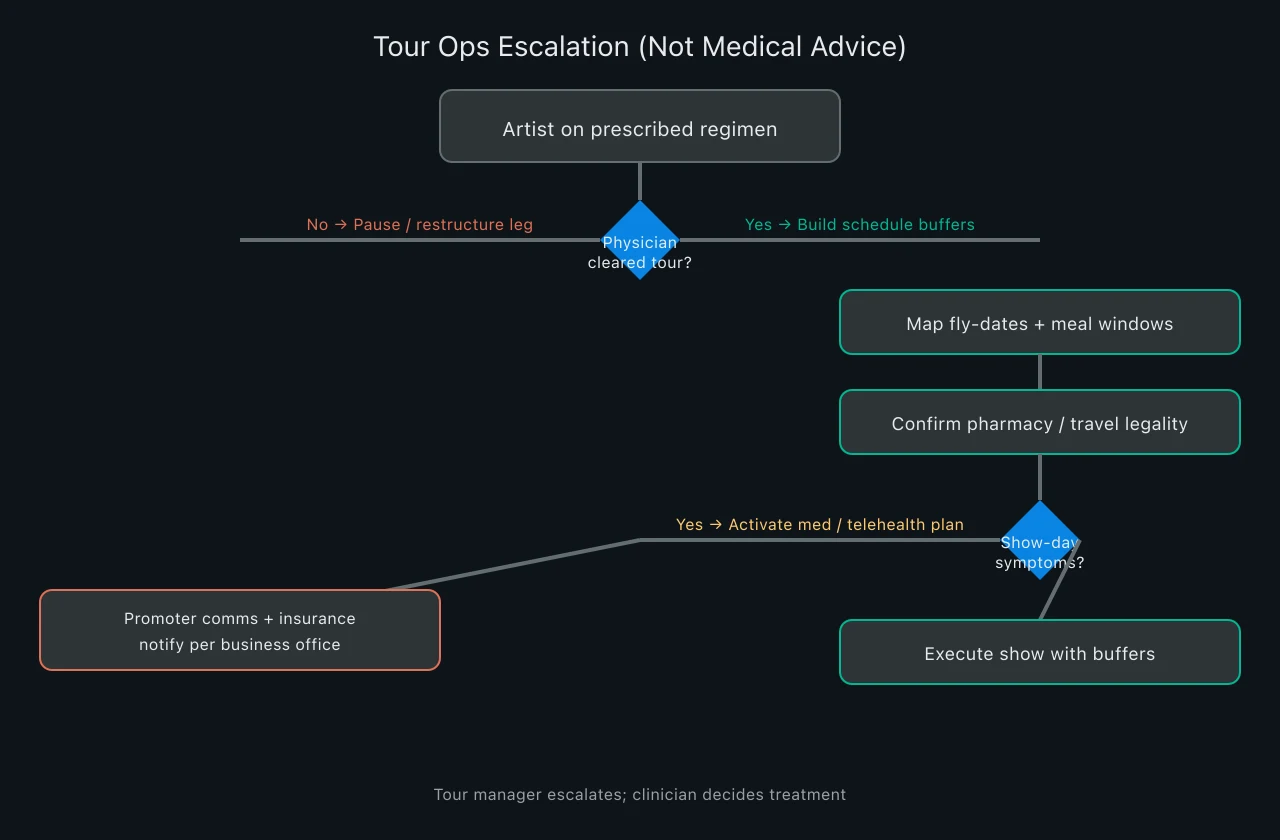
Weight-loss medication touring operations decision flowchart
The flowchart's terminal actions are communication and scheduling—not dosage changes. Any branch implying treatment adjustment should route immediately to the artist's physician.
Crew, Dancers, and Background Vocalists
Headliners receive disproportionate attention, but touring ensembles include dancers and vocalists on their own prescriptions. Operational equity means pre-tour health questionnaires (managed by qualified HR or medical contractors) capture accommodation needs without demanding specific diagnoses.
Choreography captains and dance captains should know which rehearsals cannot be compressed when a performer needs recovery time—information shared at discretion of the performer and their clinician. Tour managers enforce those boundaries in the day sheet.
Background vocalists flying separately from principals face higher meal irregularity. Unified per diem policy does not equal unified biology; scheduling must allow ensemble members the same pre-show buffers requested by principals.
International Touring and Medication Travel
Cross-border tours introduce customs, import restrictions, and differing approval statuses for the same molecule. An artist lawfully prescribed in one country may face scrutiny entering another. Tour operations research ahead; artists carry physician letters and original packaging—standard travel practice for any prescription.
Time-zone shifts disrupt injection or dosing schedules that some regimens require. Calendar tools should display home-time and local-time for appointment alignment; only the clinician adjusts timing across zones.
European festival season and UK arena runs compress travel. Medication requiring refrigeration needs verified hotel minibar policy or medical-grade travel coolers—gear logistics no different from insulin cold chain, handled by tour production coordinators.
Promoter and Venue Communication Boundaries
Promoters ask for "anything we should know." The correct operational answer respects privacy: "We have protected medical time blocks and may need flexible catering windows—details in the rider." Promoters do not need drug names; they need reliable show delivery.
If performance delay is possible due to health escalation, early transparent communication preserves relationships better than surprise no-shows. Template language in tour manager playbooks reduces ad hoc panic texts.
Venue medical staff at arenas often assist with on-site evaluation. Pre-show brief them on who is authorized to receive medical information for the artist—typically a designated personal assistant or tour physician liaison, not the entire crew chain.
Mental Health and Public Scrutiny
Weight-loss medication use attracts media commentary unrelated to tour logistics. Operational preparedness includes social and PR coordination so tour managers are not answering health questions at load-in. Refer press to designated spokespersons.
Body image pressure in entertainment intersects with medication discourse. Tour operations cannot solve cultural problems but can refuse to schedule weigh-in jokes in promo, weight-loss challenges in content calendars, or rider provisions that undermine clinician-directed nutrition plans.
Employee assistance programs and tour-accessible counseling resources belong in duty-of-care budgets—especially on long legs where isolation amplifies scrutiny.
Budgeting for Contingency Days
Julian Cole's touring finance approach treats contingency lines as real money, not optimism padding. When an artist on a supervised regimen plans a high-intensity leg, budget one contingency day per three fly-dates for recovery or medical appointment overflow. Unused days return to margin; used days prevent catastrophic clawbacks.
Contingency is cheaper than defaulting on a six-figure festival guarantee because the artist boarded a flight while acutely unwell against clinician advice. Business managers should see contingency days as insurance-compatible documentation of prudent planning.
Model travel insurance premiums with brokers when health-related cancellation risk rises—again, a business office function informed by physician clearance status, not tour manager speculation.
Van Tours vs Fly-Dates: Operational Contrast
Van tours offer more predictable ground transport stops and often superior hydration access than airport sprints. They also impose long sedentary hours and truck-stop food variability. Fly-dates compress time but amplify dehydration and meal skipping.
Neither mode is "safer" categorically for any medication class—that is clinical territory. Operationally, van tours simplify pharmacy refill logistics domestically; fly-dates complicate international continuity. Route planning should not assume artists will "tough through" either mode without accommodations.
Catering Riders and Backstage Nutrition
Riders list proteins, vegetables, hydration, and timing. For artists whose clinicians recommend smaller portions or bland foods during adjustment periods, rider language can specify "no heavy dairy pre-show" or "broth and electrolytes available 90 minutes before call" without citing prescriptions.
Catering teams are allies when given clear windows rather than vague preferences. A tour manager who forwards rider requirements 48 hours before load-in reduces day-of friction that artists sometimes misattribute to medication effects when the root cause was missing catering.
Allergen and interaction concerns between foods and medications are clinical questions. Rider specs implement physician guidance supplied by the artist—they are not invented by hospitality coordinators guessing pharmacology.
Documenting Accommodations for Settlement
When tour schedules include paid recovery days or additional hotel nights tied to health logistics, document them for settlement and tax allocation. Ambiguous "personal days" create disputes between artist and management companies.
Time-stamped calendar exports showing blocked medical appointments support insurance claims and demonstrate duty-of-care without exposing protected health information in promoter-facing documents.
What Tour Managers Should Never Do
- Recommend starting, stopping, or adjusting any weight-loss medication
- Share one artist's medication information with other crew or promoters without explicit authorization
- Pressure artists to perform when they report symptoms their clinician would categorize as restricting activity
- Procure prescription medication domestically or abroad outside licensed pharmacy channels
- Interpret FDA or public health materials as personal medical guidance for specific artists
- Use weight or appetite comments in scheduling discourse
Violations expose personal liability and tour-wide legal risk beyond any single missed show.
Building a Tour Health Operations Playbook
Generalize lessons into a playbook section distinct from personal medical files:
- Emergency contact tree including telehealth provider and insurance medical line
- Per-city clinic referral list maintained by business office
- Standard pre-show buffer minimums by production intensity tier
- Fly-date hydration checklist for tour managers
- Promoter delay communication templates
- Privacy protocol for crew health accommodations
- Contingency day budget template by routing archetype
Playbooks evolve each leg. Post-tour debrief should ask: Did scheduling assumptions match reality? Were meal windows honored? Did international pharmacy planning hold? Answers inform finance and routing, not prescribing.
Case Study: Festival Fly-Date Stack
An indie-pop principal continued a physician-prescribed GLP-1-class regimen cleared for touring before a six-festival, nine-day fly-date stack. Tour manager mapped pre-show meal blocks and inserted two-hour connection buffers—operational changes with zero medical input. On day four, acute nausea (cause not diagnosed by tour staff) threatened a shortened set. Artist contacted telehealth; physician advised rest and hydration protocol the artist followed independently. Show proceeded with 20-minute delay; promoter notified per contract force majeure clause. Insurance broker documented physician interaction for file.
Lesson: buffers absorbed delay without guarantee loss. Without buffers, the same day becomes a breach conversation. The regimen was never stopped or adjusted by tour personnel.
Case Study: Arena Residency Contrast
A veteran rock act held a four-week arena residency with fixed hotel, predictable catering, and no consecutive fly-dates. Artist on weight-management therapy per private physician plan experienced lower travel-related gastrointestinal disruption than on prior festival summers—correlation noted operationally, not causally claimed. Tour manager credited stable meal timing and eliminated red-eye legs. Residency routing reduced operational risk tier even though production physical demand remained high.
Lesson: routing shape affects logistics friction independent of medication category. Finance teams evaluating residency vs festival economics should include health logistics friction as a soft cost line.
Synthesizing Performance Safety and Margin
Performance safety and tour margin align more often than conflict narratives suggest. Missed shows destroy margin; prudent buffers protect both. Weight-loss medications in public discourse are one factor among dozens—vocal health, mental health, injury, substance recovery—that require operational respect without managerial medicalization.
Tour managers who build schedules assuming superhuman tolerance for irregular meals and dehydration will eventually collide with human limits. Planning for clinician-supervised regimens is planning for humans on tour in 2026, not moral commentary.
FAQ: Weight-Loss Medication and Touring
Is this article medical advice?
No. Tunetrackernews provides touring operations perspective only. All medication decisions require licensed clinicians who know the individual's history.
Should artists start weight-loss medication before tour?
We do not recommend starting or stopping any medication. That question belongs solely to an artist and their physician, weighing factors tour articles cannot evaluate.
Can a tour manager tell an artist to stop medication for shows?
No. Managers may escalate health concerns, enforce rest agreements per physician guidance, and restructure routing—they do not direct treatment.
How do publicly known GLP-1 side effects interact with touring?
Public sources describe gastrointestinal effects and appetite changes in some patients. Irregular tour meals and dehydration may compound discomfort for some individuals. Physicians assess individual risk; tour managers adjust schedules.
Must artists disclose weight-loss medication to promoters?
Contract and privacy law vary. Operational practice favors rider-based meal and schedule accommodations without drug-specific promoter disclosure unless counsel advises otherwise.
Does tour insurance cover illness related to medication?
Policy-dependent. Business managers and brokers review exclusions and disclosure duties at bind time and when health circumstances change.
How do international tours handle prescription continuity?
Research import rules per country, carry physician documentation and original packaging, plan refill logistics and cold chain if required. Tour operations coordinate; clinicians prescribe.
When should a tour leg pause for health logistics?
When physician guidance, repeated performance compromise, insurance requirements, or legal medication availability make continuation imprudent—modeled as business decisions with promoter and insurer communication.
Weight-Loss Medication Touring Summary
Is weight-loss medication safe for touring musicians? Safety is a clinical determination for each individual, not a tour blog conclusion. Operationally, touring introduces meal irregularity, fly-date dehydration, high physical demand, and international pharmacy complexity that interact—sometimes uncomfortably—with publicly documented side-effect profiles of common weight-management therapies.
Tour managers should secure physician tour clearance documentation, build schedule and hydration buffers especially on festival fly-dates, maintain privacy boundaries with promoters, coordinate insurance and contingency budgeting with business managers, and escalate symptoms through clinician-defined pathways—never through dosage improvisation.
Pausing or restructuring a leg when medical oversight recommends it protects margin and people simultaneously. Treating weight-loss medication on tour as unmentionable guarantees worse outcomes than treating it as a logistics planning input bounded by strong disclaimers and respect for licensed care.
Consult your physician before touring on any prescription regimen. Consult your business manager about contingency budgeting. Consult your tour manager about whether the routing you announced is humane to execute—not whether the medication is right for you.
Operational excellence on tour means planning for real bodies, real prescriptions, and real limits—while keeping medical authority where it belongs: in the clinic, not the load-in email thread.


