

YouTube In-Stream vs Discovery ads is the first fork in a music release media plan—and most teams choose it before they have defined what a viewer is supposed to do next. The campaign brief says "YouTube views," the artist sends a four-minute official video, and the buyer toggles between skippable in-stream and discovery-style inventory without naming whether the flight is interrupting a watch session or catching someone already hunting for something to play. That ambiguity is expensive: the same creative, budget, and audience can look brilliant on one format and wasteful on the other because interrupt and intent obey different psychology.
This piece is a format-comparison guide for label marketers, indie growth leads, and agency buyers planning a music release on YouTube—not a CPV optimization playbook. Julian Cole's media-ops lens treats In-Stream and Discovery as two lanes on the same highway: one forces a pause in someone else's content; the other competes in a shelf of thumbnails when the viewer is already in discovery mode. You will get the interrupt-versus-intent model, creative specifications by format, a budget-split matrix for typical release arcs, decision rules for when to overweight each lane, and a hybrid sequencing template you can paste into a campaign brief.
Format choice precedes bid strategy—interrupt and intent lanes need different creative, caps, and success metrics.
Interrupt vs Intent Model
Every YouTube ad format sits on a spectrum between interrupt and intent. Interrupt formats insert your message into an experience the viewer did not choose—you are renting someone else's attention. Intent formats appear where the viewer is already browsing, searching, or deciding what to watch next—you are bidding for a click among peers.
Skippable in-stream ads are the canonical interrupt lane. They run before, during, or after videos on YouTube and partner sites. The viewer came to watch a gaming walkthrough, a reaction clip, or a lyric video from a peer artist. Your music ad is a gate. Success depends on surviving the skip button, earning thirty seconds of retained attention, or provoking an immediate click. The emotional contract is asymmetric: you interrupted them; your hook must justify the pause.
Discovery ads—historically surfaced as thumbnail units in YouTube search results, home feed discovery placements, and related-video grids—live in the intent lane. The viewer is scrolling for the next thing. Your ad resembles organic content: thumbnail, title, channel name. They opt in by clicking. You pay primarily for that click (CPC) rather than for an imposed view. The contract is closer to shelf competition at a record store: your cover art and title must win against everything adjacent.
Julian Cole's rule for music releases: map each flight to a single lane before writing audiences. Interrupt flights optimize for retained seconds and view-through toward streaming CTAs. Intent flights optimize for click-through rate, landing-page relevance, and cost per pre-save. Mixing KPIs inside one ad group—chasing cheap CPV on discovery inventory or CPC on in-stream—is how teams report "great platform metrics" with flat save rates.
The model also governs frequency psychology. Interrupt tolerance is low; three to five impressions per week on cold pools is standard for prospecting. Intent placements tolerate higher repetition because the viewer only pays attention when they click—though thumbnail fatigue still caps how long one static frame can run without rotation.
Format Specs and Metrics by Lane
| Dimension | In-Stream (Skippable) | Discovery | Music Release Implication |
|---|---|---|---|
| Primary billing | CPV / CPM (objective-dependent) | CPC (engagement bid) | In-stream suits view-volume goals; discovery suits click-to-action goals |
| Viewer posture | Passive—watching chosen video | Active—browsing next watch | Hook-led cuts for interrupt; thumbnail-title clarity for intent |
| Skip / opt-in | Skippable after 5 seconds | Click to play (no forced view) | In-stream must front-load chorus; discovery must win the click |
| Typical view threshold | 30 sec or full short creative | N/A until click | Count "views" only on in-stream; discovery success = landing visits |
| Creative length | 15s–3min (15s/30s cuts common) | Any length post-click | Export dedicated ad cuts; do not rely on full MV in interrupt |
| Aspect ratio | 16:9 standard; vertical in Shorts in-stream | 16:9 thumbnail; vertical for Shorts discovery | Match export to placement report, not to Spotify canvas |
| Sound default | On in most in-stream | On after click | Lead with audible hook in first 3 seconds in-stream |
| Companion banner | Available on desktop in-stream | Limited / placement-dependent | Use for pre-save CTA on desktop music audiences |
| Primary KPI | CPV, avg view %, view rate | CPC, CTR, cost per landing click | Report lanes separately in the weekly deck |
| Frequency sensitivity | High—cap cold pools | Moderate—rotate thumbnails | Separate frequency caps per ad group |
| Best funnel stage | Cold awareness, chorus imprint | Warm intent, pre-save push | Interrupt first week; intent pre-release week |
| Placement risk | Kids / junk inventory on broad targets | Irrelevant search queries | Exclusion lists on in-stream; negative keywords on discovery |
Specs evolve as Google Video campaign types consolidate—validate in your account before locking a brief. Treat the table as a planning scaffold, not a platform terms-of-service document.
Two-Lane Format Comparison
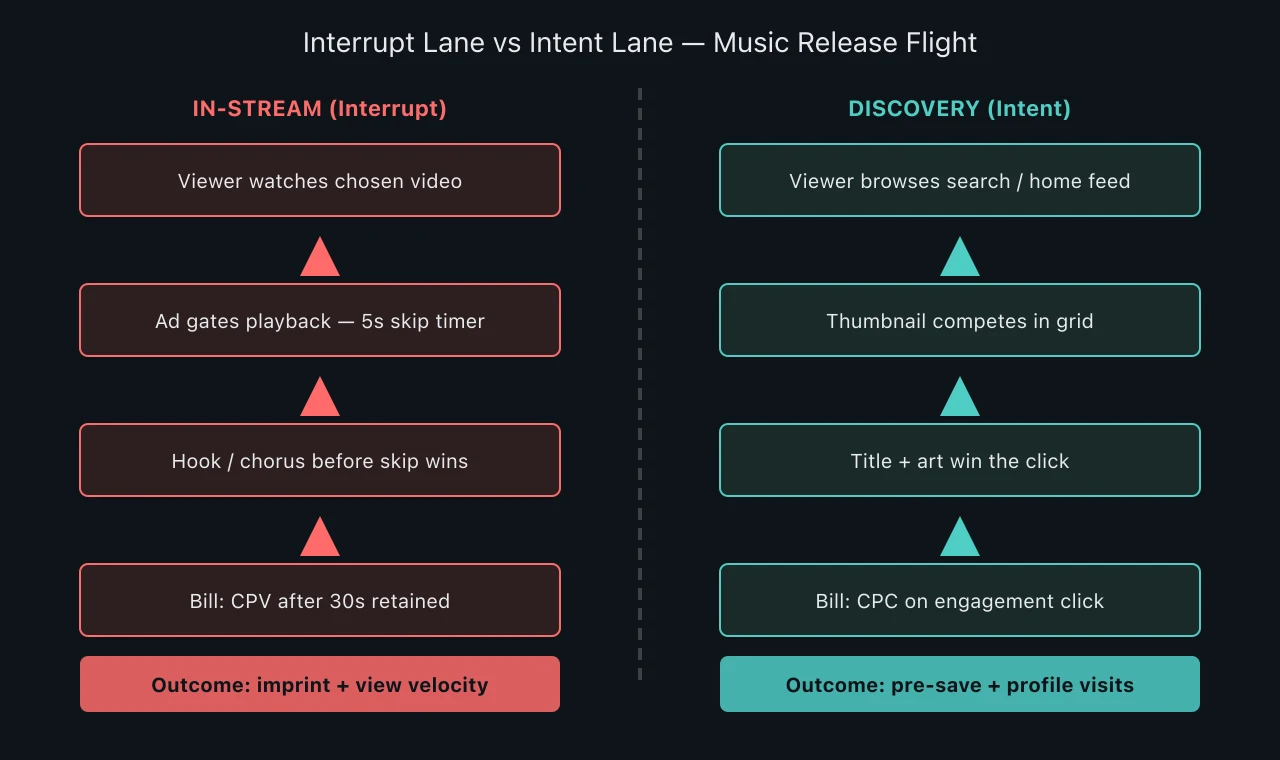
In-Stream vs Discovery two-lane comparison
The lanes do not merge in reporting—track interrupt and intent metrics on separate rows in the release dashboard so stakeholders see which format carried awareness versus conversion.
Creative Specs by Format
In-Stream Creative Requirements
Interrupt inventory punishes slow opens. Export at minimum two cuts: a fifteen-second hook-led variant and a thirty-second chorus-forward variant. The first three seconds must contain identifiable audio—vocal timbre, signature riff, or drop preview—not a black title card. Burned-in captions help sound-off starts on mobile, but music campaigns should assume sound-on for in-stream; the hook is auditory first.
Export 1920×1080 for standard in-stream, 1080×1920 for Shorts placements, H.264 MP4 per Google Ads video upload guidelines. End cards matter less than the opening five seconds; companion banners on desktop should mirror the streaming CTA. Do not run the full MV as primary interrupt creative unless prior data shows average view percentage above forty percent.
Discovery Creative Requirements
Discovery is a thumbnail-and-title problem before it is a video problem. The thumbnail must read at phone scale: high contrast, readable artist name, no cluttered collage. Faces outperform abstract art for emerging acts; logo-forward frames work for established acts with existing visual equity. A/B test at least two thumbnails per hook variant—static swaps are cheaper than re-editing video.
Titles should signal novelty and genre without keyword stuffing: "Artist Name — Song Title (Official Video)" beats vague poetic lines for cold discovery clicks. If the campaign drives pre-saves, append the action in the title only when the landing page confirms it—"Out Friday" copy must match the destination date.
Post-click, the viewer chose you—skip long logo stings and place mid-video CTA cards toward DSP saves. Track cost per click separately from in-stream CPV.
Music Release Budget Split Matrix
Budget allocation should follow release phase and audience temperature—not a fixed fifty-fifty split. The matrix below assumes a ten-thousand-dollar YouTube flight for an indie single with two-week pre-save window and release Friday. Adjust percentages by genre, territory, and catalog heat; sums are illustrative planning bands.
| Release Phase | In-Stream % | Discovery % | Rationale | Example $10K Split |
|---|---|---|---|---|
| Announcement (T-21 to T-14) | 70–80% | 20–30% | Interrupt builds chorus imprint among cold similar-artist pools | $7,500 in-stream / $2,500 discovery |
| Pre-save push (T-13 to T-4) | 45–55% | 45–55% | Intent lane rises as search interest emerges; brand terms go discovery-heavy | $5,000 / $5,000 |
| Release week (T-3 to T+7) | 35–45% | 55–65% | Capture high-intent searches for artist + song; in-stream sustains velocity | $4,000 / $6,000 |
| Post-release sustain (T+8 to T+28) | 60–70% | 30–40% | Interrupt retargeting and lookalikes; discovery for lyric/video variant tests | $6,500 / $3,500 |
| Catalog / evergreen (month 2+) | 50–60% | 40–50% | Balance cheap CPV prospecting with intent on tour-date geo bursts | $5,500 / $4,500 |
Reallocation triggers: if discovery CPC spikes above your pre-save value ceiling while in-stream eligible CPV stays stable, shift ten percent back to interrupt for awareness rather than paying premium clicks. If in-stream skip rates exceed sixty percent on cold pools, do not solve it by moving budget to discovery alone—fix hooks first, then rebalance.
Micro-budget releases under three thousand dollars often run discovery-only for pre-save week and a single in-stream burst on release day—acceptable when the artist already has organic search volume. Zero-search emerging acts should overweight in-stream in weeks one and two to manufacture familiarity before intent inventory has queries to harvest.
When to Prefer In-Stream
Choose the interrupt lane when the release goal is familiarity at scale among viewers who do not yet know the artist name. Cold prospecting against similar-artist custom intent, affinity segments seeded from peer channels, and broad music viewers with tight placement exclusions is in-stream territory. You are buying retained seconds and view velocity that support algorithmic signals on YouTube itself and social proof for playlist pitchers.
In-stream also wins when the creative is inherently visual-audio—a dance hook, sample flip, or guest feature voice. Geographic bursts for festival slots benefit from in-stream reach efficiency. Retarget viewers who watched thirty percent of a prior ad but did not convert with a second hook variant in the interrupt lane.
When to Prefer Discovery
Choose the intent lane when the viewer can plausibly search or browse for your artist, song title, genre phrase, or "new music" intent during the flight window. Pre-save week is the canonical discovery window: queries rise, thumbnails compete, and CPC buys are cheaper than forcing another interrupt on someone already fatigued by your frequency cap.
Discovery dominates when the landing destination is a high-friction action—pre-save link, ticket page, email capture—and you need attributable clicks. In-stream can append CTAs, but many views never reach the end card; discovery charges you only when someone opts in by clicking.
Brand-defense is discovery work: bid on artist name and song title variants; negative-match broad keywords that bleed into unrelated queries. Established acts with organic search volume win disproportionately during release week; emerging acts with zero search footprint still need in-stream imprint first.
Hybrid Sequencing Template
Most successful music release flights sequence both lanes instead of picking one forever. A practical four-week template:
Week minus three: In-stream only—two hook cuts, similar-artist audiences, frequency cap three per seven days, placement exclusions loaded. No discovery yet.
Week minus two: Add discovery at twenty-five to thirty percent. Target artist name, genre + "new song" intent, competitor adjacency. A/B thumbnails day one; in-stream runs the winning hook.
Week minus one: Fifty-fifty split. Discovery titles emphasize pre-save date; UTM schema locked. In-stream "out Friday" slates on retargeting only—cold pools stay hook-pure.
Release week: Discovery sixty percent through Thursday; in-stream forty percent sustains velocity. Pause irrelevant query triggers; refresh thumbnails if CTR drops thirty percent.
Week plus one: In-stream sixty percent on lookalikes and thirty-percent-viewer retargeting; discovery forty percent on lyric variant and tour geo. Report interrupt CPV and intent CPC separately—never blend into vanity CPA.
Handoff rule: thirty-second in-stream viewers who did not click enter discovery retargeting with CTA-forward thumbnails.
Common Format Mistakes
One ad group with all formats toggled on lets the algorithm dump spend into cheap broad in-stream junk. Cinematic MV opens without hook cuts guarantee skip pain. Discovery-only on debut acts with no search footprint buys typo clicks, not fans. Separate ad groups by lane in YouTube Ads and report two scoreboards—do not judge discovery by CPV or in-stream by CTR.
FAQ: YouTube In-Stream vs Discovery Ads for Music
Can I use the same video for both formats?
Yes for the underlying asset, but not the same export strategy. In-stream needs dedicated fifteen- and thirty-second hook cuts; discovery needs thumbnail and title variants. The full MV can serve post-click on discovery while in-stream runs the short cuts.
Which format is cheaper for a music release?
In-stream often shows lower CPV for raw views; discovery CPC can look higher per click but cheaper per pre-save when intent is warm. Debut acts should not choose on headline cost alone—match format to funnel stage.
Does Discovery still exist as a separate format?
Google has consolidated several video campaign types; discovery-style placements now appear within demand gen and video reach configurations depending on account version. The intent-lane behavior—thumbnail grid, click-to-watch—persists even as UI labels change. Verify available formats in your account before briefing.
Should I use non-skippable in-stream for music?
Non-skippable raises CPM and annoyance risk; most indie releases avoid it for cold prospecting. Reserve forced-view inventory for tightly scoped retargeting or brand deals with explicit recall KPIs—not default pre-save flights.
What budget split for a debut artist?
Weeks one–two: seventy to eighty percent in-stream for imprint. Pre-save week: shift toward fifty-fifty. If search volume is near zero, discovery stays below thirty percent until interrupt creative shows stable average view percentage.
YouTube In-Stream vs Discovery Summary
YouTube In-Stream vs Discovery ads for a music release is a lane choice, not a bid tactic. Interrupt in-stream buys retained seconds and chorus imprint among viewers who did not ask for you; intent discovery buys clicks from browsers already choosing what to watch next. Spec creatives separately—hook cuts and exclusions for in-stream; thumbnails, titles, and keyword discipline for discovery. Split budget by release phase using the matrix, prefer in-stream for cold awareness and discovery for pre-save and release-week capture, and sequence both in a four-week hybrid template with separate scoreboards. Format clarity upstream prevents expensive optimization on the wrong psychology downstream.


