

The YouTube music video promotion cost question usually arrives on a Thursday night, not in a quarterly media review. A bedroom producer has $487 left after mastering and distributor fees, a music video uploaded at 2 a.m., and a DM from a "promo service" promising fifty thousand views for $299. The calculator app is open. Rent is due in eleven days. Nobody on that desk is negotiating enterprise CPM floors—they are trying to learn whether five hundred dollars can buy enough signal to justify a second single, or whether it disappears into vanity metrics that look good in a screenshot and useless in royalty statements.
This is not a label playbook for six-figure launch windows. It is desk math for indie artists, part-time managers, and first-time buyers who treat $500 as a diagnostic budget: enough to test creative hooks, audience fit, and placement hygiene—not enough to manufacture chart pressure, sustained algorithmic lift, or national awareness. Julian Cole's lens on small music ad budgets is blunt: $500 is a lab fee, not a growth engine. The return is information density per dollar, not guaranteed fame.
Below: illustrative reach and CPV bands, three allocation scenarios, prerequisites that determine whether the spend teaches you anything, and an honest list of outcomes $500 cannot purchase. All dollar and view ranges are illustrative—your genre, territory, creative quality, and account history will move every number.

Five hundred dollars is a hypothesis test at the kitchen table—not a substitute for distribution, creative, or an existing listener base.
$500 as Diagnostic Budget, Not Launch Capital
Major labels routinely spend more on a single day of YouTube reach than an indie artist allocates to an entire quarter. That asymmetry matters when interpreting results. A $500 flight through YouTube Ads typically runs seven to fourteen days at modest daily caps—$35 to $70 per day is a common pacing band for first-time buyers who want data without blowing the entire envelope on day-one learning volatility.
Diagnostic budgets answer narrow questions:
Does this hook hold attention past the skip button? Skip rate and average view percentage on a fifteen-second cut tell you more than total view count.
Does a similar-artist audience respond? If custom intent built from five peer channels produces eligible CPV two to three times your junk-inventory CPV, you have a seed for the next flight.
Do placements stay on music-adjacent inventory? A week-one placement export reveals whether spend leaked into kids apps and parked domains.
What $500 does not answer: whether you can break a song nationally, whether editorial playlists will notice, or whether streaming velocity will compound without organic baseline. Treat the spend as tuition. The passing grade is a documented brief for flight two—not a viral spike.
Julian Cole's rule for sub-thousand music video buys: write the decision you will make after the campaign before you launch. "If eligible CPV exceeds $0.09 and average view percentage stays above forty percent on the hook cut, I will add $400 next month on the winning audience only." Without that pre-commitment, $500 becomes a mood purchase.
Realistic Reach, Views, and CPV Bands (Illustrative)
Promo vendors selling "guaranteed views" quote CPV that ignores placement quality and whether a human could name your artist afterward. On skippable in-stream inventory for indie music prospecting in U.S. and U.K. English markets, gross CPV often clusters in illustrative bands—not promises:
$0.03–$0.06 — Broad inventory or weak targeting; suspiciously cheap. Audit before scaling.
$0.06–$0.12 — Common band for small-budget prospecting with default targeting.
$0.10–$0.20 — Tighter similar-artist audiences or premium dayparts; nominal CPV rises, intent often improves.
At illustrative $0.05 / $0.08 / $0.12 CPV, $500 buys roughly 10,000 / 6,250 / 4,150 platform-counted views—but those views are not equivalent. Four thousand attentive views from comparable-artist custom intent may outperform twelve thousand from unmanaged broad placement. Report gross views in pacing; optimize on eligible views after excluding sub-eight-second placements and non-music inventory.
Unique reach runs lower than raw views because of frequency caps. On $500 with three impressions per seven days, illustrative reach lands between 2,500 and 7,000 viewers—far below "50K views" promo packages. Per YouTube advertising documentation, a view counts after thirty seconds or full duration on shorter assets; that is why CPV math is honest currency, not opaque impression multiples.
Delivery Bands: What $500 Buys by Objective
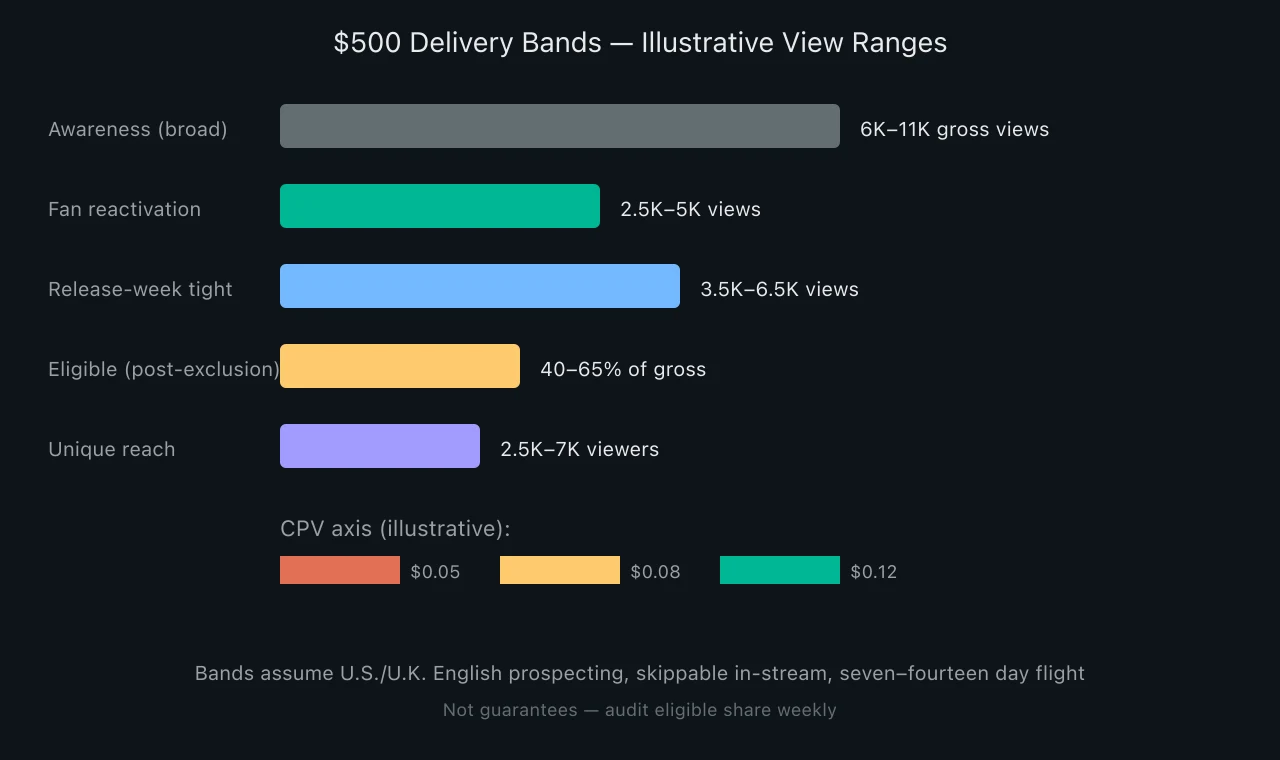
Five hundred dollar music video promotion delivery bands
The chart compresses three common $500 postures into comparable bands. Awareness flights chase raw view volume and usually land highest gross counts with the weakest save follow-through. Fan reactivation spends more per view but talks to people who already opted in somewhere in your ecosystem. Release-week tight targeting sacrifices top-of-funnel width for relevance during the only window when your metadata and playlist pitches are synchronized.
Prerequisites Before You Spend $500
Half of wasted indie promotion budget never reaches the algorithm—it dies on assets fixable for free. Export a hook-led fifteen-second cut with chorus or drop in the first two seconds; the official MV is rarely the best ad. Pin one streaming CTA, point end screens to a single next action, and match ad promise to landing experience.
Define one downstream signal—smart-link click, subscribe, or email capture—and wire Google Ads conversion tracking before launch. Without it, cheap junk views masquerade as progress. Load account-level placement exclusions for kids content and MFA-style channels; week-one exports below eight-second average view duration become your living ban list. Build custom intent from five to ten peer channels; upload customer match even with five hundred emails. Skip broad "Music Lovers" expansions.
Write exit criteria upfront: pause if gross CPV exceeds $0.15 without rising watch percentage; pause if thirty percent of spend hits junk placements after day four; scale only if eligible CPV trends down and your conversion signal holds.
$500 Allocation Scenarios: Three Postures
| Scenario | Budget Split (Illustrative) | Primary Objective | Expected Gross Views (Illustrative) | Eligible View Share (Illustrative) | Best When |
|---|---|---|---|---|---|
| Awareness prospecting | 85% in-stream CPV / 15% creative reserve | Maximize counted views toward new eyeballs | 6,000–11,000 | 40%–55% | First flight, no email list, testing hook variants |
| Fan reactivation | 60% remarketing / 30% similar-artist / 10% exclusions audit | Re-engage subscribers, site visitors, video viewers | 2,500–5,000 | 55%–70% | Prior release with 1K+ channel subs or 500+ emails |
| Release-week burst | 50% similar-artist / 35% remarketing / 15% discovery-style test | Concentrate relevance during seven-day launch window | 3,500–6,500 | 50%–65% | Metadata live, playlist pitches sent, smart link ready |
The creative reserve line in awareness prospecting is not a platform category—it is discipline. Hold $75 of the $500 mentally unspent for swapping a losing hook mid-flight instead of panic-expanding audiences. Scenarios are mutually instructive, not mutually exclusive across releases: run awareness on single one, reactivation before single two if you captured emails, release-week burst only when distribution and pitch timing align.
Budget Pie: How to Split $500 Inside Each Scenario
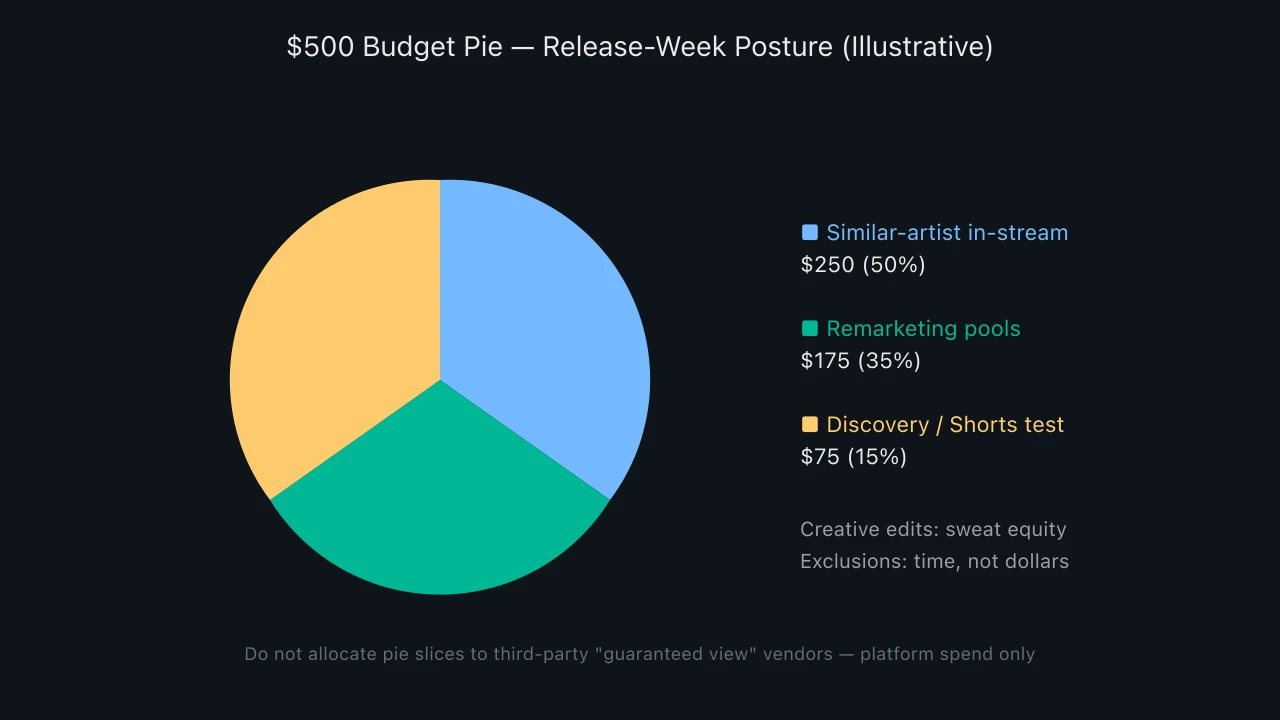
Five hundred dollar promotion budget allocation pie
Release-week posture overweights relevance: half to similar-artist in-stream, thirty-five percent remarketing, fifteen percent discovery or Shorts sniff test. Awareness flips to eighty-five percent cold prospecting with fifteen percent held for mid-flight creative swap. Reactivation inverts—sixty percent remarketing, thirty percent adjacent prospecting, ten percent exclusion hygiene as sweat equity.
Julian Cole's allocation discipline: never spend the contingency slice on day one. Artists who deploy all $500 in seventy-two hours have no ammunition when day-four placement reports reveal junk inventory.
Three Scenarios: Desk Math in Practice
Awareness accepts that most viewers will not stream you next week—it is a top-of-funnel probe. Run two hook cuts in parallel for four days at minimum fifty dollars each. Target CPV with an illustrative $0.10–$0.12 cap. Expect the highest gross views and lowest eligible share if exclusions lag. Document winning hooks and banned placements; ten thousand gross views with zero smart-link clicks is not a win.
Fan reactivation needs existing pools—roughly one thousand subscribers or five hundred emails minimum. Without them, remarketing lists exhaust in forty-eight hours and the algorithm reverts to junk inventory. Gross views fall to illustrative 2,500–5,000, but eligible share often exceeds fifty-five percent and cost per subscribe may beat awareness by multiples. Cap remarketing at four impressions per seven days.
Release-week burst only works when metadata, distributor go-live, and playlist pitches align. Front-load illustrative $55–$70 daily for seven days, then pause. Prospect peers whose listeners overlap yours—not aspirational stadium acts. If Shorts CPV looks cheap but watch percentage collapses, kill the format test and reallocate to in-stream.
What $500 Cannot Do (Honest Ceiling)
Promo marketplaces exploit ambiguity about what small budgets purchase. A skeptical realist list:
Cannot buy chart or trending placement. YouTube trending and Billboard-adjacent outcomes require velocity at scales $500 does not touch.
Cannot replace distribution and creative. A weak song with a weak video will not ROI its way to discovery on five hundred dollars of ads. Promotion amplifies; it does not invent product-market fit.
Cannot sustain algorithmic streaming lift alone. Spotify and Apple Music algorithms respond to save rate and listening depth across cohorts. A few thousand YouTube views without downstream saves rarely moves Release Radar or Discover Weekly in meaningful ways.
Cannot outbid majors in super-premium auctions year-round. You will win slices of inventory, not dominance. Expect intermittent delivery, especially in Q4 when retail advertisers crowd auctions.
Cannot sanitize bad vendor traffic. Third-party "guaranteed view" packages that bypass YouTube's official ads stack often produce bot-like or incentivized patterns that do not translate to fans, may violate terms, and teach you nothing about creative or audience fit.
Cannot fix a broken funnel. Dead smart links, missing Spotify presave, or channels with three years of dormancy convert poorly no matter how cheap CPV looks.
Cannot provide statistical certainty. Sample sizes are small; one winning variant is directional, not definitive.
Per cost-per-action economics, platforms optimize the event you pay for—views, not saves or tickets. $500 is too small to confuse those outcomes and still learn.
Measuring the Flight and Deciding on Flight Two
Export weekly: placement, views, gross CPV, average view duration, frequency, audience, creative. Compute eligible CPV as $500 divided by views from placements above your duration threshold after exclusions—that is your desk math headline, not the green platform average.
Illustrative healthy bands: eligible CPV at or below $0.11, watch percentage above forty percent on a fifteen-second hook, at least one downstream click per $40–$60 spend. Green-light flight two if eligible CPV trended down, one hook beat another by twenty percent on watch time, and placement waste stayed under twenty-five percent. Red-light if gross CPV below $0.04 with collapsing watch time, or zero downstream signal despite five thousand gross views—that is a funnel problem, not a budget problem.
Flight two at $400–$800 should narrow to the winning hook and audience only. Julian Cole's retrospective: "What decision did this $500 make easier?" If none, the spend was entertainment, not diagnostics.
FAQ: YouTube Music Video Promotion Cost
Is $500 enough to promote a music video on YouTube?
Enough to run a disciplined diagnostic flight—test hooks, audiences, and placements—and document findings for a second spend. Not enough to guarantee viral reach, chart impact, or sustained streaming algorithm lift. Treat it as tuition.
How many views does $500 buy on YouTube for music?
Illustrative gross ranges often fall between four thousand and eleven thousand platform-counted views depending on CPV ($0.05–$0.12 bands common for small indie prospecting). Eligible views after quality exclusions are typically forty to sixty-five percent of gross. Third-party "50K views" packages are not comparable to official CPV campaigns.
What is a good CPV for a $500 music video budget?
Do not chase the lowest number. Illustrative healthy gross CPV for tight indie prospecting: $0.06–$0.12. Pair with average view percentage above forty percent on hook-led cuts. Eligible CPV matters more than gross CPV once exclusions run.
Should I spend $500 on awareness or fan reactivation?
Reactivation if you have at least roughly five hundred emails or one thousand channel subscribers; otherwise awareness with aggressive exclusions. Release-week burst if metadata and pitches align with a seven-day window.
Are cheap third-party YouTube promo services worth it?
Skeptical default: no. Opaque view packages rarely provide placement-level exports, teach nothing about creative fit, and risk terms violations. Official YouTube Ads with documented exclusions produces auditable data even on $500.
Will YouTube ads directly boost Spotify streams?
Only indirectly through viewers who click through and save. Illustrative $500 flights rarely move Spotify algorithmic surfaces without an existing save-rate baseline. Measure smart-link clicks, not assumptions.
YouTube Music Video Promotion Cost Summary
YouTube music video promotion cost at the $500 level is a diagnostic exercise in desk math—not a scaled media buy. Illustrative delivery bands cluster between roughly four thousand and eleven thousand gross views depending on CPV and targeting posture; eligible views after exclusions matter more than screenshot totals. Split the budget across awareness, fan reactivation, or release-week scenarios based on whether you have existing pools to remarket and whether your launch timing is synchronized. Prerequisites—hook-led creative, conversion tracking, placement exclusions, written exit criteria—determine whether the spend teaches you anything. $500 cannot buy charts, algorithmic streaming miracles, or certainty; it can buy a documented brief for flight two if you measure eligible CPV, watch time, and one downstream signal honestly. Run the lab experiment, archive the exports, and let the spreadsheet decide whether the next five hundred dollars exists.


